/* START Google Analytics Code*/ /* END of Google Analytics Code */ A home called "Parvathi"

Saturday, August 31, 2013

Thyagaraja shows the Right Royal Way


Vid. Neyveli Santhanagopalan
K. Puttu Rao Memorial Festival - 2012


TEXT BY R. SACHI


As the K. Puttu Rao Memorial Festival 2013 gets under way in Mysore, we are happy to share here the concert from the 2012 series of Vid. Neyveli R. Santhanagopalan.

Vid. Santhanagopalan (b. 1963, Tiruchirapalli) pursued musical training under many distinguished musicians including Chembai Anantharama Bhagavatar, Vid. Srirangam Ranganathan, Vid. Tanjore Sankara Iyer, and Vid. T. N. Seshagopalan. In 1985 he toured Russia along with Vid. Seshagopalan. His music is in great demand in India and abroad, as he is known for the purity of tradition, creativity and an attractive presentation style (* Ref 1) He is proficient on the veena and is a composer. He is also active as a panel judge in televised talent shows.

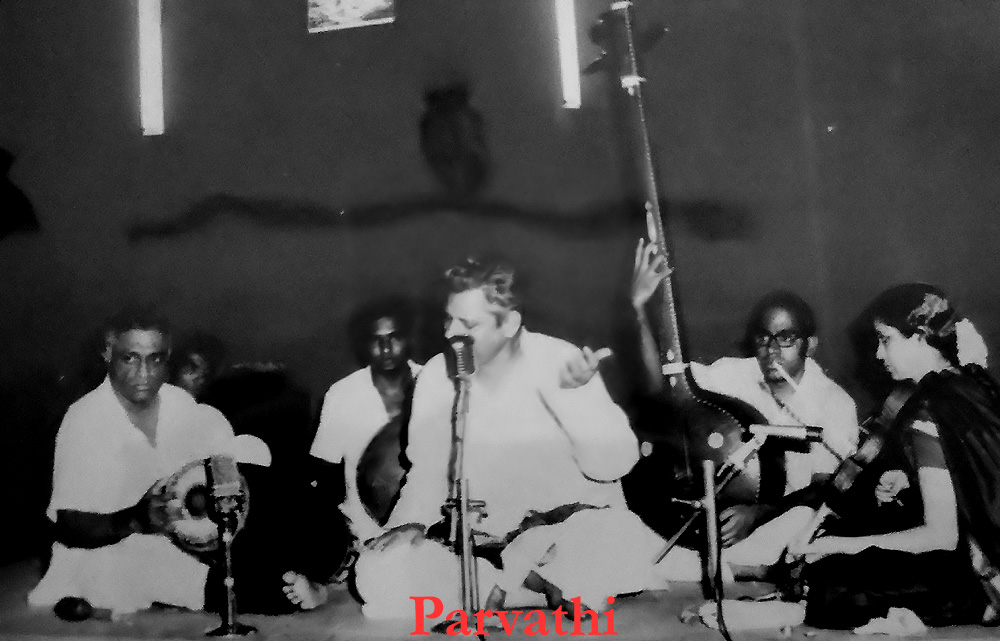
In this concert he is ably accompanied by Vid. Govindaswamy, Vid. Shivashankaraswamy, and Vid. Manjunath. Vid. Santhanagopalan presents Kamavardhini and sings “Sada Enna Hrudayadalli” in a very emotive way. This concert garnered a rave review that we had featured in the last year’s report ( * Ref 2 ). The main piece presented in the concert is the famous song “Chakkaniraja”in the ever-popular Kharaharapriya. In this song, Saint Thyagaraja extols the right royal way to salvation and says ( * Ref 3 ),


Thyagaraja also states how he shuns serving those on the evil path in “Durmargachara”. This Ranjani song is also featured in this concert.


Concert Details

K. Puttu Rao Memorial Music Festival, Jaganmohan Palace, Mysore – Sept. 2, 2012

Vid. Neyveli Santhanagopalan – Vocal
Vid. M. S. Govindaswamy – Violin
Vid. Shivashankaraswamy – Mridangam
Vid. Manjunath – Ghatam

Song List

01 Vanajaksha-Atatala Varnam – Kalyani – Pallavi Gopala Iyer *** 02 NadaTanumAnisham-Chittaranjani- Thyagaraja *** 03 Saadinchane-Aarabhi- Thyagaraja *** 04 SadaEnnaHrudayadalli- Kamavardhini- Vijaya Vitthala Dasa *** 05 Ramabhadra Rara-Anandabhairavi- Bhadrachala Ramadasa *** 06 Durmargachara-Ranjani- Thyagaraja *** 07 RamanakkuMananMudi-Hindola – Arunachala Kavi *** 08 ChakkaniRaja-KaraharaPriya- Kharaharapriya *** 09 Tillana-Behag - Papanasam Sivan


References

1. Karnataka Sangeetha Vishaya Vishwakosha – Dr. V. S. Sampathkumaracharya, (pub. D.V. K. Murthy, Mysore)

2. Report-on-Sri-K-Puttu-Rao-Memorial

3. The Spiritual Heritage of Thyagaraja- C. Ramanujachariyar (pub. Ramakrishna Math, Chennai)


Sunday, August 18, 2013

2013 - K.Puttu Rao Memorial Music Festival


Inviting all 'Rasikas'


Respected Rasikas,

We thank all of you who honor us with your kind presence day in and day out on this blog. We wish through you, to include many others.

We further request you to make your kind presence felt at the observance below:


We also wish to thank many of the Vidwans and Vidushis who will be performing with their virtuosity and learning, in truth to their great tradition. We wish to thank many of their great lineages, in parents, grandparents and teachers who have imbibed in them.


As this occasion is for the remembrance of a great music connoisseur, the 'Pitru'( ancestor ) of our Host Mr. K. Srikantiah, we also invite remembrances of many of the great musical 'Pitru(s)', who were once with us, and who commandeered the very same platform.


Friday, August 9, 2013

A Vibrant Musician from Andhra – Nookala Chinna Satyanarayana


The year 2013 has witnessed already the passing of many doyens of Carnatic music. Vid. Satyanarayana passed away recently and we quote excerpts from The Hindu below.

Mahamahopadhyaya Padma Bhushan Nookala Chinna Satyanarayana was born in 1923 at Anakapalle in Andhra Pradesh. Nookala was spotted as a young talent and came under the initial guidance of Vid. Balamuralikrishna’s father, Vid. Mangalampalli Pattabhiramayya. At Vizianagaram he learned to play the violin from renowned musician Dwaram Venkataswamy Naidu. But the influence of Dr. Pinakapani made him take up Carnatic vocal. Nookala’s personality changed as a musician under Dr. Pinakapani’s tutelage.

Over the years, Nookala became an icon in the field of Carnatic vocal. His analytical approach to music was stupendous and he passed on the same to his students, making their knowledge of musical science complete. Ahead of his times, Nookala was engaged in comparative studies of western and Hindustani music, and was an active author and even teacher on Skype to his overseas students.

Sri K. Srikantiah draws our attention to a special quality of attractiveness in Nookala’s music and also his impeccable diction in Telugu and other languages. Indeed Nookala is a vibrant musician from the great land of Andhra Pradesh.


In this concert, we also feature Vid. M. A. Krishnamurthy on the Ghatam. This artiste also passed away recently. He was a very popular ghatam artiste and played with all the stalwarts of Carnatic music. Trained under Vid. P.G. Lakshminarayana, he played the mridangam as well as ghatam.

Sri K. Srikantiah recalls fondly his association with Parvathi and mentions that he must have performed over 60 times in Parvathi concerts over many decades. Vid. Krishnamurthy also served as a staff artiste on AIR, Bangalore.

Vid. Krishnamurthy’s cheerful presence on the concert stage will be missed by many.

The other stars featured in this concert are Vid. Palghat Raghu and Vid. T. Rukmini.


CONCERT DETAILS

Parvathi Ramanavami Concert, Mysore (12 April 1976)
Nookala Chinna Satyanarayana ------ vocal
T.Rukmini ------------------ Violin
Palghat Raghu ------------ Mridangam
M.A.Krishnamurthy ------------ Ghatam

SONG LIST

01. Vatapi –Hamsadhvani- Muthuswami Dikshitar 02. Bantureethi – Hamsanada – Thyagaraja *** 03. Brovabhaarama – Bahudaari – Thyagaraja *** 04. Nee pogadakunte- Shubhapantuvarali – Thyagaraja *** 05. Anaathudanu kaanu – Jingla – Thyagaraja *** 06. Ranganaathude – Sowrashtra –Ponniah Pillai *** 07. Kaddanu variki – Todi – Thyagaraja *** 08. Undedi Ramudu- Harikambhoji – Thyagaraja *** 09.Chellare – Ahiri – Thyagaraja *** 10. Ramakatha Sudha – Madhuvanti – Thyagaraja *** 11. Sri Ramachandra Kripalu – Tulsidas Bhajan *** 12. Kapi Madhuripunaa – Jayadeva Ashtapadi *** 13. Dooru Maduvarene – Behag – Purandara dasa ***


Tuesday, July 9, 2013

The Core of Carnatic Music’s Appeal is the Krithi


VID. MAHARAJAPURAM SANTHANAM - 1977 RAMANAVAMI CONCERT


AN APPRECIATION by R. SACHI

We feature this time a typical ebullient concert of Vid. Maharajapuram Santhanam. Vid. Santhanam established himself as a classical concert crowd puller in the ‘70s and ‘80s with his virtuosity, voice timbre, and concert repertoire. He was particularly popular in rendering the songs with sowkhyam and madhuryam, especially the ragamalikas. In this concert, we have a major example, Nalinakanti-mati, with a huge bouquet of ragas.

Gurvayoor Dorai, H.P.Ramachar, Maharajapuram Santhanam, M.Chandrasekharan


We feel that the principal appeal of Carnatic music lies in its ocean of krithis or lyrics. The krithis, especially of the Trinity, Purandara Dasa and other great composers, provides an incomparable fund of joy, with devotional meaning as well as musical richness. Many musicians confess that to master a raga, what they must do is learn and practice well the major krithis in that raga. So the krithi goes beyond just wordy delight. The krithi is in fact the infrastructure of Carnatic music.

Vid. Santhanam covers a wide array of krithis in this concert. From his favourites like Mohana and Garudadhwani, he also forays into many other popular numbers. His obvious delight in rendering the “Nalinakantimati” ragamalika is infectious. The accompanists- Vid. M. Chandrasekharan and Vid. Guruvayur Dorai, have provided spirited, innovative accompaniment. As we have said in this blog elsewhere, it is not difficult to understand why Vid. Chandrasekharan has been a perennial favourite for violin accompaniment. His totally committed, virtuosic, tonally nectarine, accompaniment has made many a concert in Parvathi memorable. Similarly, Vid. Dorai is a very solid mridanga vidwan and his deep and measured strokes always enhance the musical impact.

We also want to quote the translation from The Spiritual Heritage of Thyagaraja for the Garudadhwani song. Like many others, this song’s musical appeal somewhat hides the deep spiritual import of the saint composer’s thoughts:


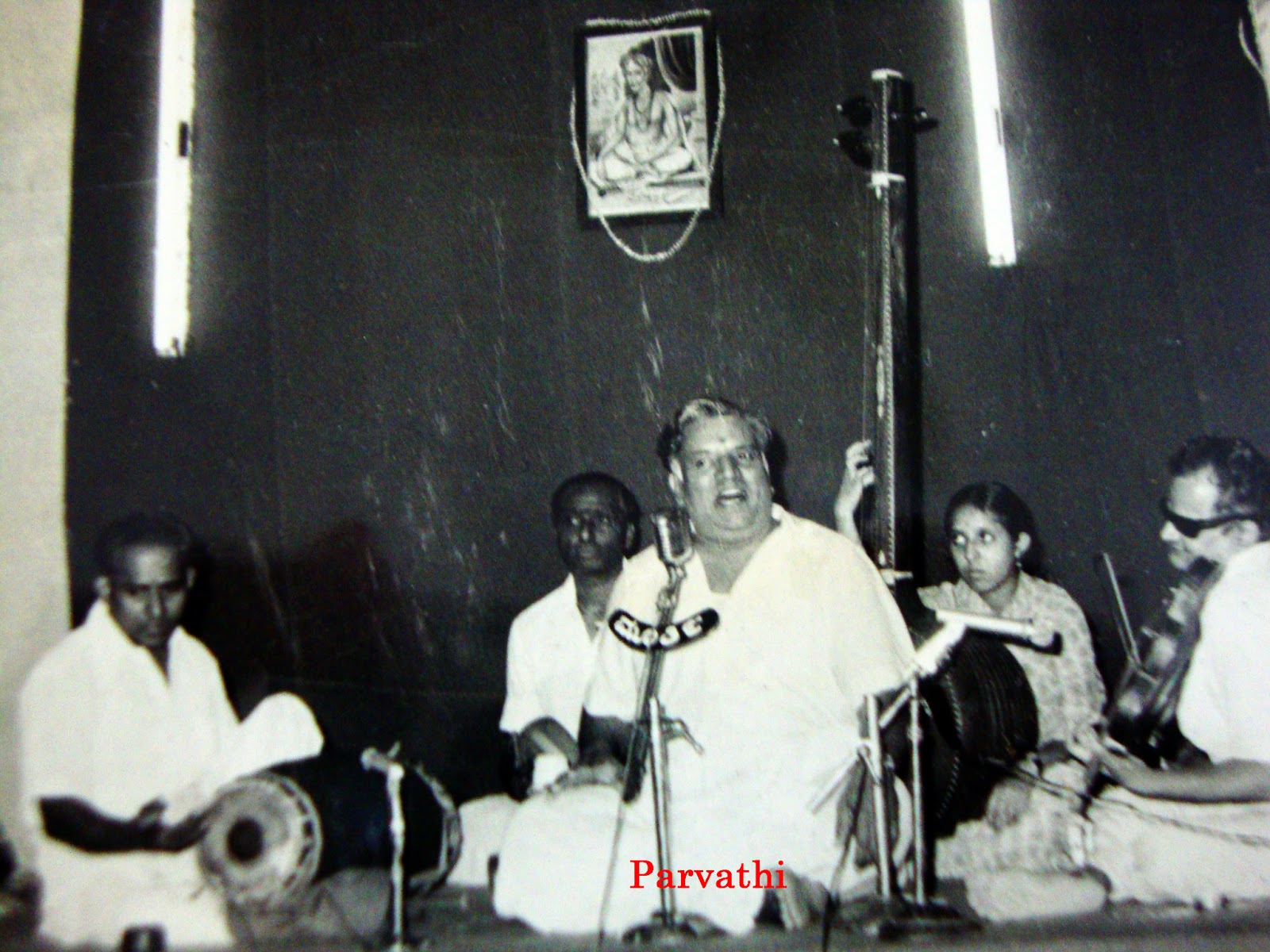
It is only fitting that Saint Thyagaraja’s image adorns the stage in the photo of this concert.


CONCERT DETAILS

Ramanavami Festival, Parvathi (3 April 1977)

Vid. Maharajapuram Santhanam – Vocal
Vid. M. Chandrasekharan – Violin
Vid. Guruvayur Dorai – Mridangam
Vid. H.P. Ramachar – Khanjira

Song List

01. Seetapate----- Khamach- Thyagaraja *** 02. Samajavaragamana-Hindola- Thyagaraja *** 03. Tatvamerugatarama-Garudadhwani- Thyagaraja *** 04. Evarura-Mohana- Thyagaraja *** 05. Sloka & Lalgudi Tillana – Brindavani*** 06. Nalinakantimati-Ragamalika- Madurai T Krishnaswamy *** 07. Ragamailka – continued *** 08. Tungateera- Salagabhairavi – Kamalesha Vitthala Dasa*** 09. Bansiwale – Mohanakalyani – Swati Tirunal *** 10. Mangalam ***


Wednesday, June 12, 2013

The one who enjoyed Sangita as well as understood the meaning of Gita


HARIKATHA by SMT. VISHAKHA HARI


TEXT by R. SACHI

This time we feature a Harikatha by Smt. Vishakha Hari. She is a lady of many accomplishments, including a distinguished career as a chartered accountant, and is now focussing full-time on musical discourses in the best traditions of the Harikatha Kalakshepa. As we have already mentioned before, over the years, the home of Parvathi welcomed Harikatha exponents as well as musicians and other artistes.

In the 2012 Puttu Rao Memorial Music Festival, Mr. Srikantiah wanted to feature this famed artiste Smt. Vishakha Hari, and this turned out to be her first public performance in the city of palaces. The subject of Ramayana is also a speciality for her as well as a subject of perennial appeal to all rasikas. Therefore we have this lovely offering this time.


The musical fare included speaks volumes for her training under Vid. Lalgudi Jayaraman and her musical repertoire is matched by her narrative skills honed under her guru Sri Sri Anna (Paranur Sri Krishnapremi). The accompanists have also done a commendable job in adding to the musical impact. They have tucked in a neat RTP in Kharaharapriya, giving ample scope for their musical expression.

Now a few words about the hero in Sundarakanda: Hanuman. Hanuman is one of the most popular deities all over India and even South-east Asia. Devotees extol him for his divine qualities of valour, devotion, and wisdom. As Saint Thyagaraja says, Hanuman was twice blessed in a unique way: he understood the import of the Bhagavadgita, and also thoroughly enjoyed true music offered as a prayer to Lord Rama.

We feel inspired to quote an extract from Sri Ramayana Darshanam, the epic poem by Dr. K.V. Puttappa ( Rastrakavi Kuvempu). When Hanuman meets Sita and he narrates to her the situation in Kishkindha and stresses Rama’s anguished sense of urgency to come and rescue her, Sita exclaims:

“Oh Hanuman, I bow down to you with folded hands. My thanks to your mother, Oh son of Anjana! May your parents be blessed. May your tribe be acclaimed. Let your noble reputation shine everywhere, forever! By telling me how my lord yet pines singularly for me, you have given me ambrosia. But by telling me how grief-stricken he is, you have given me poison, so you’re both kind and cruel! Fate that drove Rama and Lakshmana to this distress is surely unkind, and yet is it not Fate’s kind act o have arranged this happy encounter between us? Oh best among simians, forget not to narrate in detail all that you have seen and heard, and how the Solar dynasty’s scion’s dear wife is subjected here to utter wretchedness everyday. It was only Ravana’s wife Mandodari’s kind intercession that got me a year’s respite from death. Ten months are gone, and only two are left. Tell Rama to come at once and save me within these two months. This is my plea to Rama, and gifted orator that you are, may your message be fruitful”.


Sundarakanda is the most recited and loved portion of the immortal epic of Rama. And in this Harikatha, we have a real treat. Let us enjoy it!


Details:

K. Puttu Rao Memorial Festival, Jaganmohan Palace, Mysore on 4. 9. 2012

Vid. Vishakha Hari – Harikatha on Sundara Kanda
Vid. Ananthakrishnan – Violin
Vid. Arjun Ganesh – Mridangam


Tuesday, May 21, 2013

The Mojo of Laya in Carnatic Music


Vid. Abhishek Raghuram, Parvathi 2012


In a recent DD-televised panel discussion featuring notable Carnatic and Hindustani musicians, a statement was made how Carnatic music has created a special place for laya. The important role played by mridangam and other percussion instruments, the special place for tani avartanam, and the matchless treasure of krithis that embody the best confluence of melody and rhythm in myriad ways…all this gives a unique mojo to Carnatic music. There is no wonder that mridangam vidwans and other laya vidwans occupy a special place in our hearts. Vid. Abhishek Raghuram has taken this a step further, transitioning from the role of a percussionist to a leading young vocalist today, and creating a new brand of Carnatic vocal music suffused with laya ornamentation. Abhishek recently won the Ustad Bismillah Khan Yuva Puraskar of the Sangeet Natak Akademi.


L to R: Tumkur Ravishankar, Tumkur Shashishankar, Abhishek Raghuram, Charulata Ramanujam


Abhishek comes from the “garadi (akhada)” or percussion school of the incomparable late Vid. Palghat Raghu, his grand-father. When Vid. Raghu was conferred the Sangeetha Kalanidhi title in 2007, his since-famous lec-dem on aspects of rhythm featured his two young grandsons Abhishek and Anand in performance. Abhishek has also honed his music skills under the tutelage of Sangeetha Kalacharya Vid. P.S. Narayanaswami.

This time we are happy to feature Abhishek’s concert from the 2012 Putturao Memorial series held at Mysore.

The accompanists have ably travelled the scintillating course of the concert with Abhishek. After a delightful “Ee Vasudha” in Shahana dedicated to the Kovur Sundareshwara by Saint Thyagaraja, he takes up Poorvi Kalyani for a most elaborate treatment. He paints its contours in a kaleidoscope of colours, much like a Windsor Manor Mango Festival featuring a surprising variety of dishes all with the mango theme (including one with mango marinated in champagne!). We can infer its overall impact on the audience when we read the critic Mr. Krishnamurthy’s words in his review for the Star of Mysore, ”the unprecedented Birkas, unimaginable sancharas were the highlight of Ragalapane”. The following song Parama Pavana Rama gives full rein to Abhishek’s laya prowess, and the violinist Charulata and the percussion duo of Ravishankar and Shashishankar as well, acquit themselves creditably.

In fact this song is mentioned in an incident narrated by Mysore Vasudevacharya in his memoir of his visit to the house of Ramnad Srinivasa Iyengar (his guru bhai). It was a meeting between two vaggeyakaras, and the occasion was graced also by the presence of Veena Sheshanna and Subbanna. Vasudevacharya writes how Poochi (nickname) looked after his students and made sure they mastered each song. Once, Poochi’s student Salem Doreswamy Iyengar was reprimanded by the guru for not rendering Parama Pavana Rama perfectly. That night, with Vasudevacharya looking on as a guest at his home, Poochi discovered that the student was not asleep but gone missing from his room. An alarmed guru went in search and finally discovered him beside the pond at the back, practising the song fervently through the night. The guru ran down the steps and placing his hands affectionately on his pupil's shoulders, exclaimed: "Dore! What is all this?" Doreswamy Iyengar was totally immersed in his singing, not aware of anything else. He was singing his guru's composition in Poorvi Kalyani, Parama Pavana Rama, his voice filling the serene night with ineffable sweetness, each note of the raga throbbing with life.

After the main item, we have a real feast of manodharma-soaked melodic pieces – in Kapi, Yamuna Kalyani and Sindhu Bhairavi. Abhishek offers his tribute to his grand-father (as well as grand-uncle Lalgudi) in his rendition of Krishna Nee Begane, in the typical Lalgudi style.

So welcome to a great concert!


Details – K. Putturao Memorial Concert, Jaganmohan Palace, Mysore – Sep. 1, 2012

Abhishek Raghuram – Vocal
Charulata Ramanujam – Violin
Tumkur Ravishankar – Mridangam
Tumkur Shashishankar – Ghatam

Song List

01. Abhogi varnam – Patnam Subrahmanya Iyer*** 02. Tulasidala – Mayamalavagowla-Thyagaraja *** 03. EE Vasudha – Shahana- Thyagaraja*** 04. Parama Pavana Rama – Poorvikalyani-Poochi Srinivasa Iyengar *** 05. Janaki Ramana – Kapi – Vanamaamalai Jeeyar **06. Krishna Nee Begane – Yamuna Kalyani- Vysasaraya *** 07. Bhavani Dayani – Sindhu Bhairavi *** 08. Piraviyalai – Thiruppugazh Sindhu Bhairavi and Mangalam ***


Monday, May 13, 2013

Music's Bylanes VI – Interludes with a Maestro


A memory in B&W – Vidwan Lalgudi Jayaraman


It has been a grieving few weeks for the multitudinous fans of the maestro Sri Lalgudi Jayaraman.

While the grief phase might be somewhat on the wane, we presume many would still be reaching out somewhere for a few quick clips of the great man, or indulging in some quick minutes of a strapped life for a favorite portion of his music, or even doing a quick scan of news items to see what might have been missed out on his life.

It is sort of hard for a human to reconcile themselves to a situation on someone, who till just yesterday was such a living presence and who by some quirk turn of fate, we are now told, is no more.

While this writer has had no competency in going to the forum groups and rejoicing with the many astute Rasikas who linger there with their finer impressions of his playing, he did savor the few precious moments afforded to him as a young teen, when he could wander freely in the house armed with a somewhat effortless Kodak Brownie.

That simple contraption would yield for contemplation, half a century later, a couple of black @ white moments of frozen time (re-posted above) with the Vidwan in the company of the other giants - UKS, AR and some of “Parvathi's’ own elders held young by time. They had found themselves coming together on a particularly memorial Puja day dedicated to the Goddess Gayatri.

And then that momentary interlude, also framed in time, by the same teenager who happened to express a certain regret to the great man (having been mesmerized earlier by the violin play) that he had never been lucky in visiting the sacred Thiruvaiyyaru. He subsequently found himself gazing into two mirthful liquid pools that surprised him somewhat with their answer “Why don’t you come with me. Stay with me. I will look after you”.

Even after so many years, there never has been cause for doubt that those words were uttered by a man evolved in abject sincerity.


---------------------------------------------


In speaking of things “Parvathi”, ours has been a metaphor only to capture a certain era.

To some of us, the fortunate few, who were present then and who are present today amidst the newer generations, it provides for contrasts. The word ‘value’ has a certain value only when you can compare things in light of contrasts.

That such an era is passing us by, continuously, has come about more as reminders in recent times , as we have stood by in homage through these pages to a Parur M.S. Gopalkrishnan, a Vellore Ramabhadran, a beloved actor in Karnataka’s Vishnuvardhan or the V. Shantaram documentary producer winner M.V.Krishnaswamy. Also, included in this circle as a finger count have been some of Parvathi’s own members.


The K. Puttu Rao tree – branching off into five generations


At home to the MahaSwamiji of Sringeri