/* START Google Analytics Code*/ /* END of Google Analytics Code */ A home called "Parvathi"

Thursday, January 26, 2012

The course of Kalyani, all beneficences of life - Madurai Somu waxing eloquent


In our humdrum lives, it is easy to pass by the true beneficences of life, busy as we are “getting and spending”, as Wordsworth said.

Therefore do we need to thank every moment our heritage, upbringing, and childhood experiences that foster a love for classical music. Our music combines so many life-affirmative resonances that nobody can ever feel totally down and out if he or she can even faintly recall the joy of music. Carnatic music insightfully combines all musical values - melody, rhythm and lyric - into a worship of life. And one of the high points of Carnatic music is Kalyani. Kalyani means not only the popular raga but also benediction, the Cosmic Mother, a cool pool of holy water we can immerse ourselves in… so many connotations. And the raga Kalyani celebrates life like none other. Hence every composition in Kalyani is such an enriching experience.

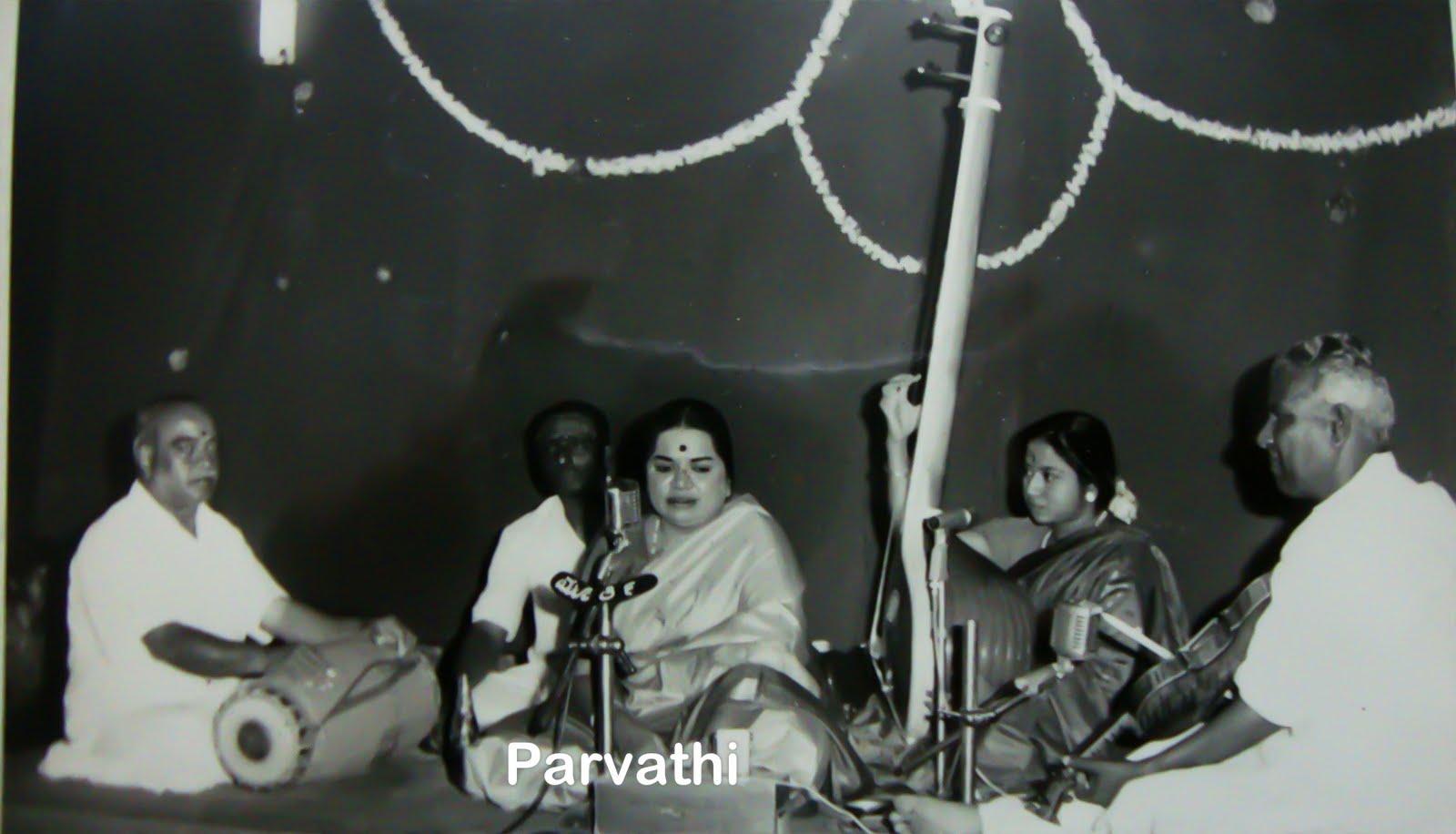
Madurai Somu, the eternal favourite of Parvathi rasikas, begins this concert with Kalyani. MSG follows his raga contours closely, and we have a solid foundation for the song that follows, śivē pāhi mām , of Thyagaraja. The saint refers to Kaveri, the nectarine river that courses through every Carnatic music lover’s veins...

Thyagaraja addresses the mother goddess as kAvErijOttara vAsini kAtyAyini dharma samvardhini , meaning, “ You are Katyayini, known as Dharma Samvardhani residing on the north side of Kaveri river”. This composition is one of his Thiruvaiyaru khestra compositions.

The neraval and swaras are executed very melodiously, with some great accompaniment by MSG and the redoubtable Raghu. Raghu intones the words so well on the mridangam, modulating each stroke to match the melody.

What strikes you is the fine fettle of Somu’s voice, matched by the sweetness of MSG’s violin, as well as Raghu’s measured percussion. An elaborate Bhairavi has a fullness to it. Somu lends a tangy flavour to the nishada, and MSG replicates it. Raghu takes off in the neraval and swara like only he can. The result is a virile treatment of Bhairavi lasting over 40 minutes. The audio quality of this home recording done 41 years ago is outstanding.


Madurai Somu is all praise for MSG as the honeyed flow of Abheri from his violin simply heightens the mood of this ever popular raga. We just got the happy news of MSG’s being honoured as Padma Bhushan in today’s Republic Day honours. A richly deserved recognition by a grateful nation of this outstanding violinist.

The Shanmukhapriya RTP is a feisty improvisation. Even here, Raghu revels in the rhythmical segments like a homing bird.

Among the following items, the impromptu shloka in Jijhooti and other ragas is highly memorable.


THE CONCERT
1971 Gowri-Ganesha Festival in "Parvathi"

Madurai Somasundaram – Vocal
Parur M.S. Gopalakrishnan ---- Violin
Palghat Raghu ------- Mridangam

01. Sive Pahimam – Kalyani –Thyagaraja *** 02. Manavi aalakincha- Nalinakanthi -Thygaraja *** 03. Shri Rajarajeshwari – Bhairavi –TBA*** 04. Shankaraparane – ragamalika –TBA *** 05. Nagumomu – Abheri – Thyagaraja *** 06. Shanmukhapriya RTP *** 07. Unnai Bharata – Hindolam – TBA *** 08. Azhagiya mayil – Basant Bahar – TBA *** 09. Bhaja mana bhajare – Bhimplas – TBA *** 10. Swarna Gowri Srimahaganapathe – Shloka – Jinjhooti, Punnagavarali, Sindhubhairavi, Natakurinji, Kambhoji, Saveri Kalyani Bhairavi Kamach Kanada Kedaragowla *** 11. Nadabindukala – Jinjhooti – Arunagirinathar *** 12. Bhajore Bhayya – Desh, Mand – Kabir *** 13. Mangalam ***


Thursday, January 5, 2012

Welcoming the Year with the “Madhura” Vani of Mani Iyer School

We are happy to bring you a recording of the concert by Vidwan T.V. Sankaranarayanan held in the Puttu Rao Memorial series in the Jagan Mohan Palace, Mysore recently. The vidwan is a great favourite of Parvathi rasikas, with his effervescent style and the bani of the great Madurai Mani Iyer. The world celebrates Madurai Mani Iyer’s centenary throughout 2012. As this blog is also a tribute to the great rasika Sri Puttu Rao and his legacy at Parvathi, we think it is fitting that we begin the new year by giving a great concert fare from Vidwan TVS just on the eve of Sankranthi. We would like to quote some fine words about Vidwan Mani Iyer from the Hindu:
2002 Birth Anniversary (http://www.hindu.com/thehindu/fr/2002/10/25/stories/2002102501340900.htm)
" A vidwan with a unique style, Madurai Mani had indeed cast a spell on the listeners of Carnatic music, young and old, connoisseurs and even the rickshawallahs of those times. People came in hordes to listen to his singing. They sat on the walls, on the floors and wherever they could find a place to sit or stand. They did not mind the inconvenience. They only wanted to listen to Madura Mani as he was fondly called. Madurai Mani was certainly Madura (sweet) Mani. His music was melodious. More than anything else, he enjoyed singing and that reflected in his personality both on and off stage. In fact he often eschewed lyrics that smacked of disillusionment with the world and other worldly matters. He firmly believed that music should enliven the listener. That was his conviction right from the start of his professional career as a musician, a joyous journey that began in 1924 at a temple Kumbhabishekam in the district of Ramanathapuram. He was 12 years old then. "
2011 Margazhi Season (http://www.thehindu.com/todays-paper/tp-national/tp-tamilnadu/article2754050.ece)
From the pen of Vidwan Ravikiran:
" The torch-bearer of the Madurai Mani Iyer bani, T.V. Sankaranarayanan reminisces about his uncle's incredible repertoire, memory and musicianship. “Mama taught me numerous songs that one would have rarely heard him sing at concerts — Idisamayamura (Chayanata), Sanatana (Phalamanjari), Evarunnaru (Malavashri), Paramatmudu (Vagadheeshwari), Samukhana nilva (Kokilavarali), Namoralagimpa (Devagandhari), Etavuna nerchitivo (Yadukulakambhodhi), Nadachi nadachi (Kharaharapriya), Ninnuvinaga (Poorvikalyani), Durusuga (Saveri)... I can go on and on,” he says. “What is incredible is that he would not have revised these songs in 20 years but would access them from memory at will.” This was augmented by the celebrated mridangam vidwan T.K. Murthy. “At a concert in Delhi, Mani Iyer sang outstandingly but a critic, known for his inconsistent and perverse reporting, had a dig at him the following day for singing his usual fare. Mani Iyer just smiled but in another concert the same day, his list consisted of pieces that even I — who had accompanied him for several years — had never heard him sing. The critic, who also made it to the concert, apologized profusely!” TVS adds: “His voice had just the right balance between delicateness and weight and his sense of gamakas was impeccable. And the way he could hold any note almost endlessly was mesmeric! It would create an all-permeating tranquility that had to be experienced to be believed.” Anyone who has spoken to me about this distinguished musician has been unanimous in accrediting him as a human being of impeccable qualities. He was gentle, courteous, well-meaning, helpful to younger artistes, loving towards his disciples, committed to the art, and devoid of negativism even in jest. In short, as pitch-perfect in life as in music... "
THE CONCERT Performed on Sept 4, 2011 T.V Shankaranarayanan ----- Vocal Mahadevan (son of TVS) ---- Vocal support M.S. Govindaswamy -------- Violin C.Cheluvaraju --------------- Mridangam M.A.Krishnamurthy ------- Ghatam 01 Maha Ganapate Namo- Hamsadwani- Indira Natesan*** 02 Orajupuju- Kannada Gaula – Thyagaraja *** 03 Appa Rama Bhakti- Pantuvarali- Thyagaraja *** 04 Ee Pariya Sobagava- Ragamalike – Purandaradasa *** 05 ManasuNilpaShakti- Abhogi – Thyagaraja *** 06 Smara Janaka Shubha Charita – Behag – Swathi Thirunal *** 07 Marakathavallim – Kambhoji – Muthuswami Dikshitar *** 08 Virtuttam – Bageshree, Tilang *** Rama Rama Rama Enniro-Tilang *** 09 EnglishNote- Shankaraabharana – Muthiah Bhagavathar *** 10 EppoVaruvaro- Jonpuri – Gopalakrishna Bharathi*** 11. Mangalam ***

Friday, November 18, 2011

Gamanashrama sung by Ganavisharade Dr. M. L. Vasanthakumari


To our community of listeners, we bring again another stellar concert from the redoubtable Dr. MLV. A musician hailing from the classical mould, she combined outstanding creativity with excellent voice control. The result was quite often deeply memorable raga elaborations, rare krithis mined from the repository of compositions going beyond the trinity, and a brisk technique of delivery that gripped the audience from the word go. It is no exaggeration that today, as we listen to fast paced "modernist" Carnatic music, we often recall the GNB bani and the unique place held in our hearts by Dr. MLV.

In this concert, we are treated to elaborate renderings of Madhyamavati and Kharaharapriya. The recording quality is not good in quite a few places. But there is a persuasive argument why we share this concert - there is a brilliant, yes brilliant, rendering of Gamanashrama in the Ragam, Tanam and Pallavi. Dr. MLV is quite at home giving us the rich fare of a rare raga more remembered as the 53rd Melakarta whose Janyas are Purvi Kalyani and Hamsanandi. There are very few compositions in this raga which was called Gamakakriya by the Dikshitar school. There are also only a handful of recordings of RTP in this raga in Carnatic music archives. We could translate literally Gamanashrama to 'tough going'!

The concert has many fine Bhajans, Dasa compositions and ragamalikas. Overall a rich experience that one associated with Dr. MLV in Parvathi concerts.


PARVATHI CONCERT
April 1, 1972

Dr. M.L. Vasanthakumari --- Vocal
Smt T.M. Prabhavathi --- Pinpattu
Sri Tiruvallur Subrahmanyam --- Violin
Sri Tanjavur Krishnamurthy Rao --- Mridangam
Sri H.P.Ramachar --- Khanjira.

01_Varnam- Shuddha Todi- Kothavasal Venkatarama Iyer 4:37
02_Srimahaganapathe_Abhogi - N.S. Ramachandran 4:22
03_Swaminatha_Natai_ Muthuswami Dikshitar 7:44
04_Nadupai_Madhyamavathi_ Thyagaraja 19:12
05_Kalayami Raghuramam_Begada_Swathi Thirunal 20:03
06_Mariyadagadayya_Bhairavam_Thyagaraja 5:55
07_Ramaneesamana_Kharaharapriya_Thyagaraja 29:25
10 Gamanashrama RTP ( Kanada Hindola) 43:08
11_Yadavaraya_Ragamalika_Kanakadasa 5:31
12_Yakenirdaya_Ragamalika-Purandaradasa 5:47
13_Abhang_Devaranama 8:11
14_Payoji Maine Ramratan_Mishra Pahadi_Meera Bai 4:35
15_Ragamalika Shloka Mamava Pattabhirama_Manirangu_Dikshitar9:33
16_Barokrishnayya_Ragamalika_Kanakadasa 4:55
17_Mangalam 0:39


IF AUDIO DOESN'T PLAY CLICK HERE.


Monday, November 14, 2011

The Lord Sri Raama as Kubera


As we waited on our very learned friend in music R.Sachi to extol the virtues of the next concert from "Parvathi", we found ourselves engrossed in a few serious issues concerning our own would be 'Identities'; and they came simultaneously from three very different sources.

The first, on the seriousness of 'Identity' was brought home by a very powerful representative of the Hindu community here in the USA, who has made this his home over several decades. He is a man who has been given to some tremendous world wide charities, who is a very distinguished scholar in his own right, and who takes away ones breath in a most dynamic manner when he is on the podium relating to this very intriguing subject. In two very rapid successions this year, he has penned two extraordinary books "BREAKING INDIA" and "BEING DIFFERENT" and is currently riding on the crest of some very thought provoking meets both in India and in the USA.

He is also currently involved in some very serious discussions with the senior members of India's government, bringing home issues facing India's integrity, its security and above all a 'lost' IDENTITY, far from the pale of issues that India's media can either comprehend or discuss with their public, other than the feeding of salacious material for some immediate end.

With just this introduction we leave you to your own devices to discover him for yourself, either through Google/Bing, through YouTube, Facebook or through a publishing entity such as the Huffington Post.

For those in India, who wish for a face to face meeting, here is your opportunity! (Click)

"Life in the 70s!"
Cherished patron and very popular Karnataka Chief Minister
Devaraja Urs, and F. K. Irani builder of Ideal Jawa
preside at an event in "Parvathi".
Seen also is Gowri Kuppuswamy rendering the invocation.

Our other absorption, came from some of those innocuous but precious moments relating to a life, spent with the very respected octogenarian Sri. K. Srikantiah.

Of particular note and leading inevitably towards contemplation, were those words wherein he spoke of 'mystical forces at work' in his life

"... you know, all these years, any time I became involved in this 'Karya', I would be besieged with hundreds of responsibilities and problems... sometimes these problems would become huge obstacles, all created by all sorts of people and their agencies. It seemed so petty and incomprehensible and here I was providing the Lord's music free to all of them!... I felt, many a time, of giving all this up,...but there was always that one thought with Lord Raama! that held it all together... some inexplicable force would always make all these problems go away...the solutions were all beyond me...and in the end, each occasion would be a success leaving everyone feeling happy ..."

The ever smiling legend of Bollywood - Dilip Kumar- during a visit
in the early 70s!


A final urge to examining our own identity came in the light of reading the Ramayana, in its very first section where Valmiki asks the sage Narada:

"Who can possibly be full of virtues in this present world?"

Narada thrusts upon him the description of a Sri Raama.

One of the descriptions he provides is in comparing Raama with Kubera.

While reading this, we were made conscious of the very ignoble way in which we ourselves think of the word Kubera. When we have occasion to use the name, we often use it as a term, in comparing someone as 'Avan Kuberan' or 'Avanu Kubera', and we allude to it singularly as someone who is possessed of wealth.

So, where is the virtue in this?

Narada, however, in emphasizing Raama with Kubera, has a message for all us. Raama the Prince is a 'prince of the heart', to be emulated by us as a model of bountiful-ness; a 'Kubera' in the distribution of his own wealth towards the welfare of people around him.

In a very refined way (and these books of human heritage are indeed so beautiful) we are pointed to the very gross ways in which we color our very own minds!

It all comes from the theater that we subscribe to!


Sunday, October 9, 2011

Venu Gaana Praveene – Sikkil Sisters


To introduce the artistes we feature in this concert, we cannot do better than to quote the article that appeared in the Hindu in 2002 when they were conferred the Sangeetha Kalanidhi title by the Madras Music Academy:

"Indeed, the Sikkil sisters, as they are popularly known in the music fraternity, have perfected the `gayaki' style of playing on their musical instrument-the flute-certainly no mean achievement for, in Carnatic music unlike in the West, there are no separate scores for musical instruments. ``To us the audience is of prime importance. We sincerely try to please them. That is the aim of our music," declares the elder of the sisters, Kunjumani. An unassuming artiste, she talks, on their music, in a manner totally devoid of any frills and artifices. Her sister Neela seemed content to allow her sister to narrate their story. As Kunjumani began her narration, we travelled back in time just sixty years to the place of their birth - Sikkil, a small village in Thanjavur district.

Back home at Sikkil, the sisters plunged heart and soul into their chosen field. They gave many concerts together. They were guided in their every move, not only in their career but also in their music by their father. With careful monitoring was shaped the `style' of the Sikkil sisters. A slow and gradual revelation of the colours of the raga, well within the rules of grammar, delicate swara volleys, a firm eschewal of populist trends in classical music and with several other attributes in their music, the Sikkil sisters firmly entrenched themselves both in the hearts of the listening lay public and the discerning connoisseur. Recognition came in the form of several concert assignments both in different parts of India and abroad. As a natural corollary to their music also came awards aplenty. The earliest was the Venugana Praveena awarded to them as early as 1942, by the Mysore samsthanam. The latest is the ultimate aspiration of any musician, `Sangeeta Kalanidhi,' to be conferred on January 1, 2003."

Mysore is here again shown as a great centre for the promotion of fine arts, and the Parvathi concert by the sisters Sikkil Neela and Sikkil Kunjumani in 1976 is a feast for the ears. Two interesting aspects…we have always said that Kharaharapriya was a favourite of the Parvathi audiences. And also we have featured some great flute concerts (of Vidwans Ramani, Mahalingam and Gopalakrishnan). So the tradition continues as we feature an elaborate rendition of Chakkaniraja on the flute this time by the Sikkil Sisters.


The Concert Details
( held at at Parvathi on Aug 29, 1976 )

Sikkil Sisters (Neela and Kunjumani) ---- Flute
Mysore Nagaraj -------------- Violin
Tanjore Upendran ------------ Mridangam
M.A. Krishnamurthy -------- Ghatam

Song List
01. BrOcEvArevarurA – Khamach- Mysore Vasudevacharya*** 02. Durmargachara – Ranjani- Thyagaraja *** 03. Chakkani Rajamargamu – Kharaharapriya – Thyagaraja *** 04. Baro Krishnayya – Raga Malika –Kanakadasa*** 05. uyyAlalUgavayya – Nilambari – Thyagaraja*** 06. Enna thavam seidanai – Kapi – Papanasam Sivan*** 07. Shloka – Kalyanavasantha, Darbari Kanada *** 08. Govardhana giridhara – Darbari Kanada – Narayana Thirtha***

(We regret the poor audio quality in some parts)


Saturday, September 17, 2011

It's all about balance - Dr. Sreevalsan Menon

Before we bring you the very fine concert by Dr. Sreevalsan Menon, we would like to provide a closure to the ‘K Puttu Rao Memorial Concert’ which ended on Sept 4, 2011, with its five day feast of grand performances , fine speeches by dignitaries and the participation of a vibrant audience. We are told that even Mother Nature brought an auspiciousness to the proceedings, in sending her proverbial rains to cool the environment .
Lighting an auspicious lamp for the arts!
While the newspapers did their just share of the reporting, we would like to reflect on what we heard and on what we can take away. A definitive thing was what India’s noted Novelist Dr. S.L. Bhyrappa alluded to in his opening remarks. Dr. Bhyrappa, has been known throughout his many monumental works to be an avid thinker on matters of “ truth” , both in our empirical world and in the metaphysical world of 'Vedanta'. He is a strong believer that human independence lies in an intellectual freedom, which can only be nurtured by strong foundations, like those laid out in the teachings of India’s rich and ancient past subscribing to many a value.
" A kingdom for a stage, princes to act, and monarchs to behold the swelling scene! " - William Shakespeare “King Henry V”
As a Blogger on Bhyrappa remarked
“ The genius of Bhyrappa’s works stems from the genius of India. Bhyrappa’s works triumph in any test because they are powerfully-creative expositions of universal values. Trying to write about SL Bhyrappa’s works is akin to trying to enclose the Sun in your fist.”
So, here is a summary of what he said:
- He asked us to pay heed to Classical Music which is on the great decline in India. - With a razor sharp deftness he distinguished what being ‘aristocratic’ meant versus what just being ‘rich’ meant. He urged people to be ‘aristocratic’, in their nature, possessing a taste in finer things such as music and in the performing arts. “Rich ones only make money”, he concluded. - Paying tribute to the memory of Sri K. Puttu Rao, he said “ those who continued to patronise music are the real lovers of music and Putturao is one amongst them,'
Now, for an actual newspaper report from amongst many reports ( click image ):
THE K. PUTTU RAO MEMORIAL CONCERT 2011 Jagan Mohan Palace, Mysore (Following text is by Sachi R. )
Dr. Sreevalsan Menon has been performing as a popular Carnatic vocalist for some years now. His guru, Shri Neyyattinkara Vasudevan had come and performed at "Parvathi" a few times. Known for his traditional classicism, often listeners would mention KVN, MDR and such heavy names while listening to Shri Vasudevan. His disciple, a doctorate in Agricultural Sciences and a well-placed officer, Dr. Sreevalsan Menon has established himself as a musician of repute in many dimensions. His range of work include Malayalam poetry, Swathi Thirunal's less known romantic compositions, and even music for a movie called My Mother's Laptop.
Dr. Sreevalsan Menon performed on September 1, 2011 in the recent Puttu Rao Memorial concert in Mysore. We bring to you an excellent recording of the entire concert. The first thing that strikes about this concert is the balance and composure in Dr. Menon's voice. It is indeed a gift to have a rich voice with a big range, no nasal twang, no tendency to loudness. And it is an additional merit to harness it with a sense of balanced aesthetics, without tricks and pyrotechnics. The concert has another dimension of balance. The violinist is the well-known Mysore Nagaraj, with his 'MSG' or 'Hindustani' flourishes. The mridangam and ghatam accompaniments are very competently handled by Tumkur Ravi Shankar and Shashi Shankar, brothers and sons of Mridanga Vidwan Shri Tumkur Bhadrachar. The recording is well balanced and brings out the mridangam bass touches as well as the sharp tonality of the violin. The concert again shows a rich balance in the repertoire presented.The Sri raga varnam by 'Garbhapurivasar', Vasudevacharya's Gowla and Abheri classics, Swathi Thirunal, Purandara Dasa...not a humdrum mix of the usual. Abheri deserves a special mention. The vocalist presents a rich tapestry in his resonant voice. The violinist responds with delectable 'shehnai' touches. The song itself is wonderful. Mr. Srikantiah recalls how Shri Vasudevachar came home and presented his new composition to Shri Puttu Rao, his friend and patron. Shri Puttu Rao was moved so much, and embraced the great composer, savouring the words 'Rajakumaram Ramam', and exclaiming how appropriate the words were. Poorvi Kalyani comes with verve and pace, the violinist getting inspiration from the vocalist to sketch its lower octave contours to much effect. And the first krithi from among the Trinity, Jnana Mosagaraada is sung with finesse. The words that Thyagaraja uses to describe Shri Rama, "Paripurna, Nishkalanka, Niravadhi Sukhadayaka" apply equally to what a well balanced music concert can do. An elaborate Enduku Peddala in Shankarabharanam follows, rounded off with Sindhu Bhairavi dasara pada and thillana. The tani between the brothers is very sonorous.
Dr. Sreevalsan Menon ----- Vocal Mysore Nagaraj ------ Violin Ravishankar --------- Mridangam Shashishankar ------ Ghatam Song List 01. Sami Ninne -Sri Raaga Varnam – Garbhapurivasar Karur Devudu Iyer *** 02. Pranamamyaham – Gowla – Vasudevachar*** 03. Sakalagrahabala – Atana – Purandara Dasa*** 04.Paramapurusha – Vasantha – Swathi Thirunal*** 05. Bhajare re Manasa – Abheri – Vasudevachar*** 06.Jnanamosaga rada – Purvi Kalyani-Thyagaraja*** 07.Enduku Peddala – Shankarabharanam- Thyagaraja*** 08. Venkatachalanilayam – Sindhu Bhairavi – Purandara Dasa*** 09. Thillana – Khamach – Patnam Subramanya Iyer*** 10. Mangalam***

Tuesday, August 30, 2011

In Memoriam 2011: Sri Kunigal Puttu Rao - II


Sri K. Puttu Rao lived a mere 65 years.

‘Mere’ did we say?

(Even, the great GNB himself passed away into immortality at a young 55, when the world wanted him to rule undisputed for another half a century? So, how do you reconcile ‘mere’ with sixty five years? )

Precisely. This is why we have this helpless notion that life sometimes looks like a travesty (maybe even as a ‘Maya’, if you like). Even though sixty five is not a small age (this writer has experienced that roll-over within his own lifetime), we are forced into using the word ‘mere’ in a relative setting; as applied to a man having exhibited a powerful vitality and passion while living, only to be found plucked into sudden nothingness where you would think the health and passion he displayed would propel him towards twice the longevity!


THE CONSUMMATE ATTORNEY

It used to be whispered, once upon a time, in the inner circles (that exists no more), that Kunigal Puttu Rao, in his day, was a ‘very shrewd’ lawyer who earned even the respect of ‘their Lordships’. He was the consummate and committed defense lawyer whose ‘client’ could do no wrong! He was known to have taken on cases of even supposed 'undesirables' ( a subjective view held by some members of a society on anyone outside their norms ), affording them the necessary protection under the law as owed to one’s citizenry. "You are not guilty until proven!" was an ideal he bought unto his heart and profession. He would be prone to bringing friends and clients home for a celebration after winning their cases, and it would be especially hard on the part of the matriarch of the family who had her own daily 'Niyama' to attend to, but whose services would be requested at all odd hours for food and other things on the arrival of an ‘a-thithi’ ( ah, you got it right! – that welcoming, feeding and honoring of a guest, who arrives with no prior appointment! – what an added refinement to an already great civilization! ).


Did Puttu Rao not ever smile?
Perhaps not, unless you found him in the distinguished company of a
Sir C.P. Ramaswami Iyer or an Ariyakudi Ramanuja Iyengar!
Could it be music? Could it be law?

A MAN'S MAN

What was a very deep mystery about “Parvathi”, the house that he built, was about how it ever ran! It was such a large and burgeoning household, which depended solely on just one income. Granted, K. Puttu Rao sometimes expressed the grit of a lion and his spouse, the erstwhile Parvathi (amma) no less in resilience than that of a tigress, the combined effect would yield, dominantly in no time, a large household of seven "ligers" with never ending demands associated with one's growing up; the phenomenal expenses of long term educational fees, the economics of food and clothing and transport, costs of private tutoring towards traditional language and arts, the impact of costly ceremonies to be performed as befitting each member of a traditional household, and the huge expenses that came to be associated with religious ceremonies. These would be held every other day, as determined by a crazy almanac, and culminating in invitations to a prolific number of guests, priests and entertainers.

Added to all of this was a certain ‘strange’ notion cultivated by distant family members, that the house was the equivalent of a free ‘board and lodge’ house (a veritable 'chatram'). Members would show up from distant villages, first with a customary ‘note’ from some well known family head, claiming some filial connection with an accompanying request for some ‘temporary’ shelter, till a certain justified event could be completed. These initial short stays however always happened to get recycled, to the point where after a while, the person would be found to have happily ensconced themselves 'as a member' with now a stronger case than ever. There were also other 'member(s)' established under a natural duress, such as a widowed lady unable to support herself or a lady having been abandoned by a husband, or an orphan girl, whom the family came by in compassion, who had to be included as family till such time as she could be given away in marriage, or into another pasture of safe custody.


CARNATIC MUSIC'S GREAT AFICIONADO

Earlier, on many an occasion, we spoke of Sri. K. Puttu Rao's abiding passion for music and in his being at home to several stalwarts of Carnatic Music ( click ). We now add to that ever growing list, memories of some other stars in the CM firmament who graced "Parvathi" during his lifetime:

Immortal G.N.Balasubramaniam (GNB) in the house !
(click on photo to magnify)


Immortal Duo!
Chembai Vaidyanatha Bhagavathar and Palghat Mani Iyer
in the House !
(click on photo to magnify)


Immortals Manakkal Rangarajan and T. Chowdiah in the House !
(click on photo to magnify)


IRON FIST IN A VELVET GLOVE

Puttu Rao was known to be a strict disciplinarian, especially with his sons and his staff. Somewhere, however, over the years, people realized that while there might be that quick temper and a bark to the man, there was also the outer shell with a whole lot given to a softer side. This would be noticed, particularly during certain events and in its calculated moments. While pictures in the house, sometimes revealed an Oldsmobile, a Dodge Kingfisher or a Chevy Impala over the years, it would not be uncommon to find Mr. K. Puttu Rao trudging many a time on foot to and fro from Court.

At times, one would find him in a ‘tonga’, too, doing a back and forth from Mysore's great Devaraja market, with its myriad stalls of fruits or its beautiful stalls of sweet smelling Jasmine flowers. From here, he would invariably pick up beautiful hair adorning for his large retinue of daughters-in-law with whom he was ever conscious of doing the right thing in making them integrate seamlessly into his own family. He would even be seen, as the 'tonga' waited, at the cloth emporiums of Mysore’s main thoroughfare on Sayaji Rao Road, where he would indulge in some of his fancies; where he would pick up select pieces of cloth hoping for the benefit of a customized tailoring of immaculate shirts and coats that he wore with aplomb on himself. He would also be seen ordering rich blouse material (the 'Khanas') for all the Gods and the women folk of his own family. The whole thing would prove to be nothing more than a fanciful charade into an evening's outing; he would concoct an elaborate 'scheme' of seeming to tuck away all his treasures into some hidden compartments from preening eyes, only to realize, once again, the inevitable! It would all vanish, in no time, without nary a sign of the actual culprit (or culprits) ever being found from within that large contingent of humans that dwelt in that house.


M.L.Vasanthakumari was always regarded as 'family' !
Seen with Puttu Rao's pride - the daughters-in-law !
(Is there a young Sudha Raghunathan, too,somewhere there?)

Puttu Rao's zest for life, as we have indicated before, was not confined to just music and musicians alone, or on being God fearing to one's daily propitiation's. He was fiercely loyal and prone to take on various challenges of a social order, in order to do good. He worked with Mysore's several institutions and committees; with Mysore's City Cooperative Bank, Mysore Cooperative Society and many of its charitable Housing projects. He loved to battle in order to save institutions. Notable amongst these was the institution (pictures below) of which he was once both its Secretary and its President. He saved it from many a lender's hand, providing some deft legal maneuvering, but ironically died the very next day, after the courts had moved in his favor!

Bidarama Krishnappa Rama Mandiram in it's 'heydey' !


Its once pristine interiors - Courtesy: The Hindu

As we leave you with the memory of a man in whose lifetime, there was a great 'cause celebre' for the heritage of Carnatic Music, we remind you of the concerts in his honor that commence on Aug 31, 2011 in Mysore.

As with the tradition of our blog, we would also like to leave you with some music. What better than a video presentation of Padma Bhushan and Sangeeta Kalanidhi T.V.Sankaranarayanan (who will be casting his magic on the last day of the memorial concert), performing as he did twenty five years before! in "Parvathi", the house that K. Puttu Rao built and where he bequeathed his last!

Vidwan T.V. Shankaranarayanan is shown accompanied by Vidwans G.J.R. Krishnan (violin), M.A.K Murthy (Ghatam) and incidentally Vellore Ramabhadran who accompanied him first in his (TVS's) memorable debut on February 2, 1968!