/* START Google Analytics Code*/ /* END of Google Analytics Code */ A home called "Parvathi"

Wednesday, June 16, 2010

Dr. Emani Sankara Sastry – the one man symphony in Carnatic music


A handsome young veena maestro came to Mysore in the 60’s and stirred up the imagination of the Carnatic music lovers with his cuckoo song and his rosewood veena. That was Sri Chitti Babu.

This chronicler (R. Sachi) remembers how that vidwan’s guru himself came and played some months later. Looking every bit a grand master of the grandest of Indian musical instruments, the veena, the guru produced such a range of musical sounds from his veena that he could be hailed verily as a one man symphony.

That was Emani Sankara Sastry. His music was a wide spectrum. Some lilting silken streams of sound and some majestic cascades. Some sounds that were so vocal you had to pinch yourself to remember it was the veena, and some vibrant and emphatic patterns that spurred the percussionists like a military march. This maestro simply left you bemused. At last you understood why Carnatic music did not need a 50-piece orchestra. The veena alone was enough. No wonder Lord Shiva played the veena. In addition to Goddess Saraswathi and Sage Narada. And even Ravana.

Emani Sankara Sastry (1922- 1987) was born in Draksharamam, Andhra Pradesh. He came from a family of celebrated classical musicians. His father Vainika Bhooshana Veena Acharya Emani Achuta Rama Sastri was a famed vainika and sastragna; a contemporary of Sangameshwara Sastri and Veena Venkata Ramana Das of Andhra. After graduating from Andhra University, Vidwan Emani Sankara Sastry worked as the music director in Gemini Studios. Emani joined All India Radio in 1959 as producer of music at Madras. Soon he rose to the position of director and composer of national orchestra and chief producer of music at AIR New Delhi. He was the asthana vidwan of Tirumala Tirupati Devasthanams and a member of the University Grants Commission. He was conferred among many titles the prestigious title of Maha Mahopadhyaya by the Banaras Hindu University – the first Carnatic musician to be so honoured.

He was invited to perform at the United Nations in the 60’s. He won the admiration of violinist Yehudi Menuhin and at his special invitation participated in the festival of international music council at Paris in 1974. This concert was named the concert of the century by discerning reviewers. He also performed for the UNESCO at Alma Ata, Soviet Union.

Emani played memorable Jugalbandi duets with maestros like Pandit Ravi Shankar, Ustad Halim Zaffar Khan. The featured concert is a duet with Vidwan M.S.Gopalakrishnan.

When this chronicler had the good fortune to meet Vidwan Emani in Delhi, the maestro was all grace and charm. When the Vidwan spoke about music, there was a twinkle in his eye. He recounted his prodigious training from a young age under his unsparing father. At his home, there was a painting of his father playing the veena holding it vertically, as Lord Shiva has been depicted in ancient sculpture.

While playing a recording of his famous UN Concert featuring Kalyani, the vidwan remarked to this chronicler how it was vital that the artiste addressed the veena with reverence, and pleaded, “mother, kindly allow me to play some music”. That was his approach to music always.

Vidwan Emani composed Adarsha Shikhararohanam, an orchestral tribute to the conquest of Mount Everest by Tenzing Norgay in 1953. He also composed another opus, Indu Chakra, to symbolise the significance of the Indus Valley in Indian culture (and the great river projects of the ‘50s) using the six ragas in the first melakarta cycle. His orchestral pieces were liked so much by Dr. S. Radhakrishnan, the then President of India, that he was known to hear the recordings almost every day.

In this concert, we have a treat of symphonic genius, from both Vidwan Emani and the redoubtable maestro M.S. Gopalakrishnan. Emani expounds Meru samana with peaks of emotive grandeur to do justice to Thyagaraja’s imagery of Rama standing battle-ready like the Meru mountain. He transports you in every song to realms beyond conventioncal Carnatic song. The way he strikes the first notes of Purvi Kalyani is colossal. And when he announces the Surdas bhajan and sings the lines, you know what a master artiste he is.

The sheer tonal delight of MSG’s violin enhances his perceptive collaboration here. MSG does not fiddle to distract in the middle of the veena passages, and bides his turn to provide apt counter points at every stage of the concert. His honeyed bow seems to dance in the swarm of resonant bees that the veena conjures up. A remarkable concert indeed, from Viriboni to Veda mantra.

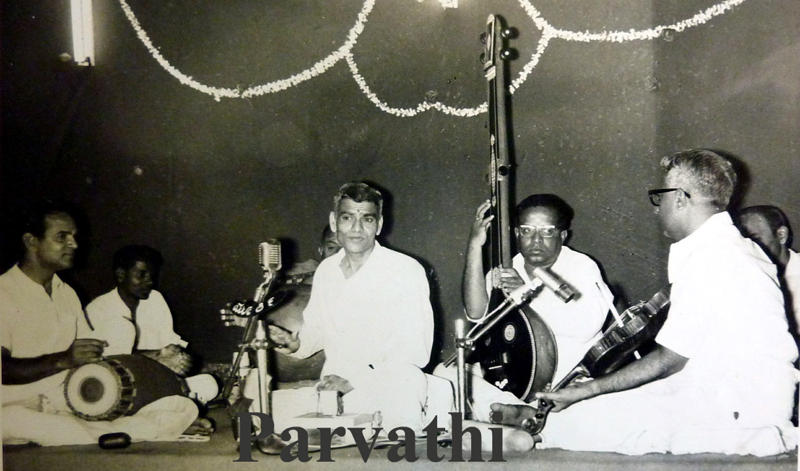
The rasikas at Parvathi were treated to this torrent of virtuoso excellence in 1971. We are indeed lucky, after 39 years, to have a chance to listen to this recording, thanks to Sri K. Srikantiah’s munificence.


PARVATHI CONCERT
Emani Sankara Sastry---Veena
M.S. Gopalakrishnan-----Violin
Guruvayoor Dorai----Mridangam
on April 10, 1971.


[ 1. Veeriboni -Bhairavi Atatala varnam- Pachimiriyam Adiyappa *** 2. Vatapi Ganapathim –Hamsadhvani – Muthuswami Dikshitar *** 3. Merusamana –Mayamalavagowla – Thyagaraja *** 4. Orajoopuchu – Kannadagowla – Thyagaraja *** 5. Gnanamosagarada – Purvikalyani – Thyagaraja *** 6. Raghuvamsha –Kadanakutuhalam – Patnam Subrahmanya Iyer *** 7. Brochevarevarura – Kamach – Mysore Vasudevachar *** 8. Sudhamayi – Amrutavarshini- Muthaiyya Bhagavatar *** 9. Ragam Tanam Pallavi – Kharaharapriya *** 10. Surdas Bhajan – Misra Hindustani Todi *** 11. Jagadoddharana – Hindustani Kapi – Purandara Dasa *** 12. Veda Mantra *** 13. Mangalam. ]


SHRI SRIKANTIAH RECALLS ' GNB '

"...man, I tell you when that person called GNB sat on the platform, in his very first concert in Mysore …I swear, I thought I was in some 'Swara loka'...what a 'roopa'!... those diamond ear rings...hair so neatly groomed …I was so crazy admiring him that after the performance I went up to him and asked him “Sir, what is the scent you are wearing?” Unhesitatingly, he said ‘Swag’! …my God to hear his 'bhirkha'...the 'vaikhari'…the new trend in Kalayani...in Carnatic music he introduced us to a totally new wave. It just arrested me... I just went crazy for GNB. Then slowly over time a friendship developed...GNB would come home...he came to sing at my elder brother’s wedding...for that he was accompanied by Chowdiah and Palghat Raghu...even to this day that performance is etched in my memory... then you know there was a big blow to all of us in his passing away at Tiruvananthapuram, in his fifties...he was then a principal of the college there... all in all he was my hero!.....ah, now I remember that other song from 'Shakuntala'... ”Premayil…” (Sri Srikantiah regales once again)…Can you believe all this is somewhere between 1939 and 1942?...”

"...now, the Bidaram Krishnappa Mandiram secretary, Advocate Ramachar, is Vasudevachar's great friend and he has started the Saraswati Samaja Music Sabha...their first concert is in Town Hall...GNB, Mani and Chowdiah were invited first time to inaugurate it...GNB was simply in terrific form that day...it is my privilege to be there and I am sitting next to the great Octogenarian Vasudevachar ...then GNB chooses 'Khamach' and starts to sing 'Brochevararevurara'...the rendering is electrifying...at that point Vasudevachar turns to me and says "Magu" (he always called me Magu-young man),..."Nana Kriti nalli ishtu merugu ide anta ivvate gottu aitu " (only today have I come to realize that this composition of mine has such a glitter!). ... man, was I thrilled!...as soon as the ‘kutcheri' was over then I jumped onto the platform and went straight to GNB and said “this is what the composer has said to me…”...Immediately GNB girded the sash around his mid waist came down with me and bending down touched the great man’s feet...saying that this was his greatest honour to receive such an acknowledgment from the master composer himself.

Where, I ask you, do you see such incidents of respect these days?..."


Monday, May 24, 2010

Scholarly Touch : Prof. T. R. Subramanyam

Carnatic music is an interesting field of art. It is as much cerebral as it is musical. Given its rigorous classical structure, much like the German language, it has a terseness to it that generally puts off those interested in light music. But at the same time, the more “Mensa' types are attracted to it, as every composition presents a kind of riddle, with its raga, tala structure, and composer's style. Some musicians even go out of their way to mystify the audience.


But what can one do with good training, an improvisation technique that does not bore and at the same offers a cerebral version of Carnatic music? The answer presents itself as Prof. T. R. Subramanyam (TRS). As you listen to his music, the first thing that strikes you is his fine voice. A rich timbre, a facile movement to the higher octave, brigas and modulation, all are present. He has a charming way of pronouncing words, and also a zest in rendering songs.

TRS is a disciple of Musiri Subramanya Iyer. He formally graduated from the university. TRS retired a few years ago from the University of Delhi, where he was a Professor in the Department of Music. He has given many lec-dems, including on Ragam Tanam Pallavi.

In this Parvathi concert, he renders Palisemma Muddu Sharade in Trishra Eka Tala, in Shriranjani. This rendition is quite interesting, and is his own tune. Similarly his Pantuvarali composition “Idu Bhagya” is gripping. TRS's admiration for GNB's music is evident in several places in the featured concert. The concert recording itself rather truncated, but has many interesting moments. The accompanists have risen to his challenge and both the violin and mridangam excel in several places.

TRS renders a fantastic string of ragas and sings a wonderfully evocative shloka, Adi Shankara's Meenakshi Pancharatnam, which is unforgettable.


The Hindu writes, “Apart from having been a successful performer and a very generous teacher, TRS has also been one of those few vidwans who have greatly encouraged the younger generation of artists by attending their concerts irrespective of the bhani which they follow.”

Parvathi Concert Details

T.R Subramanyam ---Vocal
Chalakudy Narayanaswamy---Violin
V.Kamalakara Rao-----Mridangam
Manjunath -----Ghatam
on 9-4-1974 at Parvathi


[ 01. Evarani- Devamruthavarshini- Thayagaraja *** 02. Rara mayintidaka – Asaveri – Thyagaraja *** 03. Palisemma muddu Sharade- Shriranjani- Purandara Dasa *** 04. Idu Bhagya – Pantuvarali- Purandara Dasa *** 05. Mokshamu Galada -Saramathi – Thyagaraja *** 06. Vara Narada – Vijayashri – Thyagaraja *** 07. Kalyani Raga Alapana ( Vocal and violin) *** 08. Shivakamasundari – Mukhari – Papanasam Sivan *** 09. Meenakshi Pancharatnam – Ragamalika (Poorvi Kalyani, Nayaki, Saama, Hamsaanandi) *** 10. Dhyanavu Krutayugadalli – Ugabhoga- Sindhu Bhairavi *** 11. Tamboori Meetidava – Sindhu Bhairavi – Purandara Dasa ]

Parvathi Days
( Text from R. Sachi's soundbites of Shri. K. Srikantiah )

"... on some days the house would just be a bedlam... starting early in the morning with the first cup of coffee ... sounds of my mother doing puja intermingled with Balamurli exercising his vocals... refrains of Parur in another room with the violin... TVG banging away on the mridangam in a third room...."

" .... along with these types of things going on all the time...there was that Bidarama Krishnappa Rama Mandiram too with its brilliant 'Kutcheris'... Maharajapuram Vishwanatha Iyer... and Musiri Subrahmanya Iyer... all these great heavyweights would come... I am young and I am engulfed in their music...Maharajapuram used to sing brilliantly Bilahari, Abheri, Arabhi...Mohana...I don't think there was any greater music than those wonderful times....now Father is also President of the Rama Mandiram... as I told you earlier Maharajapuram Vishwanath Iyer brought his wife with him on an occasion... and my father invites them both for lunch the next day... before that the previous day the funds at the gate were less...so my Father immediately before the 'mangalam' orders me to go home and ransack his coat pockets and almirah and bring whatever money there is in our house... he would always make up a respectable total himself ... this was the life back then..."


Friday, May 14, 2010

"The effervescence of gay abandon" : Begum Parween Sultana


South Indian cuisine is so variegated and tasty that it is impossible to tire of it, and everyone craves for the tangy and sharp taste of the savouries day after day. The sweet dishes are not far behind, and after any festive meal, the one question asked by those who missed the feast is, “what was the sweet dish?”

So one has to wonder about the almost fatal attraction that sweet dishes from eastern India have for us south Indians. It is difficult to get past 'rossa gulla', but 'ras malai 'and 'misthi doi ' take one’s consciousness to a different plane indeed. Such is the ceaseless joy of life’s surprising beauty.


We talk of taste, delight and surprise also in music. When Begum Parween Sultana, hailing from eastern India, descended on the southern musical scene In the seventies, people were simply mesmerised. One could not but help think of Goddess Saraswathi. Her resonant voice, her regal demeanour, her vocal calisthenics, her roof-blowing top octave, her measured modulation, all left the listener in a stunned silence of musical nirvana.

And surely, the Begum came and regaled the rasikas in Parvathi too!

Begum Parween Sultana has been conferred the title “Sangeet Samraa~jni” by the Assam government. She was born in 1950 in Nowgong, Assam, and trained under her husband Ustad Dilshad Khan of Patiala Gharana.


Patiala Gharana boasts famous exponents like Bade Ghulam Ali Khan, Begum Akhtar, and thumri singers Naina Devi and Girija Devi.

Begum Parween Sultana is the youngest-ever winner of the Padma Shri award (1976). She began performing at the age of 12. No mention of Parween Sultana is complete without her unforgettable rendition of “Bhavani Dayani” in Bharavi. There is also a fine film song in her voice (Khudrat 1980).

We now feature a fine Concert ( Ramanavami series, date 5 April 1977 ) held in "Parvathi" for the delight of the devoted rasikas.


[ 01 Madhuvanti Khayal - 02 Misra Khamaj Thumri - 03 Misra Piloo Surdas Bhajan - 04 Bageshri Bhajan - 05 Manj Khamaj Bhajan ]


REMEMBRANCE OF DAYS IN "PARVATHI"


[ Dr. S Dandapani, retired as Professor of Educational Psychology from the Regional College of Education, Mysore NCERT after three decades of teaching graduate and post graduate students besides guiding Ph.d. scholars. He did his M.A. in Psychology from Presidency College, Madras and a Ph.D. in Education from the University of Mysore. He was also a Fullbright Scholar in the USA under the East-West Center Exchange Program. The following text is extracted from the letter whose motif is shown above ]


" .... you brought musicians from all over India (including Parveen Sultana!) to regale Mysoreans during Sri Ramanavami...we, some of the connoisseurs reflect back to the memorable days of celestial music that we heard in your sprawling house. Those were unforgettable days...I used to pack my children and my wife to ....listen to the music of Jesudas and others with my tape recorder. I used to watch your supervising the 'pandalwalas' , erecting the structures a few days before the festivals with a hand fan to cool yourself. You used to look strikingly smart and sleek with your simple half-hand white shirt and dhoti and 'angavastram'. Your ancestral house with a lovely lawn in front, a portico, a sprawling drawing room where the portraits of your father and mother would be hung on the wall, your Puja room where your daughter also used to join the archana by the Purohit to do puja to Sri Rama....You were very fond of Madurai Somu! The great MDR with his tuft used to regale us with his baritone voice. I witnessed the concert of Radha- Jayalakshmi ....."


1975- RK NARAYAN, TOO, REMEMBERS FROM WASHINGTON D.C.


Tuesday, May 4, 2010

'Rare and Refined' : Vidwan T. K. Rangachari


"...Ananda Sagara in Raga Garudadhwani a favourite of my grandfather...The swara patterns he weaves with Garudadhwani is simply simply superb..."

- D.B. Ashvin ( Carnatic Vocalist and grandson of Kalaimamani T. K. Rangachari )


[Text by Sri R. Sachi ]

Just after that delectable fare from 'Chandru' ( previous post ), we feature another concert, by a doyen and teacher, Vidwan T. K. Rangachari.

Regrettably, we have not much biographical detail about this master. We are informed that Vidwan T.K.Rangachari (1912-1979) learnt music initially from Namakkal Narasimha Iyengar and later trained under K.Subbiah Bhagavatar. He was a student in Annamalai University where he earned a Sangita Bhushanam diploma. Later he was a lecturer at the same university and also taught at the Central College of Music in Chennai.

Vidwan Rangachari was a frequent and popular performer in Mysore. In fact he performed in the company of Lalgudi Jayaraman at the wedding concert of Mr. K. Srikantiah. And later too in many festivals. In this 1969 Ganesha Chaturthi festival, he is brilliantly supported by M. Chandrasekaran and Vellore Ramabhadran.

After the Bhairavi Varnam, Vidwan Rangachari presents the arangetram of his own musical composition in Mandari of the Ganesha Pancharatnam of Adi Shankara. This shloka, with a pronounced Trishra rhythm in the words, was composed by Adi Sankara perhaps to be recited in a celebratory mood by all. The very first stanza emphasizes how Ganesha enjoys the 'kadubu' treat, and wears the crescent moon as adornment in his crest. He protects all those who delight in the beautiful aspects of God's creation. No wonder the debut of this song occurred auspiciously in Parvathi – a place where rasikas enjoyed listening to great music for many decades.

The third song is surely a rare one in Narayani- by Thyagaraja. The next item is also a rare one- Brovamma in the raga Manji. This raga has a unique flavour and distinguishes itself from Bhairavi by some lovely, languorous off-beat movements.

Vidwan Rangachari has fulsome praise for Chandru, and even holds him responsible for choosing Evari Mata in Kambhoji!

Vidwan Rangachari seems inspired by the mridangam to sing Sogasuga. He then takes up a shloka from Mukundamala, a lovely ragamalika which will linger long in our hearts.

The Vidwan reveals his earnestness when he apologises for any likely mispronunciations in Kannada when he sings Jagadoddharana.

All in all a concert that should be described as 'rare and refined'.


CONCERT in "Parvathi" on September 19, 1969l

T.K.Rangachari-----Vocal
M.Chandrasekharan-----Violin
Vellore Ramabhadran------Mridangam
H.P.Ramachar------------Khanjira

[ 1. Viriboni – Bhairavi Ata Tala varnam – Pachimiriyam Adiyappa 2. Ganesha Pancharatnam- Adi Sankara (Raga Mandari, set by T.K. Rangachari) 3. Bhajanaseyu Margamu – Narayani – Thyagaraja 4. Brovamma – Manji – Shyama Shastri (partial) 5. Evari Mata – Kambhoji – Thyagaraja 6. Sogasuga Mridanga Talamu - Sriranjani-Thyagaraja 7. Mukundamala Shloka - Raga Malika - Kulashekhara Alwar 8. Jagaddodharana - Hindustani Kapi - Purandara Dasa 9. Tillana - Tilang ]


Thursday, April 22, 2010

"A blend of Vocal, Veena and Nagaswaram" : Violin Maestro M. Chandrasekaran


[Photo: Courtesy http://www.carnatic.com/people/cs-violin.html ]

"... he will always be 'Chandru' to me, as I affectionately used to call him... he first performed in "Parvathi" all the way back in 1965... since then he has performed so many times with all the Veterans for many of the festivals in the house..."

"...as you know, from birth he has always been physically challenged and it was a great comfort for me to see that he was always accompanied on his travels by either a disciple or family member...those were the days you had to change trains twice, from Madras to Bangalore and then from Bangalore to Mysore...now, once, to my great astonishment and shock 'Chandru' arrives all alone for a concert! When I worriedly questioned him he said coming to "Parvathi" was nothing new to him... and he says all of that in that beautiful innocent demeanor of his...I advised him never to venture out like that again...and I saw to it that he was safely escorted back all the way home..."

-K. Srikantiah's Recollections


On Dec. 15, 2009, the inaugural concert of the season at the Music Academy in Madras (Chennai) featured three Sangeetha Kalanidhis. Vidwan T.N. Seshagopalan was accompanied by two other greats, Vidwan M. Chandrasekaran and Vidwan Vellore Ramabhadran. They were the recipients of the Sangeetha Kalanidhi title in the years 2004, 2005 and 2006 in the reverse order.

The Hindu, in a tribute on 1 Dec. 2005 to Sangeetha Kalanidhi designate M. Chandrasekaran, quoted Dr. Pinakapani, “Chandrasekaran's style of violin playing is a blend of vocal, veena and nagaswaram."

2009 also marked the sixtieth year of concert performances for the violin maestro M. Chandrasekaran. He had received his first award in the Music Academy in 1950, just a year after he started performing in public at the age of eleven. Vidwan Chandrasekaran has gone on record that he owes everything to his mother, who dealt with his visual impairment at the age of two and undaunted, taught him music, as well as Braille. He has founded a trust in her memory, the Charubala Mohan Trust, to encourage young artistes.

The art of violin accompaniment is like walking on the edge of a razor. Carnatic music, when amplified through the mike system, poses challenges to artistes and audiences alike. It is difficult to balance the instruments and yet preserve the fabric of the original music. In addition, the violinist has to keep up the accompaniment throughout the concert, getting a respite only during the tani avarathanam. After a marathon swara cycle, the main artiste often takes a break, but the violinist is impelled to respond. The main artiste has the advantage of planning the concert ahead, and playing in his zone of comfort. But the violinist has to deal with the unknown, preserve and embellish the manodharma of the main artiste, and improvise in his solo passages without excess or digress. The dialogue during alapana, neraval and swara passages has to be harmonious, eschewing one-upmanship. On many occasions, the main artiste may slacken a bit and lose his grip on the proceedings. Then the violinist has to raise the flagging tempo and rekindle the main artiste. All this is asking a lot. And without the important eye-contact, the challenge is all the greater.

We must remember these aspects when we listen to Vidwan Chandrasekaran. He has made hundreds of concerts unforgettable by his indefatigable artistry as an accompanist. Of course he is a great soloist, and noted as a composer and even vocalist. But he will always be remembered as the crown prince among accompanists.

The Parvathi concert series posted here bear ample testimony to Vidwan Chandrasekaran's talents. We have featured his recording in a double violin concert with T.N. Krishnan as well as in violin accompaniment for Balamuralikrishna, Madurai Somu, Doreswami Iyengar, Ramani, and M.D. Ramanathan already. In every concert, we can hear his frequent “Aahs” of spontaneous appreciation for the main artiste. When his turn comes, he has excelled in improvisation. In his solo passages, he has reminded us of the Shehnai maestro Bismillah Khan. He has cooed the lovely sounds of rakti ragas with Ramani. He has embellished the majesty of the veena. In MDR's concert, when he plays to the words, “Veeram Dhanurbhanjane”, MDR is spurred by his forceful play to exclaim, “Oh, you're yourself armed with the bow!”

We feature a concert recording here from 1999, his fiftieth performing year. It is a violin duet with his daughter Smt. G. Bharathi, who we are informed has an active musical career in the USA.


Concert
'Parvathi' March 30, 1999


[Photo: Courtesy http://www.hindu.com/ms/2005/12/01/stories/2005120100120200.htm ]

M. Chandrasekharan & G.Bharathi (Violin Duet)
T.A.S.Mani ----(Mridangam)
M.A.Krishnamurthy ---(Ghatam)


[ 1. Naa Jeevaadhaara – Bilahari- Thyagaraja (partial) 2. Durmargachara- Ranjani – Thyagaraja 3. Nannu vidachi – Reetigowla – Thyagaraja (vocal) 4. Manavyalakinchara – Nalinakanti – Thyagaraja 5. Ragam Tanam Pallavi – Simhendra madhyamam (& Ragamalika) 6. Baro Krishnayya – Ragamalika ( Maand, Misra Piloo, Jaunpuri) – Kanaka Dasa 7. Bhagyada Lakshmi Baramma – Madhyamavati – Purandara Dasa ]


Sunday, April 11, 2010

"Samaja Varagamana" : Vidwan M.D. Ramanathan


April 13, 1971
Vidwans: M.D. Ramanathan, Trichy Sankaran, M. Chandrasekharan, M.S. Manjunath

Vidwan M.D. Ramanathan, known as MDR to all music lovers, is a rare star in the Carnatic firmament. His creativity and unique interpretations always earned Oohs and Aahs from the knowledgeable.

Jon Higgins, who shone briefly and impactfully in Carnatic music, was once asked why he, as a westerner, had not chosen western music for a career. His answer was insightful and, paraphrased, stated that in Carnatic music, your musical idea is more important than your voice. In western classical music, if you don't have the right kind of voice, you will not succeed as a vocalist. This is not true in Carnatic music.

But what if one were endowed with a baritone voice that would be the envy of a Pavarotti or a Bocelli? And were also blessed with a delightful musical sensibility and the creative instincts of a composer? And inherited the lineage of Thyagaraja-Patnam-Poocchi-Tiger? That was MDR. The first and foremost alumnus of the Kalakshetra Shiromani course, he was anointed by Tiger Varadachar as his successor and was a favourite of Rukmini Devi. He taught for many years in Kalakshetra, and came across to his students and others as a high soul who dwelt in the far orbits of musical creativity and shunned pettiness. He was a scholar and composer of delightful, nuanced kritis like “Thyagarajagurum Ashraye” in Kedaram.

This chronicler ( R. Sachi and click to see companion post on MDR ) first heard MDR in Mysore's famed venue Bidaram Krishnappa Ramamandiram in the mid-sixties. A childlike personality, MDR bowed down before the Pattabhi Rama picture, touching his ears with crossed hands (as one does traditionally in front of Ganesha), tucked the “Sevanthige” flower into his tuft, and got ready to serve a great feast of music in the company of Lalgudi and TVG. MDR fans always found ample humour in his concerts, what with his mannerisms, his surprisingly deep voice, and his tendency to toy with musical ideas creatively.

MDR invariably attracted “class” accompaniment. His low sruti was a challenge much like inclement weather to the violin and mridangam, but accompanists delighted in his truly rich sruti-aligned idiom and the measured gait of his music. The apt words to describe his magnificent laya would be “Samaja Varagamana”- words Thyagaraja uses to describe how Krishna (Thyagaraja has composed VERY few songs on deities other than Rama) walked with the dignity of a caparisoned elephant.


SRI SRIKANTIAH's RECOLLECTIONS

"..Sri M.D.Ramanathan was of course a fond disciple of Tiger Varadachar,and he followed the tradition set by his guru... always keeping his sruti low... his style of singing always had a great fan following..."

"... during MDR's visits to 'Parvathi', I would drive him
on a few occasions to the Chamundi Hills, for Goddess Chamundeshwari's darshana in the mornings...One morning... in Parvathi... MDR decided to just sing informally, with no accompaniment... 'Mukhari' Raga and 'Ksheenamai' kriti... this informal rendering was simply an unforgettable experience for me...his rendering of Kharaharapriya ( which is featured in the posted concert ) is indeed excellent..."

"...It appears Sri Maharajapuram Santhanam and others contacted Sri Yesudas for his benefit concert for MDR when MDR was unwell... but before it could happen, MDR passed away..."

" now, I am thinking about Trichy Sankaran, too, who has accompanied MDR, here...
he has made his great mark in mridangam playing... carrying on the excellent and soft mridangam playing style of his guru Sri Palani Subrahmanya Pillai. He had started to accompany quite a few senior artistes at Parvathi during the Ramanavami music festivals in the 70's ... but he decided to depart for Canada and settle down there as a distinguished Professor of Indian music... in this context, I must also tell you of a very touching thing about Sankaran's guru Sri Palani Subrahmanya Pillai...during one of his informal visits to Parvathi, he expressed his desire to take rest in Mysore for a month, and wanted to stay in the adjoining guest house of Parvathi... but it was not meant to be...as we were trying to make arrangements ... he just passed away...very very sadly..."


A SIDE NOTE

In many a picture of "Parvathi" posted on our blog (including the one above), one may have likely seen a familiar figure, ever wearing a white turban and found generally seated in the front row of a concert. To the uninitiated and at a cursory glance the person would appear as a self-effacing individual, at best a hard core Rasika. But not to those who knew of him. As the popular news paper The Hindu remembered him in an obituary "He was one of the greatest minds in Indian Philosophy and Sanskrit Literary traditions". He is none other than Mysore's famous Sanskrit scholar Prof.G.N.Chakravarthi, a recipient of the Sediyapu Award, Veda Rathna Award, a national award instituted by the Bharatiya Vidya Bhavan, and Kannada Rajyotsava Award. Ever a fixture in "Parvathi", including being friend and teacher to many of its members, he was always affectionately referred to in his lifetime as 'Meshtre' (the quintessential teacher!).


THE CONCERT


[ 01. Vanajakshi – Atatala varnam – Pallavi Gopala Iyer 02. Rama nipai – Kedara – Thyagaraja 03. Angarakam ashrayamyaham – Suruti – Muthuswami Dikshitar 04. Samaja Varagamana – Hindola – Thyagaraja 05. Lekana ninnu – Asaveri – Thyagaraja 06. Tatwameruga tarama- Garudadhwani – Thyagaraja 07. Pakkala nilabadi – Kharaharapriya – Thyagaraja 08. Sringaram Kshitinandini – Navarasa Sloka Ragamalika/Kadaikan-Begada 09. Paripalaya paripalaya – Reetigowla – Thyagaraja 10. Rama Rama – Nilambari – Thyagaraja 11. Jojo Sri Rama (utsava sampradaya) – Reetigowla – Thyagaraja 12. Mamava Pattabhi Rama – Manirangu – Muthuswami Dikshitar 13. Nati mata – Devakriya – Thyagaraja 14. Tillana – Hindustani Kapi – M.D. Ramanathan 15. Mangalam – Sowrashtra- Thyagaraja ]


Monday, March 29, 2010

"Ingeetham should come before Sangeetham” : Vidwan Palghat K.V. Narayanaswamy


Those who have been following the annals of Parvathi would have asked in their minds, “What about KVN ? Did he not perform at Parvathi ?”

Well, as we delight our listeners with more and more fascinating concerts, we now come to KVN, as Palghat K.V. Narayanaswamy is universally known.

April 23, 1970, "Parvathi", Mysore
Vidwans: KV Narayanaswamy (Vocal)- T.N. Krishnan (Violin)- Umayalpuram Sivaraman(Mridangam)- K.S. Manjunath (Ghatam)- H.P.Ramachar (Kanjira)
CHRONICLE OF TEAM MEMBER R.SACHI

Who doesn't know KVN among the Carnatic music aficionados? Just three coordinates will do.

1. KVN is universally acclaimed to be the inheritor of the Ariyakudi legacy. Ariyakudi Ramanuja Iyengar was hailed as the crest jewel in Carnatic music (Sangeetha Shikhamani).

2. KVN enjoyed the admiration of many musical greats – let us just mention Pandit Ravi Shankar, Yehudi Menuhin and of course KVN's own guru Palghat Mani Iyer.

3. Rasikas who have a penchant for specific composers all claim that KVN's renditions are truest to their tradition... and most notable for this are the Travancore royal family and KVN's mastery over the compositions of Swati Tirunal.

KVN was born in 1923 into a musical family in Palghat. This chronicler knew him closely in the '80s. He heard directly from the master how he would be bribed with four annas just to practise music as a young boy. The same boy later would have great teachers: C. S. Krishna Iyer, Palghat Mani Iyer, Papa Venkataramiah, and Ariyakudi Ramanuja Iyengar. It was Palghat Mani Iyer who taught KVN how to actually “sing”- be it alapana, compositions, and swaras – the actual intonations, and the embellishments, without the rough edges and idiosyncrasies one normally finds in any busy performer. That is why you will find in KVN a perfect balance of everything, and no quirks like nasal twangs or too much gimmickry. He always remembered the words of Ariyakudi, that one should have immense understanding and common sense before musical sense. He would quote Thyagaraja, “Ingitham should come before Sangitham”. That is why all rasikas found in KVN the true expression of “mot juste”.

KVN was reverence personified when speaking of Ariyakudi, whom he called “Gurnathar”. In many interviews, he has spoken in a hushed awe about his Guru. It is a bit like Swami Vivekananda's relationship with Sri Ramakrishna. Once, when Swamiji was asked to speak about his master in America, with tears in his eyes he said that he could not do justice to the topic at all.

KVN used to sing a song in memory of his Guru, composed by T.S. Balakrishna Shastrigal. On the suggestion of the famous critic Subbudu, KVN had set it to a languid tala scale and a lovely ragamalika. He would pause with awe when he came to the words, “Nija-guru-pada-sevitha- shishya-vrindam”.

KVN spent time in Mysore with Ariyakudi, who was the guest of the Mysore Palace. This chronicler believes that was the time when Ariyakudi would sit on a swing in a veranda and enjoy the salubrious hospitality of the princely city. He would begin to compose the music for one of the songs in Andal Thiruppavai. KVN the scribe would write it down. And it would be finally polished into shape. Everyone follows the Ariyakudi tradition for singing Thiruppavai and you hear these lovely songs not only in concerts but also during the Margazhi season on AIR.

Once KVN sang a delightful composition in raga Ranjani. This chronicler asked him later whose composition it was. He said it was that of Mysore Ganapathi Sacchidananda Swamiji and KVN himself had set it to music.

KVN taught many university students in India and USA. He was for many years a professor at the Music Teacher's Training College in Madras. He also had many stints at the Wesleyan University in California.

Someone once mused, “what if KVN had a powerful resonant voice?” This chronicler replied that KVN's musical armamentarium is like a BMW or Mercedes engine. So much power would not suit a ceremonial golden chariot, known more for its glitter than as a conveyance. The chariot would hardly cope with performance of a BMW or Mercedes engine. That somewhat explains how KVN had honed his vocal equipment to produce perfect Carnatic music aligned to the resonance of a tambura. And consequently was the supreme vocalist in Carnatic music for many generations of rasikas. And both God and the gifted composers of Carnatic music listened to KVN in thrall.

Sri K. SRIKANTIAH RECOLLECTS


An Assembly of the Giants in Tiruvayyaru![ Annaswamy Bhagavatar- Kumbhakonam Rajamanickam Pillai - Chembai Vaidyanatha Bhagavatar - Semmangudi Srinivasa Iyer - Ariyakudi Ramanuja Iyengar ]

“… you know I had such a lot of respect for KVN …. he performed so many times in our house “Parvathi”…sometimes with Lalgudi, sometimes with Parur (Gopalakrishnan) … sometimes with T.N.Krishnan … with Shivaraman … Ramabhadran …with Raghu … very, very chaste concerts … always a crowd favorite…”
“… but whenever his name comes up …somehow, immediately, Sri Ariyakudi’s (Ramanuja Iyengar ) name also crops up in me …you know when my father Shri K.Puttu Rao died in 1959, Shri Ramanuja Iyengar came all the way to “Parvathi” to extend his personal condolences … during one of my visits to Tiruvayyaru for the Thyagaraja Utsavam, I attended a concert of Dhanammal sitting next to Ariyakudi, and Ariyakudi was so very happy about it”
“... you know there is also that time in 1963 …when a public function was arranged in Rajaji Hall in Madras to honor Sri Ariyakudi as architect of our modern Carnatic music … now in this connection, one fine morning, KV Narayanaswamy shows up in “Parvathi”… and guess who he has brought along with him? Sriyuts Madurai Krishnan and Rajam Iyer … now they all want His Highness Jayachamarajendra Wodeyar to preside … so they wanted my help … how could I say “No” ?... I arranged for an interview through the Durbar Bakshi of the Palace … and they were all very happy when the Maharajah gladly agreed … I remember the commemoration committee was chaired by Justice P.V. Rajamannar ... they also included my name in their committee … overall it was a very grand function… the Maharaja had earlier conferred the honorific 'Gayaka Shikhamani' on Shri Ariyakudi ..."
'PARVATHI' CONCERT
K. V. Narayanaswamy -----Vocal
T.N Krishnan ------- Violin
Umayalpuram Sivaraman ------Mridangam
K.S.Manjunath -----Ghatam
Performed on 26-3-1972


[ 1. Era napai–Todi varnam–Patnam Subrahmanya Iyer 2.Evarani–Devamrutavarshini-Thyagaraja 3.Ninne nera nammi naanu raa-Pantuvarali–Thyagaraja 4.Enta rani–Hari kambhoji–Thyagaraja 5.Ora jupu–Kannada Gowla–Thyagaraja 6. Manasu Swadhina–Shankarabharana–Thyagaraja 7. Brochevarevarura–Khamach–Mysore Vasudevachar 8. Janaati Rama–Shloka Ragamalika–Traditional 9. Thiruppavai–Sindhu Bhairavi–Andal 10. Tillana–Paras–Ramnad Srinivasa Iyengar 11. Mangalam ]

If you have difficulty in accessing the audio, please click here.