/* START Google Analytics Code*/ /* END of Google Analytics Code */ A home called "Parvathi": M. Chandrasekharan
Showing posts with label M. Chandrasekharan. Show all posts

Wednesday, August 20, 2025

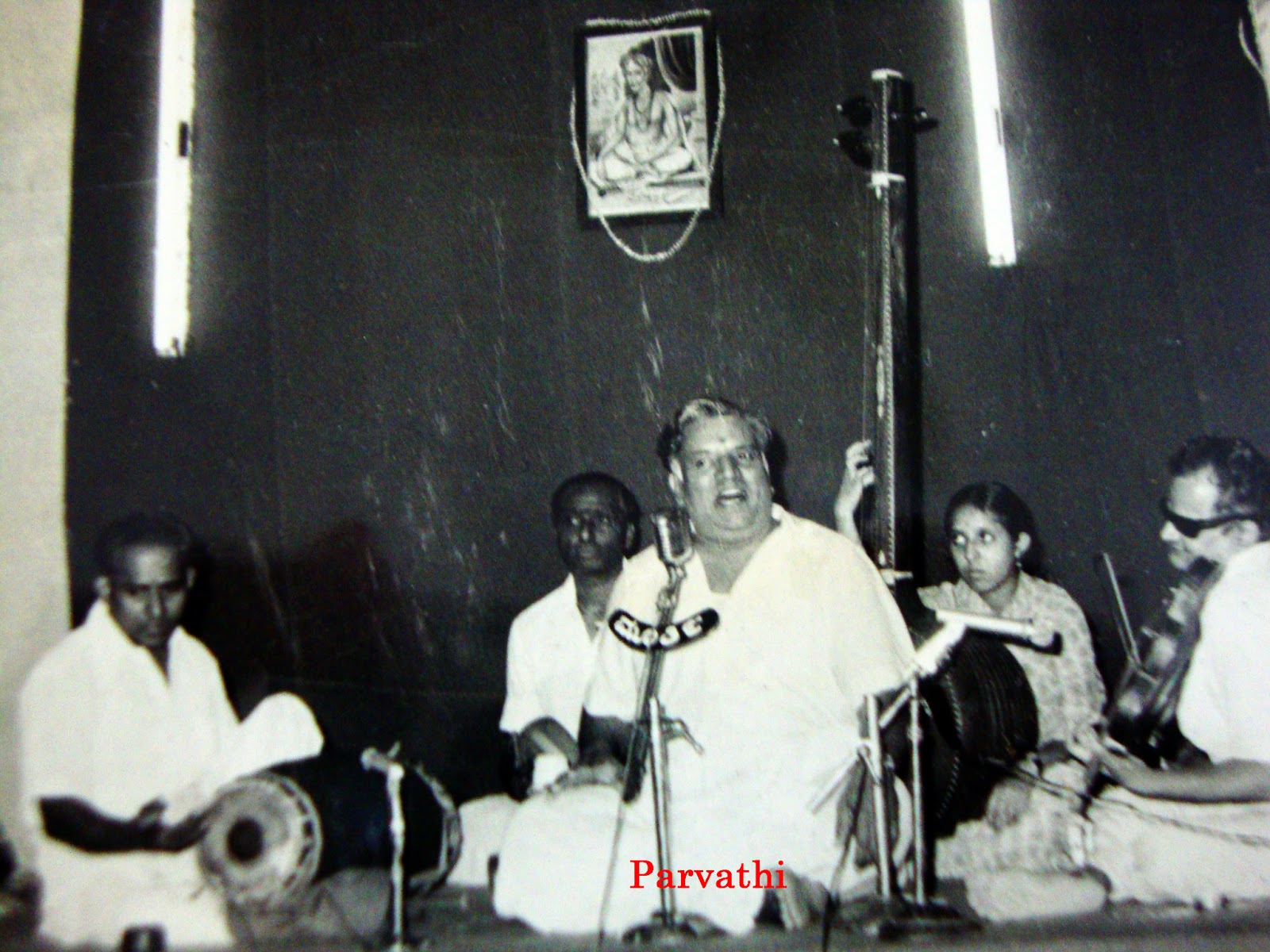
A Tradition of Recognising Excellence - M. Balamuralikrishna - Parvathi Ramanavami Concert 1971

Parvathi felicitating Maestro M. BalamuraliKrishna 1971


Soon after starting the Ramanavami festival in the 60s, Mr. K. Srikantiah made a concerted effort to attract the best of musicians and felicitated them. Thus it was that in 1971, Vid. M. Balamuralikrishna was handsomely felicitated in the presence of several connoisseurs and musicians. 

We are sharing this concert recording from 1971 as our blog's penultimate tribute to Sri.K.Srikatiah's memory among rasikas and musicians world over for his immense service to the cause of art and Mysore rasikas.

Keenly aware of the occasion then, BMK also performed a stellar concert in the company of the best of artistes, viz. Vid. M. Chandrasekharan, Vid. Umalaypuram Sivaraman and Vid. Vikku Vinayakram. His Chandrika raga alapana, followed by his own composition, was received with many appreciative murmurs. His treatment of Devadi Deva had established his stardom already in Mysore, being applauded by the composer himself! Here, he rendered it with the same gusto. "Chandru" followed the mood and method assiduously. Kharaharapriya was a favourite of Sri. K. Srikantiah and the raga and song would have surely thrilled him. All in all, this concert has the stamp of BMK, full of melody and inventiveness. 

Vid. Umayalpuram Sivaraman,  recipient of Padma Vibhushan and Sangeeta Kalanidhi among several titles, celebrated completing 80 years of performing in concerts very recently, by playing in the Kalahasteeshvara Temple, Kumbhakonam, where he had his arangetram in 1935! Our felicitations to the doyen of percussion art. 


M.Balamuralikrishna --------------- Vocal 
M. Chandrasekharan---------------- Violin
Umayalpuram Sivaraman --------- Mridangam
T.H. Vinayakram ---------------------- Ghatam
Date: 7th April 1971 - held at the Parvathi Ramanavami Pandal
  1. Endaro Mahanubhavulu - Sriraga - Thyagaraja
  2. Enta Muddo - Bindumalini - Thyagaraja
  3. Nee Sati Neeve Ranga - Chandrika - Balamuralikrishna
  4. Peridi Ninnu - Kharaharapriya - Thyagaraja
  5. Paramapavanamu - Kedaragaula - Balamuralikrishna
  6. Devadi Deva - Sunada Vinodini - Mysore Vasudevacharya
  7. Tani
  8. Jagodaddharana - Kapi - Purandaradasa
  9. Naapaali Sreerama - Shankarabharanam - Thyagaraja
  10. Ya Ramita - Patdeep - Jayadeva
  11. Sita Kalyana - Kurinji - Thyagaraja
  12. Thillana - Kadanakuthuhalam - Balamuralikrishna
  13. Mangalam - Madhyamavathi -Balamuralikrishna


Friday, July 11, 2025

The Unparalleled Maestro - Dr. M. Balamuralikrishna


Dr. M. Balamuralikrishna in the home of Parvathi - 1967


There has never been a more prolific and multifaceted musician in Indian music than Dr. M. Balamuralikrishna. As one who composed in all the 72 melakartas as a teenager, as one who conquered Madras audiences while still being an "Outsider",  as one who was the only classical male vocalist to make a mark in film music, in light music, as well as in devotional music across languages, and achieve fame and reverence as a vocalist among Hindustani music audiences, he did it all. His appeal to Hindustani audiences was such that he was featured alongside Bhimsen Joshi and Kishori Amonkar! No raga or composer escaped his masterly treatment. What appeared as an effortless ease on the stage was the product of a genius honed to perfection in Nature's bosom.

BMK, as he was affectionately called by Madras audiences, once proudly claimed that no award or honour due to a musician would ever be denied to him. He also claimed he enjoyed eating ice-cream just before a concert!

M. Balamuralikrishna rose meteorically to fame in the 1960s through his innovative approach to Carnatic music and his expanding influence beyond traditional concert settings. By the late 1960s, he was hailed as one of the most famous Carnatic singers, known for his brilliant voice, mastery over multiple instruments, and prolific compositions.

Balamuralikrishna successfully wielded administrative roles, notably as music producer and later programme director for All India Radio (AIR) in Vijayawada and Hyderabad. He launched the influential early morning devotional radio show "Bhakti Ranjani," which became widely popular and was later adopted by other stations. These roles helped him create new audiences for Carnatic music and brought his artistry to a broader public.

In this house concert, conducted at the residence of Sri. K.K. Murthy, the younger brother of Sri. K. Srikantiah, BMK's forte across all these dimensions, is on full display. His own compositions shine with his unique treatment. He sings the songs that he made famous - be it a song of Jayadeva or of any other composer, even in the film world! 

The way BMK sings Amrithavarshini, Shanmukhapriya, Kapi...they will linger long in our hearts and minds. 

We are posting the last few remaining archive recordings left behind by Sri. K. Srikantiah... with a sense of duty and fulfilment.

Concert Details: 

M. Balamuralikrishna - Vocal
M. Chandrasekharan - Violin
Vellore Ramabhadran - Mridangam
Ghatam - ?
Date: Sometime in 1967.


Song List
  1. Samagana Sarvabhauma - Amrithavarshini - Balamuralikrishna
  2. Ksheerasagarashayana - Devagandhari - Thyagaraja
  3. Sada tava pada - Shanmukhapriya - Balamuralikrishna
  4. Sharasharasamaraika Shura - Kunthalavarali - Thyagaraja (with BMK chitteswara)
  5. Jagadoddharana - Kapi - Purandaradasa
  6. Thangaratham - Abhogi - Viswanathan Ramamurthy/Kannadasan
  7. Pravisha Radhe - Kosala - Jayadeva/Balamuralikrishna
  8. Natavara Gangadhara - Abheri - Venkatrajau - Film Swarna Gowri
  9. Orunaal Poduma - Ragamalika - Balamuralikrishna - Film Thrivilayadal
  10. Ahir Bhairav Thillana - Balamuralikrishna
  11. Mangalam


Friday, December 23, 2022

The Excellence of Flute in Carnatic Music - Vid. N. Ramani


Vid. N. Ramani - Sri Ramanavami 1980

The world of Carnatic music is best described in two words - Sangeeta and Sahitya. The compositions of the great vaggeyakaras are like mantras that invoke the Nada Brahmam in us as we listen to a chaste rendition of their songs.

But as सङ्गीतरत्नाकर declares, गीतं वाद्यं तथा नृत्यं  त्रयं सङ्गीतमुच्यते - the trinity of Song, Instrument and Dance is Sangeeta.

The Srimad Bhagavatam declares that as soon as Sage Narada received spiritual instruction from his father, Lord Brahma, he began travelling the three worlds, singing the glory of Sri Hari, accompanying himself on the Veena!

But what about pure instrumental music? The instrumental soloists have etched a permanent place for themselves in Carnatic music. Notable among them, and the favourites of the home of Parvathi, were Vid. Lalgudi Jayaraman, Vid. Chitti Babu, Vid. Mandolin Shrinivas, and, last but not the least, Vid. N. Ramani.

The Wikipedia informs us that Vid. Ramani was born into a musician family in Tiruvarur. He learnt the art of the flute from his maternal uncle and legend Vid. Mali, and carved a significant place for himself with the best of the gayaki style of Carnatic music combining his instrumental virtuosity with adherence to the Pathantara of songs rendered by the best vocalists of the time.

In this concert, Vid. Ramani is accompanied by the maestro Vid. M. Chandrasekharan on the violin, Vid. Vellore Ramabhadran on the mridangam and Vid. M.A. Krishnaswamy on the ghatam. The repeated exclamations of "Bhale", 'Bhesh", and "Kya Baat Hai" can be heard peppering the wonderful flow of music. Notable renditions are Hindolam, with wonderful essays by the flute and violin, and also Kharaharapriya, an eternal favourite of Sri. K. Srikantiah.

Concert Details

Ramanavami 1980
N. Ramani - Flute
M. Chandrasekharan - Violin
Vellore Ramabhadran - Mridangam
M.A. Krishnamurthy - Ghatam
Date 26 March 1980

Song List
1. Chani Todi Teve - Harikambhoji - Thyagaraja
2. Sri Narada Nada - Kanada - Thyagaraja
3. Enta Muddo - Bindumalini- Thyagaraja
4. Manasulo Ni Marmamu - Hindolam - Thyagaraja
5. Palintuvo - Kantamani - Thyagaraja
6. Rama Nee Samanamevaru - Kharaharapriya - Thyagaraja
7. Ni Dayache Rama? - Yadukula Kambhoji - Thyagaraja
8.  Bhajan- Shivaranjani
9. Bhajan - Sindu Bhairavi
10. Arumugam Arumugam - Kuntalavarali- Arunagirinathar (Thiruppugazh)

(The recording is 42 years old and any shortcomings may be kindly excused.)


Friday, November 18, 2022

The Singer for all Seasons – Vid. K. J. Yesudas

The Singer for all Seasons – Gaana Gandharvan K. J. Yesudas 
 1977 Sri Ramanavami Concert at Parvathi


By R.Sachi

If we know of a man for all seasons, and a man of many parts, then we can also begin to appreciate India's singer for all seasons, Padma Vibhushan K.J. Yesudas. To give a perspective of his achievements, let us see Wikipedia:

Kattassery Joseph Yesudas (born 10 January 1940) is an Indian playback singer and musician who sings Indian classical, devotional and film songs. He is widely regarded as one of the greatest singers in the history of Indian Music and also as a cultural icon. Yesudas is estimated to have recorded more than 50,000 songs in various Indian languages, including Malayalam, Tamil, Kannada, Telugu, Hindi, Odia, Bengali, Marathi as well as Arabic, English, Latin, and Russian, in a career spanning six decades. He is often referred to as Gaana Gandharvan (transl. The Celestial Singer).

Yesudas won the National Award for the Best Male Playback Singer a record eight times, the Filmfare Awards South five times, and the State Award for the Best Playback Singer forty-three times, including awards given by the state governments of Kerala, Tamil Nadu, Andhra Pradesh, Karnataka, and West Bengal. He received the Padma Vibhushan (the second-highest civilian award) in 2017 from the Government of India for his contributions to the arts.

Yesudas started his academic music training at R. L. V. Music Academy, Thrippunithura, and completed the Ganabooshanam course. Later he studied at Swathi Thirunal College of Music, Thiruvananthapuram under the tutelage of the Carnatic music maestro K. R. Kumaraswamy Iyer and the doyen Semmangudi Srinivasa Iyer but could not complete his studies due to financial constraints. For a brief period, he also studied music under Vechoor Harihara Subramania Iyer, after which he took advanced training from Chembai Vaidyanatha Bhagavatar.


This author witnessed an event when the doyen Chembai was honoured with a statue of Goddess Saraswathi during his concert for some organisation at the Madras Music Academy hall. He, in turn, promptly conferred it on his disciple Yesudas who was accompanying him on the stage, saying that Gaana Saraswathi would like it to be given to him!


We have featured several concerts performed at the home of Parvathi over 5 decades by Vid. Yesudas. He shares a unique chemistry with Sri. K. Srikantiah, and has come more readily to perform in Parvathi than even at the Mysore Palace Dasara.

In this concert, Sri. Yesudas is accompanied by two Sangeetha Kalanidhis who have made and continue to make our lives richer through their music – Vid. M. Chandrasekharan on the violin and Vid. T. V. Gopalakrishnan on the mridangam. There is also ghatam accompaniment by Vid. T.V. Vasan and khanjira accompaniment by Vid. H.P. Ramachar. Sri. Yesudas sings in three octaves with ease, and negotiates a plethora of rich ragas and famous compositions of the great Vaggeyakaras, and gives nearly an hour of his popular film songs that draws huge applause.

Hindolam is very well presented. Then, there is a consummate presentation of Kharaharapriya and the famous Thyagaraja song Pakkala Nilabadi. 

As the Vidwan begins the alapana of Shankarabharanam, an idea strikes me. The most common scale in the world of music is this raga, also called C Major or the Ionian mode. In fact, this raga is the most natural scale offering a harmonic relationship between any two notes. 

True to its name- which means Lord Shiva’s ornament, Shankarabharanam accommodates many different interpretations, just as Lord Shiva has three ornaments - the crescent moon in his crest, the cascading Ganga down his matted locks, and snakes all over. Shankarabharanam has Carnatic gems of Krithis like Akshayalingavibho and Swara Raga Sudha, as also the currently hugely popular, child-friendly, Nottuswarams. These are like the splendid moon on Shiva’s crest. Then the raga allows for expansive, fluid, and evocative alapanas and Tanams (listen to Vid. Yesudas here!). They are like the Ganga cascading down Shiva’s matted locks! Finally, Western/ Jazz/ Rock/Heavy metal interpretations are also hugely popular. They are a bit like the fascinating snakes that coil and slither all over the Lord's body! What a gift of music is Shankarabharanam from Lord Shiva to us all, irrespective of our tastes!

The reason for featuring this concert in the Parvathi finale is simple – the December Music Season may come and go, but Gaana Gandharvan Vid. Yesudas will thrill any listener in any season, and this concert is precious proof of that!


Concert Details

K. J. Yesudas - Vocal
M. Chandrasekharan  - Violin
T.V. Gopalakrishnan - Mridangam
T.V. Vasan - Ghatam
H.P. Ramachar - Khanjira
Date 4 April 1977

during Ramanavami Festival, "Parvathi", Mysore, April 1977.

Song list:

1. Evari Bodha – Abhogi varnam – Patnam Subrahmanya Iyer

2. Siddhi Vinayakam – Chamaram (Shanmukhapriya) – Muthuswami Dikshitar

3. Pavanaguru-Pavanapuraadheesham Aashraye – Hamsanandi – Swathi Thirunal

4.       Govardhana Girisham – Hindolam – Muthuswami Dikshitar

5.       Pakkala Nilabadi – Kharaharapriya –Thyagaraja

6.       Manavyalakimcha radate- Nalinakanthi- Thyagaraja

7.       Adhiye Paranjyothiye – Narayanagowla? – Vedanayagam Pillai

8.       Shankarabharanam alapana

9.       Tanam with mridangam accompaniment

10.   Enduku Peddala Vale – Shankarabharanam – Thyagaraja

11.   Thirupar Kadalil Pallikondaye – Bhairavi - Vayalar

12.   Harivarasanam – Madhyamavati – Dakshinamurthy

13.   Chand Akela Jaye Sakhi Ri

14.   Apoorva Ragam

15.   Jab Deep Jale Aana

16.   Murugane Kaana Aaayiram Kann Vendum

17.   Ni Sa Ga Ma Pa Ni

18.   Shloka – Bhimplas, Anandabhairavi

19.   Mangala Darshana Dayike – Ananda Bhairavi

20. Yogeendraanaam – Ragamalika (Kapi, Sindhubhairavi) – Narayaneeyam

21.   Mangalam

Wednesday, March 13, 2019

Vintage Violin Duo Prof. T.N. Krishnan & Vid. M. Chandrasekharan - 1972

The original concert blogpost is here: It gives all details of the concert.
Duet of two Violins - two Mridangams in "Parvathi", Mysore 1972

The audio is embedded in a different format below:

Saturday, February 3, 2018

Mother worship in Carnatic music


Vids. M. Chandrasekharan and Bharathi
K.Puttu Rao Memorial Violin Concert 2014


Review by R. Sachi


Welcoming the spring season of 2018, called Vasanta Ritu in India, we offer you a lovely violin concert by Sangeetha Kalanidhi Sri. M. Chandrasekharan, accompanied by his daughter and disciple Vid. Bharathi. The accompaniment by Vid. Cheluvaraju on the mridangam and Vid. Ramanujam on the ghatam complete a great team offering rich music in the Carnatic idiom.


Vid. Chandrasekharan is noted for his patent dark glasses as well as his singing violin with a unique personality. He has provided superb violin accompaniment for many decades to the best Carnatic musicians. His sensitive and imaginative approach to solo music is also recognised by rasikas. “Chandru” is a dear friend at the home of Parvathi and he has performed dozens of times in the Parvathi festivals. He casts a timeless charm even today on the audiences.

We have given much information about the Vidwan and his association with Parvathi in the previous concert postings. However, the subject of his mother’s influence on his music, and its importance in the context of Carnatic music, cannot be overemphasized.

Chandru’s violin guru was his mother, Smt. Charubala Mohan. We quote him from an interview to the Times of India in 2016:

Elaborating on her teaching style, Chandrasekaran says, "Her unimposing attitude gave me ample freedom to develop my own style and also appreciate various kinds of traditional music." Recalling one of his practice sessions with a smile, he says, "Just once she gave a gentle tap on my thigh because the bow for the violin kept slipping even after she taught me the technique. After that, I started doing it correctly."

Understanding the importance of exposure, Charubala ensured her son did not miss out on the performances of Carnatic stalwarts. From techniques to compositions, young 'Chandra' - as she fondly called him developed an ear for a variety of styles. "My mother would accompany me for almost every concert. If she couldn't make it, she made sure she sent someone with me. I rarely missed a performance," he reminisces.

The idea of the Mother Goddess is unique to Hinduism. Further, in Carnatic music, we have a huge body of compositions worshipping the Mother. In his famous Darini Telusukonti, Saint Thyagaraja says:


The saint was a devotee of Sri Rama, but found it fit to make this prayer to the Mother Goddess. This kind of prayer to the Mother pervades the krithis of many other composers, too, particularly Sri.Shyama Shastri, and Sri. Muthuswami Dikshitar.

Come, let us enjoy a lovely concert from a veteran master and his talented daughter!


Concert Details


M.Chandrashekharan --------- Violin
Bharathi --------------------------- Violin
Cheluvaraju ----------------------- Mridangam
Ramanujam --------------------- Ghatam

on 4-9-2014 during K.Puttu Rao Music Festival at Mysore.

01 Siddhi Vinayakam Anisham-Muthuswami Dikshitar-Chamaram (Shanmukha Priya) *** 02 Sri Jaalandhara-Jayachamaraja Wadiyar-Gambhira Nata *** 03 Enta Muddo-Thyagaraja-BinduMalini *** 04 Dattatreya Trimurtirupa-Ganapathi Sacchidananda Swamiji-Ranjani *** 05 Nagumomu-Thyagaraja –Abheri - ragamalika swaras medley: Begada, Basant, Desh followed by Tani *** 06 Tune only-Bagesri *** 07 BaroKrishnayya-Kanakadasa-Ragamalike *** 08 BhagyadaLakshmi-Purandaradasa-Madhyamavati ***


Friday, May 19, 2017

The King who worshipped the Mother Goddess


Vid. KS Gopalakrishnan- Flute,
1984 Parvathi Ramanavami Concert


"Reveling in a Flautist's Magic" by R. Sachi


It is our great pleasure to share with rasikas worldwide the flute recital of Vid. KS Gopalakrishnan, of over 3 hours, with the best of accompaniment too, from two Sangita Kalanidhis, Vid. M. Chandrasekharan and Vid. Umayalpuram Sivaraman. The concert was held at Parvathi 33 years ago.


The bamboo flute creates sheer magic in the hands of an expert flautist. The home of Parvathi and its large audience of avid music lovers had a chance to listen to many great vidwans and vidushis on the flute: Mali, Ramani, KSG, Sikkil sisters, BN Suresh, and recently Chandan Kumar, among others. The warm April weather, with occasional showers of grace, the bedecked mantapa of Sri Rama Pattabhisheka, the fragrance of parijata and jasmine, combined with the mesmerising sounds of the flute, carried off listeners into a different world of ethereal beauty. This concert will give you a charming glimpse of that world. And Sri KSG, with Sri MC and Sri UKS, fills the three plus hours with infinite melody.

Vid KSG presents a concert of great poise and virtuosity, anchored in melody and replete with imaginative phrases in Bindumalini, Kanada, Shanmukhapriya, Yamuna Kalyani...The recording faithfully captures the aesthetics and the on-stage dynamics between three maestros. The concert is so gripping that one will go into a listening loop of many hours.

The kriti taken up early in the concert is the Devi kriti in Kanada, Mamava Sada Janani, by the composer king Swathi Thirunal of Travancore. Anyone who has visited God’s own country, walked in its green forests, on its golden beaches, prayed at the Padmanabhaswami temple, and heard the compositions of Swathi Thirunal, cannot but think of heaven on earth.

The composer king lived a short but extremely beautiful life, full of music and literature. His compositions, tuned in such wonderful melodies, represent the best of Carnatic music. Vid. Rallapalli Anantha Krishna Sharma, a great Sanskrit scholar, musicologist and disciple of Bidaram Krishnappa, has discussed in his book, “Ganakale””, the lyrical excellence and the high quality of Sanskrit used by Swathi Thirunal .In the song, Mamava Sada Janani, we get an inkling of the composer’s depiction of divine beauty. That is beauty that excels anything between heaven and earth. And that beauty showers grace, the grace of the Divine Mother. The mood harkens to the Devi Mahatmyam prayer, “Sarvamangala Mangalye ...”


Come, let us enjoy this great concert!


Details

K.S.Gopalakrishnan ---------- Flute
M.Chandrasekharan ---------- Violin
Umayalapuram Shivaraman --- Mridangam
at "Parvathi" on 15-4-84 during Ramanavami Music Festival.

Song List

01 Chalamela –VarnaNaattakurinji= M Rangaswamy Nattuvanar *** 02 Sri Mahaganapthe Surapathe-Nata-Mayavam Vishwanatha Shastri *** 03 Entamuddu- Bindumalini – Thyagaraja *** 04 Marivere dikkevvaru –Latangi- Patnam Subrahmanya Iyer *** 05 Kanada Raga*** 06 Maamavasada-Kanada-Swathi Thirunal *** Tani *** 07 Sarasamukhi-Gaudamalhar-Muthiah Bhagavatar *** 08 Shanmugapriya Raga*** 09 Tana*** 10 Pallavi-Ragamalika swaras (Shahana, Hindola, Hindustani Todi, Revathi) *** 11 Emani- Huseni-Thyagaraja *** 12 Krishna nee begane- Yaman Kalyani -Vyasaraya *** 13 Bhagyaada Lakshmi baaramma-Madhyamavati-Purandara Dasa *** 14 Thiruppugazh-Hamsanandi *** 15 Mangalam***


Thursday, June 16, 2016

Ananda Natesa - a unique conception of God in HInduism


Vid. KJ Yesudas 1982 'Parvathi' Ramanavami Concert


A coverage by R. Sachi


We feature another full-fledged concert of Vid. KJ Yesudas this time. The love affair between "Parvathi" and Sri Yesudas continues after many decades and at his Putturao Memorial concert last year, almost crowd control measures were needed when 2500 people thronged the Jagan Mohan Palace. His popularity has always soared high for his delightful presentation style and unparalleled voice. In this concert, held 34 years ago, he enjoys the company of two stalwarts and eventual Sangeetha Kalanidhis, Vid. M. Chandrasekharan and Vid. Palghat Raghu. As usual, the excellent recording quality, despite its being a home recording, is a precious gift of "Parvathi" to all rasikas.


The song list includes the Tamil composition Ananda Natesa. The conception of God in cosmic dance is unique to Hinduism. Celebrated in iconography, art, music, dance and culture, this symbolism goes beyond mere beauty. The five elements are present in this dance, and the chidambara is a metaphor for the daharaakasha, the abode of the Infinite in our bosom.

Ananda Coomaraswamy, the famed writer and researcher, had this to say about the conception of Nataraja.
From the Dance of Siva by Ananda Coomaraswamy (1918) (also the image reproduced below):

" Now to summarize the whole interpretation we find that the Essential Significance of Siva's Dance is threefold: First, it is the image of his Rhythmic Play as the Source of all Movement within the Cosmos, which is Represented by the Arch; Secondly, the Purpose of his Dance is to Release the Countless souls of men from the Snare of Illusion; Thirdly the Place of the Dance, Chidambaram, the Centre of the Universe, is within the Heart. So far I have refrained from all aesthetic criticism and have endeavoured only to translate the central thought of the conception of Siva's dance from plastic (i.e.sculptural form) to verbal expression, without reference to the beauty or imperfection of individual works. But it may not be out of place to call attention to the grandeur of this conception itself as a synthesis of science, religion and art. How amazing the range of thought and sympathy of those rishi artists who first conceived such a type as this, affording an image of reality, a key to the complex tissue of life, a theory of nature, not merely satisfactory to a single clique or race, nor acceptable to the thinkers of one century only, but universal in its appeal to the philosopher, the lover, and the artist of all ages and all countries. How supremely great in power and grace this dancing image must appear to all those who have striven in plastic (an expression used to describe art forms such as sculpture etc.) forms to give expression to their intuition of Life! "


So dear rasikas, come and enjoy pure melody from 35 years ago!


Concert Details

Vid. K.J. Yesudas -------------- Vocal
Vid. M. Chandrasekharan-- Violin
Vid. Palghat Raghu ---------- Mridangam
Vid. M.A. Krishnamurti ---- Ghatam
On 5-4-82 during Ramanavami at 'Parvathi'.

Song List

01. Evaribodhana- Abhogi Varna-= Patnam Subrahmanya Iyer *** 02. Vatapi-Hamsadhvani- Muthuswami Dikshitar *** 03. Rakshamam - Nata - Meenakshisuta *** 04. Pavanaguru-Hamsanandi- Lalithadasar *** 05. Santana Ramaswaminam-Hindola vasanta- Muthuswami Dikshitar *** 06. Abhimanamennadu- Kunjari- Thyagaraja *** 07. Mokshamu galada-Saramati- Thyagaraja *** 08.Todi Raga *** 09. Ananda Natesa-Todi- Ramaswamy Sivan *** 10. Shankarabharana Raga *** 11. Tana-Pallavi-Ragamalika swaras *** 12.Nandanandana-Desh- Lalitha Dasar *** 13. Kannanai Kandayo -Sindhubhairavi-Lalithadasar ***14. Shadj ne paya- Ragamalika- Tansen *** 15. Mangalam ***


Thursday, March 3, 2016

Seeing the Romantic in Every Raga


M. Chandrasekharan & G. Bharathi-violin duet, 'Parvathi' Ramanavami 1981


An appreciation by R. Sachi


Courtesy: Times of India


Among the many musical stars that have shone brightly in the Parvathi sky, Sangeetha Kalanidhi M. Chandrasekharan, or Chandru to Sri K. Srikantiah, and Vidwan MC to others, is a bright and constant one. For many decades now, Vidwan MC has been a leading violinist wowing audiences with his remarkable violin accompaniment, solos, and duets. In Parvathi alone, he has performed a few dozen times. This blog has already featured him in 16/17 concerts, as an accompanist as well as in violin duets. This is a small indicator of the immense love and respect that is mutual between Sri KS and Vidwan MC.

For anyone who has attended a concert by Vidwan MC, three things are etched in the mind forever. First, his smiling face with dark glasses. Second, his unflagging enthusiasm throughout the concert. Third and most important, his violin playing which is remarkably sweet and highly effective in every type of music. What makes this musician tick?

Vidwan MC is 79 years old now, and has been playing the violin on the concert stage for more than 67 years. He sees music brilliantly, despite his visual handicap. He is loved by audiences and musicians worldwide. Playing the violin in a demanding genre like Carnatic music is not easy. The visual handicap adds many challenges. But not only has Vidwan MC overcome every difficulty, but he has also developed the inner eye to see music in a life-long romance. He sees the romantic side of every raga, always. The present concert is ample proof of this, and covers a range of compositions. Vidwan MC connects instantly with the audiences because he is so sensitive. He says in an interview, conducted by Kutcheribuzz on the occasion of his receiving the Sangeetha Kalanidhi title from the Madras Music Academy: " One can sense the preferences of the audience minutes after a concert begins. I see everything through my heart."

In this concert, the vidwan plays a rare composition "Ramesham Jagadeesham", composed by Bangalore Yogacharya Sundaram. It appears to be tuned in the raga Shuddha Malavi by Vidwan MC himself. In many places throughout the concert, Vidwan MC vocalises the lyrics as well.

Vid. Bharathi, daughter and disciple of Vidwan MC, has accompanied him in this concert with equal enthusiasm. Percussion support by Vid. TAS Mani and Vid. Ramesh draws praise from the main artistes.

Come, let us enjoy a lovely concert held in Parvathi, Mysore, 35 years ago!


Details

M.Chandrasekharan ----------- Violin
Bharathi ----------------------------- Violin
T.A.S.Mani ------------------ Mridangam
T.N.Ramesh ---------------- Ghatam

on 20-4-81 at "Parvathi" during Ramanavami

Song List

01. Manasa Etulo-Malayamarutha-Thyagaraja *** 02. Raghuvamsha-Kadanakutuhala-Patnam Subramania Iyer *** 03. Janani Ninnuvina-Reetigowla-Subbaraya Shastri *** 04. Bhuvaneshvariya-Mohanakalyani-Muthiah Bhagavatar *** 05. Nagumomu-Abheri-Thyagaraja *** 06. Ramesham Jagadeesham- Shuddha Malavi?-Bangalore Yogacharya Sundaram *** 07.Shanmukhapriya Ragam, Tanam *** 08. Ragamalika Pallavi *** 09. Seethakalyana-Kurinji-Thyagaja ***


Friday, August 7, 2015

Enriching Carnatic Music through Emulation


Flute Ramani – Parvathi Ramanavami Concert 1981

An Appreciation from R. Sachi

It is not for the first time that we are sharing a wonderful concert of Vid. N. Ramani with our rasikas. A much-loved flautist in the Carnatic idiom for several decades, he stands for pristine music with an enchanting appeal and a wide repertoire. His several collaborations over the years with other great musicians have also resulted in unforgettable concerts. His innumerable recordings are cherished by collectors world over

[ Cover illustration from an HMV album ]

In this 1981 concert, the music is simply ethereal. The emanating melody in some of the items makes us close our eyes and wonder if this is how probably Sri Krishna's divine music would be.

This concert took place when Vid. Ramani was at the peak in his career. Of course,Vid. Chandrasekharan on the violin here is at his usual best, elevating the concert with his accompaniment. Vidwans Srimushnam Raja Rao and MA Krishnamurthy have lent good percussion support.


In the rich repertoire shared here, there is the Begada classic, ‘Shankari Neeve”. Its composer Sri Subbaraya Shastri (1803-1862) was the second son of Sri Shyama Shastri, one of the glorious Carnatic trinity. Subbaraya Shastri is reputed to have studied music not only under his father, but also under Saint Thyagaraja and Sri Muthuswami Dikshitar. He was an expert in many languages and had learnt even Hindustani music from famous Maratha vidwans residing at that time in Tanjavur. He could play with felicity the violin and a rare Indian bowed instrument, sarinda.

Sri Subbaraya Shastri’s compositions are greatly cherished by connoisseurs of Carnatic music. They are known for their musical enrichments- of raga, swara sahitya and laya. Dr. V. S. Sampathkumaracharya (Karnataka Sangita Vishaya Vishwakosha) makes many interesting observations. Sri Subbaraya Shastri’s krithi, “Vanajasana vinuta” in Shriraga eschews the note dha, emulating the approach of Saint Thyagaraja in “Endaro mahanubhavulu”. His composition, “Venkatashaila vihara” in Hamir Kalyani is modelled on the structure of Dikshitar’s compositions. His compositions, “Janani ninnuvina” (Reetigowla) and “Ninnu Sevinchina” (Yadukula kambhoji) show the influence of his own illustrious composer father, Sri Shyama Shastri. Sri Subbaraya Shastri has shown also great expertise in swara-akshara sahitya in many of his compositions.

Thus, we can see that apart from their own innumerable musical gems, the Carnatic trinity have extended their abiding influence on Carnatic music through the enriched compositions of vaggeyakaras like Sri Subbaraya Shastri who have emulated their compositional ideas.

Apart from Begada, this concert has many very enjoyable delineations – Kapi and Bhairavi to name just two. Come, let us enjoy the musical feast from Vid. N. Ramani and team.


Concert Details

N.Ramani ---------------- Flute
M.Chandrasekharan --- Violin
Srimushnam Raja Rao --- Mridangam
M.A Krishnamurthy ------ Ghatam
on 19-4-81 at "Parvathi" Ramanavami festival

Song List

01. Pranamamyaham-Gowla-Vasudevachar *** 02. Dinamani vamsa-Harikamboji- Thyagaraja *** 03. Entamuddu-Bindumalini-Thyagaraja *** 04. Begade Raga *** 05. Shankari Neeve- Subbaraya Shastri *** 06. Kapi Raga *** 07. Inta soukhya-Thyagaraja & Tani *** 08.. Evaritho –Manavathi- Thyagaraja *** 09. Bhairavi Raga *** 10. Tana-Pallavi- swaras (Bhairavi and Mohana) *** 11. Na naati bratuku-Revathi- Annamacharya *** 12. Ashtapadi-Mohana, Rageshri,Yaman, Sindhu bhairavi- Jayadeva*** 13. Venkatachala nilayam-Sindhu bhairavi- Purandaradasa*** 14. Magudi *** 15. Tillana-Dhanasari- Swathi Thirunal *** 16. Thiruppugazh–Kuntalavarali *** 17. Mangalam***


Wednesday, December 25, 2013

Thyagaraja, The Saint Composer


Vid. Maharajapuram Santhanam – 1972 Ramanavami


Text by R. Sachi

We are happy to share with rasikas this concert from 1972 as a part of our Season’s greetings and best wishes for the New Year 2014. This season is auspicious for Hindus and Christians alike, being a period of prayer and holy celebration. The Margashirsha masa (Margazhi in Tamil) is considered the best month in the Hindu calendar as it instils a mood of prayer and tranquility.

In this concert, Vid. Santhanam has sung a wonderful composition of the saint composer Thyagaraja in Yadukula Kambhoji, a raga most suited to prayer. In the song (part of Prahlada Bhakti Vijayam), Thyagaraja describes his utter anguish at his separation from Lord Rama. His feelings are very similar to those of anguish in the voices of mystics Meera, Andal and Chaitanya. We give below the lyric and translation from The Spiritual Heritage of Thyagaraja (pub. Ramakrishna Math, Chennai)


Concert Details

Ramanavami Concert 1972, Parvathi Mysore, held on 28-3 1972

Vid. Maharajapuram Santhanamm – Vocal
Vid. M.Chandrasekaran ----- violin
Vid. Palghat Raghu ------ Mridangam
Vid. Vikku Vinayakram ------Ghatam.

Song List

01-Gananathaya-Gowla-Ambi Dikshitar*** 02-Telisirama-Purnachandrika-Thyagaraja*** 03-Banturiti-Hamsanadam-Thyagaraja*** 04-Unde Yedi-Harikambhoji-Thyagaraja*** 05-Mohanam-Alapana*** 06-Mohanarama-Mohana-Thyagaraja*** 07-Chelimini Jalajakshu Kante-Yedukulakambhoji-Thyagaraja*** 08-Kandukandu-Mohana-Purandaradasa*** 09-Yochana-Darbar-Thyagaraja*** 10-Ammaravamma-Kalyani*** 11-Sarangamarugane-Ragamalika-Veeramani***


Wednesday, October 2, 2013

Establishing the Instrumental Solo Concert in Carnatic Music


N. Ramani, Ganesha Festival 1972


Text Courtesy: R. Sachi

We are happy to feature here another lovely concert of the evergreen favourite Dr. N. Ramani. Held during the Ganesha festival in 1972, the concert offers delectable fare typical of the golden years of instrumental concerts in Carnatic music.


Vidwans (L to R): Vellore Ramabhadran, K.S. Manjunath, N. Ramani, M.Chandrasekharan


There have been several narratives of the way instrumental music concerts made their impact on the Carnatic music scene from late 1950’s. Of course there were many stalwarts wielding the bow, or flute or veena, even before, who had established themselves as path-breakers. Then of course there were the Nadaswaram vidwans who not only commanded respect but were emulated in several major Banis of vocal and instrumental music - especially for their raga elaboration and swara rendering.

But we can clearly see a golden era during 1960’s and 1970’s when instrumental solo concerts commanded audiences and appreciation from connoisseurs. Today, there is no dearth of young talent among solo instrumentalists. But somehow they seem to have yielded ground to vocalists for a number of reasons. In any case, the home of Parvathi was witness to many stellar concerts of doyens performing instrumental solos, starting with Mahalingam, Lalgudi, Ramani, Doreswamy Iyengar, Emani, Chittibabu, TN Krishnan, M Chandrasekharan, KS Gopalakrishnan, Sikkil Sisters, Mandolin Shrinivas, Mysore Manjunath and Nagaraj, and so on. Even in this year’s K. Puttu Rao festival, there were two instrumental concerts - the Lalgudi siblings on the violin and Chandan Kumar on the flute - to regale audiences. This Parvathi site is already a treasure of over 25 instrumental solo concerts and more are coming!

In this concert, we can sense the enthusiastic mood of the artistes right from the word go. The two songs on Vinayaka are rendered with aplomb. The rare Mandari krithi is presented with panache. In Mohana, the opening phrases are clearly from the Lalgudi Bani, which Ramani holds in high regard. Chandrasekharan is full of anticipation. Throughout this concert, his violin sings so sweetly that Ramani rises to even greater heights. Ramani suffuses each song with superb raga bhava. The listeners are treated to excellent renderings of Bhavanutha, Palinchu Kamakshi and then a fine Kambhoji RTP. There is a Tani in Vellore style also. The audience appreciation can be clearly heard in many places, especially during the ragamalika swaras and the lighter items.

We are sure you will immensely enjoy this offering, and we promise you more stellar concerts soon!


Concert Details

N.Ramani --- Flute
M. Chandrasekharan---Violin
Vellore Ramabhadran --- Mridangam
K.S. Manjunath ---- Ghatam

Held on Sept 12, 1972 at 'Parvathi" during Gowri-Ganesh festival

Song List

01-Viriboni-Bhairavi- Pachimiriyam Adiappayya*** 02-Vatapi-Hamsadhwani- Muthuswami Dikshitar*** 03-Gajavadana-Sriranjani- Papanasam Sivan*** 04-Endukitu Chapalamu - Mandari - Patnam Subramanya Iyer*** 05-Bhavanutha-Mohana- Thyagaraja*** 06. Palinchu kamakshi – Madhyamavati – Shyama Shastri*** Excellent Tani!!! 07-Evarani-Devamruthavarshini- Thyagaraja*** 08-RTP-Kambhoji ( ragamalika swaras -Shahana. Nilambari, Bowli, Darbari Kanada)*** 09-Tillana - Tilang - Lalgudi Jayaraman*** 10-Bhajan- Madhuvanti*** 11-Ashtapadi-Desh- Jayadeva*** 12-Thiruppugazh- Kannada _Arunagirinathar*** 13-Mangalam***


Tuesday, July 9, 2013

The Core of Carnatic Music’s Appeal is the Krithi


VID. MAHARAJAPURAM SANTHANAM - 1977 RAMANAVAMI CONCERT


AN APPRECIATION by R. SACHI

We feature this time a typical ebullient concert of Vid. Maharajapuram Santhanam. Vid. Santhanam established himself as a classical concert crowd puller in the ‘70s and ‘80s with his virtuosity, voice timbre, and concert repertoire. He was particularly popular in rendering the songs with sowkhyam and madhuryam, especially the ragamalikas. In this concert, we have a major example, Nalinakanti-mati, with a huge bouquet of ragas.

Gurvayoor Dorai, H.P.Ramachar, Maharajapuram Santhanam, M.Chandrasekharan


We feel that the principal appeal of Carnatic music lies in its ocean of krithis or lyrics. The krithis, especially of the Trinity, Purandara Dasa and other great composers, provides an incomparable fund of joy, with devotional meaning as well as musical richness. Many musicians confess that to master a raga, what they must do is learn and practice well the major krithis in that raga. So the krithi goes beyond just wordy delight. The krithi is in fact the infrastructure of Carnatic music.

Vid. Santhanam covers a wide array of krithis in this concert. From his favourites like Mohana and Garudadhwani, he also forays into many other popular numbers. His obvious delight in rendering the “Nalinakantimati” ragamalika is infectious. The accompanists- Vid. M. Chandrasekharan and Vid. Guruvayur Dorai, have provided spirited, innovative accompaniment. As we have said in this blog elsewhere, it is not difficult to understand why Vid. Chandrasekharan has been a perennial favourite for violin accompaniment. His totally committed, virtuosic, tonally nectarine, accompaniment has made many a concert in Parvathi memorable. Similarly, Vid. Dorai is a very solid mridanga vidwan and his deep and measured strokes always enhance the musical impact.

We also want to quote the translation from The Spiritual Heritage of Thyagaraja for the Garudadhwani song. Like many others, this song’s musical appeal somewhat hides the deep spiritual import of the saint composer’s thoughts:


It is only fitting that Saint Thyagaraja’s image adorns the stage in the photo of this concert.


CONCERT DETAILS

Ramanavami Festival, Parvathi (3 April 1977)

Vid. Maharajapuram Santhanam – Vocal
Vid. M. Chandrasekharan – Violin
Vid. Guruvayur Dorai – Mridangam
Vid. H.P. Ramachar – Khanjira

Song List

01. Seetapate----- Khamach- Thyagaraja *** 02. Samajavaragamana-Hindola- Thyagaraja *** 03. Tatvamerugatarama-Garudadhwani- Thyagaraja *** 04. Evarura-Mohana- Thyagaraja *** 05. Sloka & Lalgudi Tillana – Brindavani*** 06. Nalinakantimati-Ragamalika- Madurai T Krishnaswamy *** 07. Ragamailka – continued *** 08. Tungateera- Salagabhairavi – Kamalesha Vitthala Dasa*** 09. Bansiwale – Mohanakalyani – Swati Tirunal *** 10. Mangalam ***


Friday, June 15, 2012

The Glory of Serving the Lord is also through His Grace: Prof. T. R. Subramanyam at "Parvathi" 1973


We bring to you a splendid concert by Prof. T. R. Subramanyam this time. A recognized scholar, teacher and gifted musician, he has shone in Carnatic music for many decades now. We had earlier posted a concert of his to much appreciation. This time too, his concert has all the ingredients of a memorable performance, with wonderful accompaniment by Sri M. Chandrasekharan, Sri Vellore Ramabhadran and Sri K.S. Manjunath.


(2009 photo, Courtesy: The Hindu)


A noteworthy inclusion in this concert is a rendering in Khamach of a rare composition of Mysore Sadashiva Rao (ca. 1790-1880). Being a disciple of Walajapet Venkataramana Bhagavatar (a disciple of Saint Thyagaraja), Rao is said to have met and served the saint in Walajapet. He moved later to Mysore and became the royal musician in the court of Krishnaraja Wodeyar III. His famous disciples included Veene Sheshanna and Veene Subbanna. Mysore Vasudevacharya is said to have compiled his compositions. Vidwan Sadashiva Rao is hailed as the harbinger of the Mysore Bani.

In his brilliant book, “Splendours of Royal Mysore”, Vikram Sampath narrates an interesting episode. Sadashiva Rao’s definitive night-long exposition of Todi brought a misguided musician to his senses. The musician had before arrogated to himself mastery over Todi and had even mortgaged the Raga for a financial consideration to a zamindar in his native land. After listening to Rao’s Todi, he surrendered his ego and confessed that he had not known the heights of Todi before. Wodeyar himself came in disguise to witness the master class, and later revealed himself to honour the great vidwan. Vikram Sampath also narrates that a young Sadashiva Rao had at a young age composed and presented extempore “Thyagaraja Swamy Vedalina” in Todi to Saint Thyagaraja himself and won his appreciation and blessings. Many interesting episodes from Mysore Sadashiva Rao’s life are listed also in karnatik.com. His famous compositions are Saketa Nagaranatha (Harikambhoji) made famous by GNB, Ee Maguva (Dhanyasi), and Sri Kamakotipeethasthite (Saveri).

In the Khamach composition, “Sadashiva Kavi” sings of the lord of Srirangam, describing in detail His grandeur as the deity goes in a procession, and how devas, rishis, and Vaishnavas are performing devotional services. The composer says he is blessed to attend the grand event in Srirangam, and be able to serve the lord, and says that it is all His grace. This sentiment is highly evocative for all of us, as we consider how the Sri Rama Navami festivals initiated in Mysore by Vid. Sadashiva Rao afterwards inspired generations of musicians and rasikas like Bidaram Krishnappa, Sri Puttu Rao, Mysore T. Chowdiah and our own Mr K. Srikantiah, to continue the glorious tradition. This has been a continual act of worship joined by a galaxy of great musicians, some of whom we feature here.

The enthusiastic accompaniment of Vid. M. Chandrasekharan and Vid. Vellore Ramabhadran often draws out appreciation from the Prof., with words “Appadi!”, “Appadi!” The rich atmosphere of inspired manodharma sangeetha by the ensemble abounds in creativity and even a touch of flamboyance, and all rasas are served in full measure to the lucky set of rasikas. In reflection, all the bells and whistles added by TV Mahotsavams today seem peripheral to the fundamental, rich mood of Carnatic music. Nothing indeed seems lacking in this presentation 39 years ago by Prof. T. R. Subramanyam.

There is more. The musician has chosen a Kannada poem to present like a viruttam. It is composed by Betageri Krishna Sharma (1900-1982)-his pen name was Anandakanda- who was a school teacher, poet and journalist. He composed the following poem in Belgaum in mid-1930’s. We reproduce below an extract from Sahitya Akademi’s History of Indian Literature: .1911-1956, struggle for freedom : triumph and tragedy by Sisir Kumar Das:


We are sufficiently inspired by Prof. T. R. Subramanyam’s brilliant rendition (in ragas Mohana, Kannada, Bageshri and Abheri) to give you the full text of the poem:


A rough translation:

How wonderful is this Kannada language, an enchanting nectarine flow! It’s akin to the high-pitched songs of parrots, the joyous songs of cuckoos, the tête-à-tête of squirrels in early morn.

Its melody flows from the lips of Goddess Sarasvati, singing to her vina’s accompaniment in unceasing splendour.

The cascade from Krishna’s flute has inspired gopis to dance in moonlight, and that joy has filled Kannada.

Well, we reluctantly come down to earth from that mood, and give you the list of songs. Mr. Srikantiah points out that in this concert also, Prof. T. R. Subramanyam has shown noteworthy prowess in kalpanaswaras, especially daatu movements and swaraksharas, that will have an amazing appeal to rasikas.


Ramanavami Concert, Parvathi, Mysore
Date: 18th April 1973

Vidwan T. R. Subramanyam – Vocal
Vidwan M. Chandrasekharan – Violin
Vidwan Vellore Ramabhadran – Mridangam
Vidwan K. S. Manjunath – Ghatam

Song List (Please note the mridangam sounds prominent in this 39 year-old mono recording)

01. Kanada Varnam Nera Nammithi – Ramnad Srinivasa Iyengar *** 02. Gajavadana – Hamsadhwani- Purandara Dasa *** 03. Neebhakti bhagyasudha- Jayamanohari – Thyagaraja*** 04. Paramadbhuta Maina – Khamach – Mysore Sadashiva Rao *** 05. Mama hrudaye – Reetigowla – Mysore Vasudevachar*** 06. Varanarada – Vijayasri – Thyagaraja*** 07. Meevalla –Kapi-Thyagaraja *** 08. Vaddane Varu- Shanmukhapriya – Thyagaraja *** 09. Tani (partial)*** 10. Etu nammina – Saveri – Patnam Subrahmanya Iyer *** 11. Ragam Tanam Pallavi – Sriranjani+Kanada *** 12. Enitu Inidu (Kavite) – Mohana, Kannada, Bageshri, Abheri – Anandakanda*** + Bhajare Manasa – Mysore Vasudevachar *** 13.Ma Ramachandruniki shubhamangalam- Kedaragowla- Thyagaraja ***


Friday, August 12, 2011

God as the ultimate Rasika - Vidwan M.D. Ramanathan

“Oh Lord, without You, how can Thyagaraja sing the song of your gunas?”.. this is the burden of the wonderful Athana song Narada Gana Lola. All aesthetic endeavour is an expression of our response to the beauty of creation. Amongst all arts, music is called the highest human expression. William Shakespeare said, “To know the cause why music was ordain'd! Was it not to refresh the mind of a man after his studies or his usual pain?” In other words, music is the ultimate antidote to human difficulties or intellectual fatigue. Here, on the other hand, Thyagaraja says that all the miseries of our existence can be sublimated into worship by singing of the Lord’s glories. And by calling Him “Narada Gana Lola”, Thyagaraja has indicated God’s musical preferences. Narada was the Lord’s most ardent and musically gifted devotee. In many ways the Parvathi festival typified the attitude of the devotee. No commercialism. Pure music, devoutly offered by the best musicians of the era, to an eager set of rasikas in a setting created with much ardour by the family of Parvathi.

This time we are happy to offer excerpts (1 hr: 20 mins) from MDR’s 1974 concert: Concert Details Vocal M.D.Ramanathan Violin M. Chandrasekharan Mridangam Vellore Ramabhadran Khanjira H.P Ramachar on April 7, 1974 at Parvathi (excerpts only) Song List 01. Rama Nipai – Kedaram – Thyagaraja *** 02. Narada Gana Lola – Athana – Thyagaraja *** 03. Janani Ninnuvina – Reeti Gowla – Subbaraya Shastri ***