/* START Google Analytics Code*/ /* END of Google Analytics Code */ A home called "Parvathi"

Wednesday, April 24, 2013

Bon Voyage, Maestro!


A Tribute to the Carnatic Music Legend Sri Lalgudi Jayaraman (1930-2013)


When Vidwan Mysore T. Chowdiah ruled the Carnatic stage with his leonine presence, his resounding violin, and his large-hearted nature, the main artistes keenly competed to have him on their side and audiences thronged the concerts for unforgettable musical delights as well as delectable Kutcheri moments. Aptly called Pakkavadya Chakravarthy, he provided, in one scholar's expression, Krishna Sarathya - a sure formula for success - and underlined the primacy of the violin as an accompanying instrument. Thus, for the violin, its Carnatic journey reached a landmark; a journey which began with Sri Baluswami Dikshitar (brother of Muthuswami Dikshitar) and progressed over many decades in the capable hands of stalwarts who wielded the bow and tamed a western instrument to Carnatic mores. Using tennis analogy, this journey was like the transition from the Rod Laver wooden racket amateur era to the Boris Becker carbon composite professional era.

After Chowdiah, naturally, several young stars emerged. The term Violin Trinity was coined. Along with T. N. Krishnan and M. S. Gopalakrishnan, Lalgudi G. Jayaraman formed the new triumvirate of violin greats who brought a new lustre to Carnatic concert. All three came on the concert stage before their teens. However, it is interesting to note what Chowdiah said about Lalgudi: "All of us must stop playing now that this boy has appeared."

Sri Lalgudi Jayaraman, so dear to all music lovers world over, has finished his earthly journey (1930-2013). We pay our humble tribute to him and wish him Bon Voyage for his heavenly sojourn, filled as it surely will be, with ethereal music.


The Mysore Connection

Lalgudi Jayaraman comes from a family tracing direct discipleship to Saint Thyagaraja. After gurukula vasa, Thyagaraja's disciple Raman returned home, to live in Tapastheerthapuram (also called Lalgudi) across Cauvery from Thiruvaiyyaru. The saint later came to Lalgudi and stayed there at his home for some time, composing his Lalgudi pancharatnam kritis there in praise of the local deities Saptarisheeshwara and Pravirddha Srimati. Sri Rama Iyer has been mentioned as a direct disciple in Thyagaraja's biography by Walajapet Rama Bhagavatar. Rama Iyer later went to the court of Mummadi Krishnaraja Wodeyar in Mysore, as the asthana vidwan there. He once won plaudits for singing an elaborate four kalai trikala pallavi. He features in courtly attire in one of the palace paintings displayed in Jaganmohan Palace. Sri Jayaraman did research and managed to obtain a photograph of the vidwan's portrait which we reproduce here (from Sruti magazine).

Rama Iyer's son Radhakrishna Iyer resided in Ramanathapuram, and established himself as a famous violin vidwan. His second son Gopala Iyer was a multifaceted genius and had an interesting journey in matters of the spirit and music before he eventually settled down in Madras. His illustrious son and disciple is Sri Jayaraman. As they say, the rest is history.


Vidwan Lalgudi Rama Iyer – Disciple of Thyagaraja –Jaganmohan Palace Mysore Painting
(reproduced from Sruti magazine)


Mr. K. Srikantiah’s Tribute

I first met Lalgudi Jayaraman in 1950. My father had heard about this talented youngster and he had invited him to accompany GNB at Bidaram Krishnappa Rama Mandiram. However, GNB had brought along T.N. Krishnan to play the violin. So Lalgudi could not take the stage. Despite this setback, he decided to attend the concert and sat in the audience enjoying the concert, next to me. He was about 20 years then and sported a kudumi. We soon introduced ourselves, one as the violinist, and the other as the music-crazy son in the Putturao family, Srikantiah. Thus began a friendship which saw its diamond jubilee recently.

I was invited but could not attend Lalgudi's wedding at Hyderabad. However, 1958, Lalgudi accompanied Sri T.K. Rangachari in my wedding concert ( to be precise on 11 June, held inside Parvathi premises). I used to visit Lalgudi’s family at 9, Jones Road, Saidapet for many years. I have met his father and mother also. I reproduce below Lalgudi’s photograph from 1946, which he gave me, as well as my wedding concert photo. When the Chowdiah Memorial Hall was built, they also instituted the Chowdiah National award. The first national award was to be presented in 1982. I attended the selection committee meeting, where stalwarts like Veene Doreswamy Iyengar, Sri BVK Shastry and Sri Natarajan (GM, SBM and a musician) were present. I made a strong case before the awards committee that there was only one name worthy of the first ever Chowdiah National award - Lalgudi. The committee were more than convinced. Recall what Chowdiah had stated long back, that "all of us must stop playing now that this boy has appeared."

Later, in 1986, Krishna Gana Sabha honoured Lalgudi in a big function, celebrating an unbroken series of 50 violin solo concerts there. There were many dignitaries on the dais, viz. Sri Semmangudi Srinivasaiyer, the Travancore Prince, Dr. Pinakapani, Miss Lata Mangeshkar, Mrs. M.S. Subbulakshmi, and Maharashtra Housing Minister Dr. V. Subramanian. I had the honour to take the dais representing Karnataka. My speech felicitating Lalgudi was later quoted in the Hindu newspaper. Lalgudi also was gracious to mention, during his acceptance speech, our family’s long association with Carnatic music and our role in establishing a unique memorial, viz. The Chowdiah Memorial Hall in Bangalore.

Lalgudi has come and performed in Parvathi more than 30 times, giving a few solo concerts and donning the role of violin accompanist to many stalwarts. Several of these concerts have been shared in this blog. We share in this tribute some selections from these concerts.

I state here what I have said in several interviews about Lalgudi to reporters, authors and documentary makers: I have closely interacted with violin vidwans and Carnatic music stalwarts from the era of Rajamanickam Pillai and Chowdiah, Krishnan, Parur and Lalgudi, and several youngsters of today. I would like to sum up my assessment of Lalgudi. When it comes to the violin, we must first place Lalgudi aside. All other violinists form one group, Lalgudi stands separate. We can discuss others' relative merits and greatness. But Lalgudi is beyond comparisons, labels and definitions. He is the greatest as regards the violin in Indian music – as an accompanist, soloist, composer and teacher. I am glad his children and disciples are preserving the Lalgudi bani well.

Lalgudi was fond of visiting the calm and beautiful Nandi hills in summer with his family. I once accompanied him with my family. We thoroughly enjoyed the beautiful scenic setting, walks amidst the greenery, and talks about music. In fact he used to walk for one hour in our sprawling lawns between 6 and 7 AM every morning when he came over to Parvathi. He used to say it is good for one’s eyesight. Lalgudi always stayed in Parvathi during his concerts. In fact, after the concert, he used to look forward to the family feast, especially my mother’s “thatte idli”and “gasgase payasa”.

When Lalgudi won worldwide recognition in an honour from the International Music Council, Paris and the Asian Pacific Forum which judged him to be the best musician from 77 international entries, the result was announced over the national radio. I was delighted to hear the good news and I was the first one to congratulate Lalgudi and give him the extremely happy news over the phone. I visited him in Chennai as recently as 2010. He was physically not at his best but I was happy to see that he had continued to give music lessons and also compose new kritis.

We have posted a number of photos in this tribute, recalling so many special moments. We at Parvathi will always cherish our close association with a legendary vidwan and a great human being.

I am saddened that I have lost such a close friend. I cannot express my feelings any more. I can only say, without any hesitation, that Lalgudi’s passing is the end of an important era in Indian classical music. May his soul rest in peace and may he continue his musical pursuits for ever.


Recollections of Mysore Prabha

“The first thing that comes to my mind at the mention of Jayaraman Uncle's name is that he was a person very close to my father's heart.

I have several times heard my father say - "When you speak of violin-playing, keep Lalgudi Jayaraman apart, and then talk about it ".

This was not to bring down the virtuosity or merit of other veteran violinists in any way. It was just his unbounded adoration for his friend's violin-playing, particularly as a soloist."

As a young person, I always used to wonder how a person with such name and fame as Jayaraman uncle could be so simple and down-to-earth. I never heard him speak ill of anybody. He was never arrogant or boastful about his own art.He just used to smile happily with child-like pride whenever one praised his violin-playing or his compositions. And why not ? Only a jeweller knows his gems' worth ! "

Uncle Jayaraman always tremendously admired Lata Mangeshkar and her singing. (From what we have heard, the admiration was fully reciprocated by Lataji). I distinctly remember him telling me -"Every swara has a certain slot of it's own. Whenever a person sings, each and every swara should automatically go and fall into it's particular slot - like Lata Mangeshkar's singing ".

Whenever he used to visit our house, after the concert, he would ask me to sing some old Hindi film songs, Meera Bhajans, and would greatly appreciate some "Sangatis" in them.

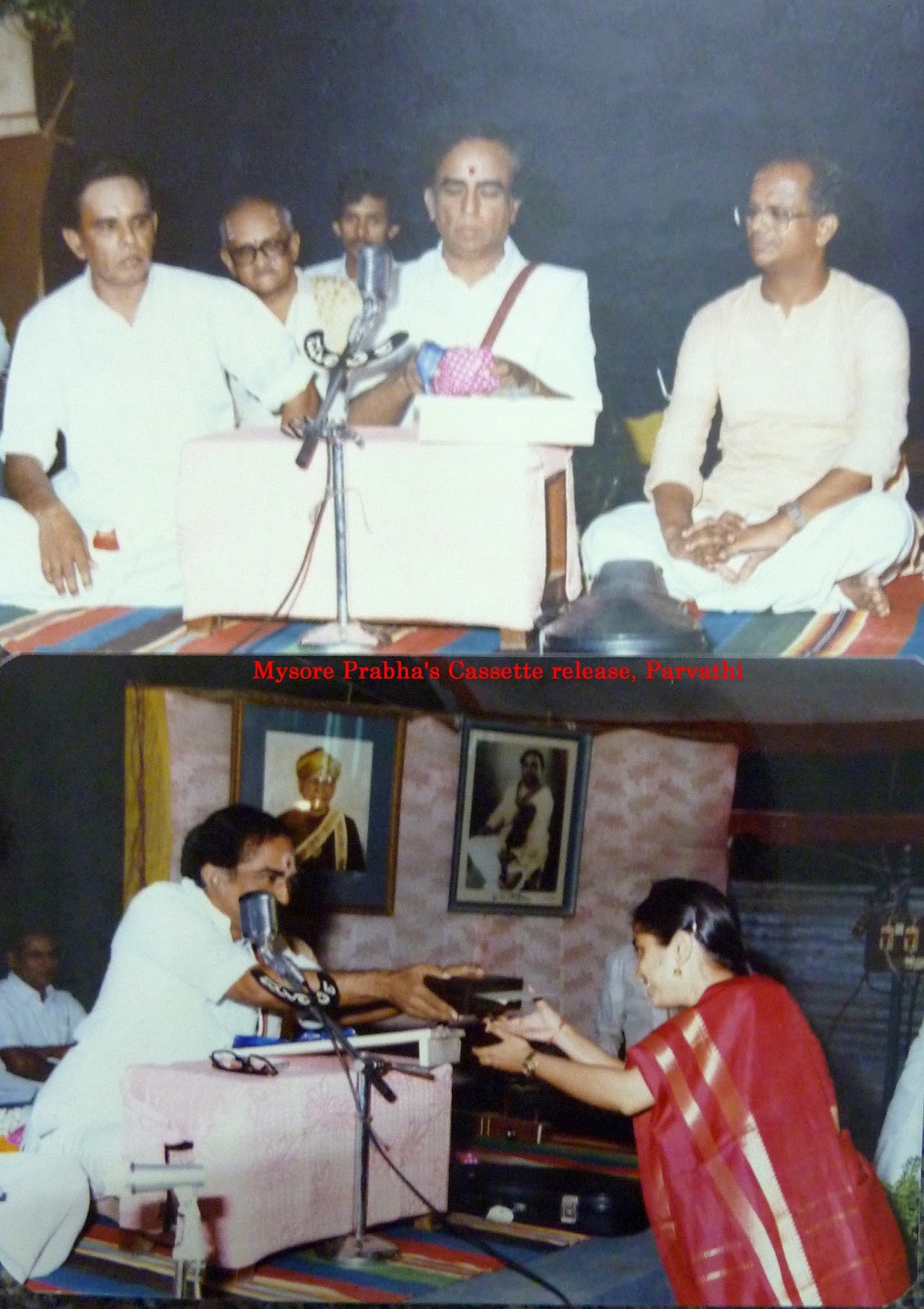
One of my most cherished treasures is the notation and script of his Dhanasari tillana which uncle wrote for me in his own hand-writing, and an autographed book of his compositions.

During every visit he would without fail bring a gift for me - be it a tape-recorder, a box of sweets or a book on music.

Uncle had insisted that I stay in Madras for a few months and that he would fine-tune my singing. I regret that I did not pay heed to his suggestion. "

With a heavy heart, we have to accept the inevitable. The sound of his violin will always echo, but the platform would be empty now !




Tuesday, April 23, 2013

Eternally in our Collective Memories


Vidwan Lalgudi G. Jayaraman

September 17, 1930 - April 22, 2013
[Courtesy The Hindu – Slideshow compilation by T. Arvind]


We join in with the manifold mourners throughout this world, who are in prayer to this great soul’s journey.

He meant so many things to the so many – a dignified friend, a laudable human being, an extraordinarily respected teacher, a par-excellent musician, a brilliant composer, a loving family man and as the countless Rasikas would like to echo within their own minds – a man who could make the instrument ‘sing’.

Through these pages, in our blog, we have shared with you all, all that could be said – while he was living.

We believe our ‘Kartavyam’ (dutiful obligation) now, is to join in with you to keep those memories alive in every way.


Thursday, March 28, 2013

Transmitting the Guru - Shishya Tradition


Sangeetha Kala Acharya P.S. Narayanaswami


(courtesy rsmridangam.com)


Vidwan P.S. Narayanaswami was a welcome guest at Parvathi over many years when he came along with his illustrious guru Sri Semmangudi Srinivasa Iyer. Sri K. Srikantiah remembers him as a very dedicated disciple of his guru. Sri PSN, as he is fondly called by rasikas, used to play on the tambura and give vocal support to Sri Semmangudi. On this occasion, however, we are happy to feature a full-fledged vocal concert of Sri PSN in the company of Sri Lalgudi Jayaraman on the violin and Sri Vellore Ramabhadran on the mridangam. The concert took place during the Ramanavami festival of 1976.

We glean from The Hindu and Carnatica these biographical details:

P. S. Narayanaswami is one of the most prominent among the several famous disciples of Sri Semmangudi Srinivasa Iyer. Sri PSN is hardly known by his full name. He is so popular as a teacher of music in Chennai that most of the young musicians of today would have had a period of training under him. Certainly, this speaks volumes about his capacity and reputation as a great concert teacher.

Born on February 24, 1934, at Konerirajapuram, to Dr. P. N. Subramaniam, a medical practitioner, Sri PSN exhibited his talent in music at a very tender age and his parents put him under Thirupampuram Somasundaram Pillai, a nagaswaram vidwan, for his music lessons. Sri PSN made rapid progress and later came under Sangita kalanidhi Mudikondan Venkatarama Iyer, and then under Semmangudi Srinivasa Iyer. Under the gurukulavasa system, he joined Semmangudi in the early 1950s.

Sri PSN had started giving concerts, both public and through All India Radio, at the age of 15. He has received a number of awards starting from when he was just 12 years old! To name some of them: Bala Gana Ratnam (1946), Sangeeta Sikhamani (1972), Sangeeta Nadakkanal (1991), Sangeetaacharya (1992), Madhura Gana Mamani (1994), Sangeeta Kala Sagaram (1996), Isai Selvam (1997), Innisai Chakravarthy (1999), Gana Kalanidhi (1999), Sangeeta Kala Acharya (2000), Sangeetha Choodamani (2003) and Padma Bhushan (2012). He was also made the Asthana Vidwan of the Kanchi Kamakoti Peetham in 1990.


Vellore Ramabhadran, P.S. Narayanaswami, Lalgudi Jayaraman - 1976


Today Sri PSN is well known as a teacher of many star disciples. He is known to attend his disciples’ concerts regularly and give them much encouragement. He talked to Carnatica some years ago about his methods of teaching and his views. He trains aspiring professionals in around 40 ragas, and makes them work on those for rendering in concerts. He does not encourage his students to follow his own style but leaves it to their intelligence to develop their own style and maintain it. He states that in order to achieve a certain proficiency, each song should be sung at least 100 times!

Coming to this concert, we feature some elaborate renditions in Shankarabharana, Kamavardhini (MD: Kashiramakriya), and Mohana. After a vibrant Viriboni, the not-so-common Neranammithi in Chakravaka receives vigorous treatment. The Shankarabharana main piece- alapana, rendition of Enduku Peddala and the swara exchanges- is the highlight of this concert. It is a delight to feel the camaraderie and mutual appreciation among these three contemporary stalwarts. The tempo of the song as well as the solid vidwat on display gives an insight into Sri PSN’s musical values that eschew vocal callisthenics as well as overworked manodharma. The overall feeling is one of a very satisfying concert experience. The violin and mridangam accompaniments carry the hallmark of genius.


Details (Parvathi Ramanavami festival, 10.4.1976)

P.S. Narayanaswami – Vocal
Lalgudi Jayaraman – Violin
Vellore Ramabhadran – Mridangam

Song List

01. Viriboni – Bhairavi Ata Tala varna – Pachimiriyam Adiappayya *** 02. Neranammithi – Chakravaka – Mysore Vasudevacharya *** 03. Ramanatham Bhajeham – Kamavardhini – Muthuswami Dikshitar *** 04. Paripahi – Mohana – Swathi Thirunal *** 05. Enduku Peddala – Shankarabharana – Thyagaraja *** 06. Ramajogi – Khamach – Bhadrachala Ramadasu*** 07. Shloka – Saveri, Bilahari, Sindhu Bhairavi *** 08. Bhaja Bhaja Manasa – Sindhu Bhairavi – Swathi Thirunal *** 09. Thillana – Darbari Kanada – Lalgudi Jayaraman *** 10. Mangalam ***


Monday, March 25, 2013

Music's Bylanes IV - some Bric-à-Brac before Music


R. K. NARAYAN – A WAY OF PUTTING IT

" Narayan was always known for his terrific wit. But one thing stands in my memory. It was the time when he had lost his only daughter Hema and we had gone to pay condolence at his Chennai home. I was concerned as to how he would have taken her death. But the poignant words he uttered when he saw me, still rings in my ear and is a lesson for many in this world as to how to deal with life."

Narayan simply said, "Hema just jumped the queue," like a true philosopher.


- K. Srikantiah [ Courtesy: Treasure Trove of Katcheris by N Niranjan Nikam – Deccan Herald ]


In some ways, the photograph (below) is momentous – especially in the memory of a young man who was associated with it.


Families: R.K Narayan, R.K. Pattabhi and the Srikantiah’s


It came together during the days when India’s great matinee idol Dev Anand was negotiating the script of ‘The Guide’.

“Ah, you just missed him, he was here just now!” was Narayan’s remark to the young man who beamed wide with a certain hope.

Narayan was never happy with the outcome of the movie version of ‘The Guide’. It didn't fit in with his profile.

He had no use for the tinsel world of a Bombay or ‘Bollywood’, where the essence and spirit of a book’s theme could not be captured without resorting to gimmicks, without a foppery of dance and music and where essential characters were reduced into made-for-movie characterizations and styles. In this movie adaption, they had even gone to the lengths of introducing a tiger for some entertainment value.

He made his feelings known in one of his most sarcastic of jibes, to ‘Life’ magazine in the USA. There was for some time, a tension between Bollywood’s evergreen hero and India’s famous author in English.

The young man of whom we spoke , earlier, had for many a decade held on to an original copy of the publication from Life. But he seemed to have lost it, without even knowing how. It might have come in handy here, for a posting. The immaculate Mr. Srikantiah, too, seemed not to possess it any more. A serious search and query to Life Magazine Publications also went nowhere.

Memories of R.K.Narayan these days, remain at best, wistful.

The memorable times with him, or with a Semmangudi or K.V.Narayanaswamy have to be re-engineered. As always, we are inspired to lean on , Mr. Srikantiah, to take us to the very places where there were hours and hours of a walk, conducted in quietly animated discussions around the grounds of a beautiful Palace nestled at the foot of Chamundi Hills (it now serves as a grand hotel).


The Lalitha Mahal Palace
Courtesy: Commons.wikimwdia.org


R.K. Narayan, in essence, was but a very truthful man (besides any human quirks or stubborn perceptions he may have held onto). He wrote about life exactly as his conditioning's in India afforded themselves.

He wrote as much about the anxious feelings of a cobbler, pushed into his daily predicament with time and money, both of which stood poignantly still for him as he might narrate the insecurities of a ten year old who might suddenly find himself plucked out harshly by his elders from the bowels of blissful sleep, for the sake of a miserable and ‘yukki’ ‘oil bath’ just before the advent of a sun rise.

While Narayan was strong and well honed into craft with the English language, he rarely displayed that servitude so often found amongst educated Indians in quoting people always with a Western sounding name as being the final testimony to a perfect wisdom .

To him, his native India contained enough immortal characters for inspiration. Any remonstrance against human insensitivity that he exhibited, was directed to those that he saw in his daily surroundings, and he drew a characterization of them only through gentle quirks, satirical gaffes or in reviewing them as receptacles of human folly; just the way life in a simple town or village in India, would ebb on.

In view of this, one cannot be held guilty for sometimes gazing quizzically at India’s academics and its writers and journalists in English; especially from a far off land where one sees people rejoicing in their own empowerment. You wonder if a Bana or Kalidasa, the rows of Sangam poets, a Subramanya Bharathi, or aphorisms from ‘Neeti Chintamani’ have no merit? You wonder at the caliber of a present educational system, meant to mold its own future citizens, that would shun anything brilliant that their own forefathers might have afforded them?

To Narayan, his Malgudi or Mysore was a life made up in roots. Without recourse to any pretensions, he stood indeed tall. You might find him in a tie and jacket, but his personal relish lay, even in sophisticated Washington, or in New York, in the making of his own first cup of coffee; in the same manner of his grandmother’s sieving from a homespun cloth, or in the same stain less steel percolator , that connected him instantaneously to a home in Saraswathipuram, Yadavagiri or his magical Malgudi.

He has been long gone, but we salute him quietly in our hearts.

We also, sometimes, go up to the corner cupboard in Mr. Srikantiah’s house, where every book that Mr. Narayan wrote, rests autographed in his memory and made out to one of his truly great friends.


**************************************************


A dear friend and Yoga teacher , living in NJ, USA, Dr. Rajan Narayanswamy , recently sent us this photograph.

He warned us that this may be our last look at another place that we once held so close to our hearts – the Malleswaram ‘ market place’. He warned us that it, too, would be disappearing, soon, and you guessed the reason correctly! – to make way for another high rise.

Eh? Didn’t the modern citizens of Bengaluru want to wear a ‘chip’ on their shoulder - of being known as the new ‘Silicon Valley’?

Well, with the denuding of trees and vast outpourings from gas and concrete, we are getting close, at least to what a Los Angeles stands for - ‘road rages’, smog, pollution, browning and all else.


[We haven’t forgotten the Music - its coming – its just around the corner]


Friday, February 22, 2013

Knowing what we don't know - True Wisdom


VIDWAN CHITTI BABU PARVATHI RAMANAVAMI CONCERT 1975


(Courtesy: chittibabu.org)


R. SACHI NARRATES ....

Recently when I visited Mr. Srikantiah, he was bursting with joy for having discovered a full concert recording of Vid. Chitti Babu from the 1975 Ramanavami festival at Parvathi, Mysore.

Scarcity of magnetic spools, and the vagaries of recording and archiving, had buried this as well as assorted other concerts in tracks here and there. This fortuitous discovery and digitization have helped us to share the full concert this time.

Vid. Chitti Babu was highly popular among Parvathi audiences in 1960's and 1970's. He delivered always memorable concerts, with melody, classicism and delightful light numbers. In this concert too, he delivers to a full house a typical Chitti Babu repertoire, from RTP to light numbers, in the company of the great mridangam Vidwan Palghat Raghu and Ghatam vidwan Manjunath.

There is also some novelty. At Mr. Srikantiah's request, Vid. Chitti Babu takes up the mike and sings a rare padam. He needlessly cautions the audience, 'Mr. Srikantiah, here I go, as you wanted me to sing today. The outcome will be your 'graha-chara!’ What follows of course is a very melodious rendering of a padam composed by Sri. Sarangapani in Jinjhuti.

The concert begins tentatively, as the veena clears its throat with 'Ramabhakti Samrajya'. But the next item is an impassioned rendering of the famous Thyagaraja piece in Dhenuka. The saint laments that no one knows the path of Bhakti. As the wise say, our journey begins only when we discover that we don't know. After all, the Oracle of Delphi called Socrates the wisest man after he had confessed to everyone in Athens that he knew nothing. Bhakti is not really to be mastered as knowledge, but approached with the true humility befitting the seeker who knows that he knows nothing of God's ways and the path to liberation. We give below the translation of the actual lyric:


O śrī rāma! People are not aware (teliya lēru) of the path (mārgamunu) of bhakti.

Roamiṅg (tirugucunu) all over (antaṭa) the Earth (ilanu) (ilanantaṭa), they babble as if in a dream

(kaluvariñcēru); but (kāni), O Lord śrī rāma! they are not aware of the path of bhakti.

Getting up (lēci) early in the morning (vēga), taking bath (nīṭa munigi) (literally takiṅg dip in water), smearing (pūsi) sacred ash (bhūti) on the body, (performiṅg japa by) counting (eñci) fingers (vēḷḷanu)(veḷḷaneñci), and posing (veliki) (literally ostensibly) as praise-worthy (ślāghanīyulai), they became (airē) totally (bāga) (literally very) committed (lōlulu) (literally dedicated) (lōlulairē) to earning (ārjana) money (paikamu) (paikamārjana), but (kāni) O Lord praised (vinuta) by this tyāgarāja! they are not aware of the path of bhakti.
(Courtesy: http://thyagaraja-vaibhavam.blogspot.com )


The concert has a number of popular items like Ninuvina, Nagumomu, Mokshamu Galada, and an English note “Rhapsody”. The main item is the famous Pakkala Nilabadi in Kharaharapriya. The short but impressive Kalyani RTP with ragamalika swaras shows mastery over the veena. All in all a very memorable concert!


DETAILS – Ramanavami Concert, Parvathi, Mysore, April 20, 1975

Vid. Chitti Babu – Veena
Vid. Palghat Raghu – Mridangam
Vid. Manjunath – Ghatam


Song List

01. Rama Bhakti – Shuddha Bangala – Thyagaraja *** 02. Teliyaleru rama – Dhenuka – Thyagaraja *** 03. Ninuvina – Navarasa Kannada –Thyagaraja *** 04. Pakkala Nilabadi – Kharaharapriya – Thyagaraja ***05. Mokshamu Galada – Saramathi – Thyagaraja ***06. Nagumomu – Abheri – Thyagaraja *** 07. Ragama Tanam Pallavi – Kalyani ( Ragamalika swaras) *** 08. Bhaktiko – Jinjhuti Padam – Sarangapani *** 09. Rhapsody – Chitti Babu ***10. Mangalam ***


Sunday, February 10, 2013

Music's Bylanes III - "Thyagaraja Seva Rathnam" - through the lenses of a Thyagaraja Bhagvathar, M.S. Subbulakshmi and others


We find ourselves gathered, as we have done many a time before, in Mr. Srikantiah’s house in Bangalore.

An Illustrious musical icon, perhaps Sangeetha Kalanidhi V. Ramachandran, or Vidushi T.Rukmini , has called from their home, and the host is engaged in a heartwarming discussion of old times with them.

We are left in a reverie.


Honorables: M.S. Subbulakshmi, T. Sadasivam and Radha Vishwanathan


We are reminded, why we of the next generation, are also gathered here.

This is the theater of our nostalgia. We can wax eloquent here, as with Sri R.Sachi ( click ), who can tell us of his boyhood days visiting ‘Parvathi’ or of his wonderful musical experiences with Sri KVN or of his visits to Rukmini Arundale’s Kalakshetra.

This is where our host, who has met them all, can tell us more of an MS and Sadasivam, of a GNB and Semmangudi, a Prof TVS or a Prof. G.N. Chakravarthy, of an MGR/Jayalitha or of any of a slew of Karnataka Politicos, or of an AV Meiyappan or Sundarambal.


Governor Dharma Vira who always remained a steadfast friend of “Parvathi”during his tenure


NIE (National Institute of Engineering, Mysore) Mr. K. Srikantiah welcomes Justice M.C.Chagla India’s Education Minister


This is where you can also find jokes on them or from many of them.

This is also where you can find yourself suddenly threaded into remembering, with a certain poignancy, the life of documentary Filmmaker M.V. Krishnaswamy.


This is "little" Doreswamy Iyengar as shown in a documentary by M.V. Krishnaswamy


The house, in the photo above [ Photo Courtesy: http://bcp.wikidot.com/city-walks:malleswaram ], used to be known as ‘Kusuma Bhavan’. It was the house of the late Mr. M.V. Krishnaswamy, the V Shantharam Lifetime Achievement Award winner in 2010.

It sits directly across Veena Doreswamy Iyengar’s house. These may be the last of the few houses that once graced Malleswaram and Bangalore with great dignity, amidst some of the finest flora. These are slowly beginning to be brought down now with high rises, mass production architecture and synthetic interior decorations that resemble many a fake movie set.

M.V. Krishnaswamy remained close to two of K.Puttu Rao’s sons; one in terms of movie work and the other in terms of pure friendship retained over Maharaja's College days. For an article of heightened sensitivity written on this great documentary maker by one of India’s very sensitive and fine journalist cum author, Sugata Srinivasaraju, please see Outlook Magazine here


Sarod Maestro Pandit Shiva Kumar Sharma, Veena expert SUMA SUDHINDRA and the late K.K. Murthy


As we sit in Mr. Srikantiah’s house we are also reminded of something in our subconscious, of the heritage from where we have come? It has a cocoon like warmth. The warmth is also from another source; the continuous steaming from an Upama, a Masala Dosa or from the delight of the Mysore coffee. You can, without feeling guilty here, ask for several cups of the same, and you will be served with the same loving hands of Smt. Vatsala or a Mysore Prabha, as they might have done for countless years for a Ramani, Lalgudi, Vellore Ramabhadran or a Parur MSG.

The household is also a rare one for our modern times. As we see the family structure being destroyed so unfortunately, in our present day world, and particularly in America (where family life is considered anachronistic giving rise to so many causes of child abuse), the family in India still seems to have retained the ability of being able to survive amidst three generations under a single roof. All of Puttu Rao’s families seem to have maintained this type of ability.

Comfortably, ensconced, with our ears trained towards the conversations, some of us turn our eyes towards the pile of music jackets.


We ask to be reminded of who he is? – time has warped our memories!


Sri Srikantiah opens up :


“This was a great legend who passed away in 1959. He was barely then 50 years into his life. He was considered as the first superstar of the Tamil Cine world and a magnificent singer. When not found singing many of his own rich compositions, he would be found singing the magnificent compositions of a Papanasan Sivan. Recognized also for his very many charitable contributions, he was that rare breed who was also patriotic enough to refuse a British honor.

His life was one of an inner strife and ultimate tragedy in the latter years. Along with other members of his studio and cinema world, he would be drawn into as a suspect, when one of the members in his own group was deemed to have committed homicide. While nothing was proven with Sri Thygaraja Bhagvathar, and he was subsequently acquitted, the entire episode devastated this sensitive soul and he was left behind a sad and lonely figure with practically no money, in spite of all his great earnings and colossal fame.”

Rest in Peace (RIP) Sri Bhagavathar! - You all but gave us so much of yourself.


[ The labels EMI and the Gramophone Company of India and Capitol records on the Thygaraja Bhagvather phone record, also ushered in a rare nostalgia; that of how proud one felt, during those early years to herald one of India’s own countryman who had risen to some dizzying heights in world recognition. Mr. Bhaskar Menon in 1978 was appointed the first chairman and CEO of the newly formed EMI Music Worldwide ]


.......to be continued


Saturday, January 19, 2013

The man who immortalised "Harivarasanam" – K. J. Yesudas


Friends and mutual admirers: Yesudas, Srikantiah, Vishnuvardhan, Bharati


Vidwans (L to R): Guruvayoor Dorai, Yesudas, Mysore Manjunath

During January 2013, the media is full of news about the Kumbh Mela, a conclave where several million people are going to visit the holy confluence of Ganga, Yamuna and Saraswati rivers at Allahabad for a dip during this auspicious period and to get blessings of holy men, as ordained in the Puranas. Both BBC and the Harvard School have taken interest in documenting this great human congregation. Perhaps no less in magnitude and complexity is the human phenomenon of the Sabarimala annual pilgrimage, which just ended this month.

We reproduce information from several sources:

The shrine of Sabarimala is one of the most remote shrines in southern India and yet it draws three to four million pilgrims each year. Surrounded by mountains and dense forests, Sabarimala is believed to be the place where Lord Ayyappan meditated. The pilgrimage begins in the month of November and ends in January. Certain customs are to be strictly observed if one has to undertake a pilgrimage to Sabarimala. A pilgrim attending the Mandalapooja should observe austerities for 41 days.


Harivarasanam is a devotional song composed in the astakam metre, recited at Sabarimala before closing the temple door every night. The song was written by Kambangudi Kulathur Srinivasa Iyer and was recited the first time by Swami Vimochanananda at the temple. Though there have been many versions of this song sung by many renowned vocalists, the Sabarimala temple plays the rendition by K. J. Yesudas of a musical version composed by the renowned music director G. Devarajan every evening after the final pooja.

The story goes that VR Gopala Menon, from Alapuzha used to accompany Thirumeni Eashwaran Namboothiri, the Melshanthi (head priest), to Sannidhanam every time, and would stay there by himself even when the temple was closed, remaining undisturbed by the wild animals. Later, when the Devaswom Board was formed, it is believed that he was asked to move out. He eventually died at a tea estate at Vandiperiyar.

Gopala Menon used to recite Harivarasanam with devotion during his time at Sannidhanam, and the news of his passing away deeply saddened Thirumeni Eashwaran Namboothiri. Once, at the end of the day's rituals, the Namboothiri was about to close the doors of the Sannidhanam when he remembered the dedication and sacrifice of Gopala Menon and he then began to recite Harivarasanam starting a nostalgic tradition that remains unbroken till date. Today, as the final verses are being sung, all the assistant Santhis (priests) leave the Sreekovil one by one. As the song ends, only the Melsanthi is inside. He extinguishes the lamps one at a time and closes the doors for the night.

It is interesting that this song Harivarasanam challenges the usual stereotypes in Carnatic music. It is associated with a lesser known Hindu deity, Hari-Hara putra Ayyappan. His temple is in a remote forest in Kerala. Harivarasanam has been set to tune by G. Devarajan, who was a self-confessed Communist/agnostic. It has been sung by K. J. Yesudas, who is not from the typical Tamil Brahminical mould. And yet it has moved millions for a long time, and is broadcast in the Sabarimala temple every day in Yesudas’s voice.

Thus, Vid. K. J. Yesudas, one of the most gifted, recognised and honoured musical voices in Indian cinema, should also be recognised as the voice that immortalised Harivarasanam .

Mr. K. Srikantiah’s close friend for many years, Sri Yesudas has come and performed in Parvathi on more than 20 occasions, to large crowds of eager fans. In the 2007 concert we feature here, his energy and enthusiasm is undiminished at 67 years. He sings a large number of his hugely popular numbers, both classical pieces and film songs. In fact, the Kannada matinee idol Mr. Vishnuvardhan (featured in the photo with Mr. Srikantiah, Mr. Yesudas and Mrs. Bharati Vishnuvardhan, another famous film star) sat through this concert, and enjoyed the song “Ellellu Sangeethave” from his hit movie Malaya Marutha, sung by Sri Yesudas!

Sri Yesudas turns nostalgic in the middle of the concert and narrates how his father (his first guru) was a famous theatre artiste and sang at an impossibly high pitch and with unbelievable felicity in the higher octave in the days when there were no mikes. He explains how being totally surrendered to the guru and learning from the masters in person as well as continual, rigorous practice are crucial to one’s progress as a musician. He cautions youngsters that they should never imagine that there is a short cut to success by merely learning music from tape recordings. He says his success is entirely due to his father’s and gurus’ blessings and encouragement.

We get also an insight into the spiritual appeal of Sri Yesudas’s music when he explains how he feels the godhead in every phrase of his music and how God pervades all beliefs and faiths equally.

We are happy to share such a lovely concert with excellent recording quality during the Sabarimala season.
[ Text due to R. Sachi ( click ) ]


CONCERT DETAILS: Ramanavami festival, 29 March 2007

K.J. Yesudas – Vocal
Mysore Manjunath – Violin
Guruvayoor Dorai – Mridangam
GS Ramanujam – Ghatam

Song List

01. Sarasija Nabha – Varnam _ Nata – Palghat Parameshwara Bhagavatar *** 02. Adiyali Gajamukhana Archisu – Hamsadhwani – Purandara Dasa *** 03. Guruvina Gulama – Hamsanandi – Purandara Dasa*** 04. Ela Nee Dayarada – Athana – Thyagaraja *** 05. Rama Sadguna – Todi- Jagannathadasa*** 06. Ragasudharasa – Andolika – Thyagaraja *** 07. Enduku Peddala – Shankarabharana – Thyagaraja *** (followed by Tani) *** 08. Brochevarevarura – Khamaj – Mysore Vasudevachar ***09. Dasadasara maneyadasa- Hindola – Kanakadasa *** 10. Thiruparkadalil Pallikondaye – Bhairavi – G. Devarajan ***11. Ellellu Sangeethave – Saramathi – Vijayabhaskar *** 12. Krishna Diwani Meera – Bhajan – Ravindra Jain *** 13. Enu Vara Bedali Nanu *** 14. Oru Neram - Dwijavanti *** 15. Speech *** 16. Swami sangeethadindolise – Abheri *** 17. Harivarasanam – Madhyamavati - Kambangudi Kulathur Srinivasa Iyer+G. Devarajan *** 18. Mangaladarshanadayike Mookambike ***19. Agre Pashyami, Yogindranam – Narayaneeyam *** 20. Mangalam ***

Please scroll down and up using side vertical slider: