/* START Google Analytics Code*/ /* END of Google Analytics Code */ A home called "Parvathi"

Friday, April 27, 2012

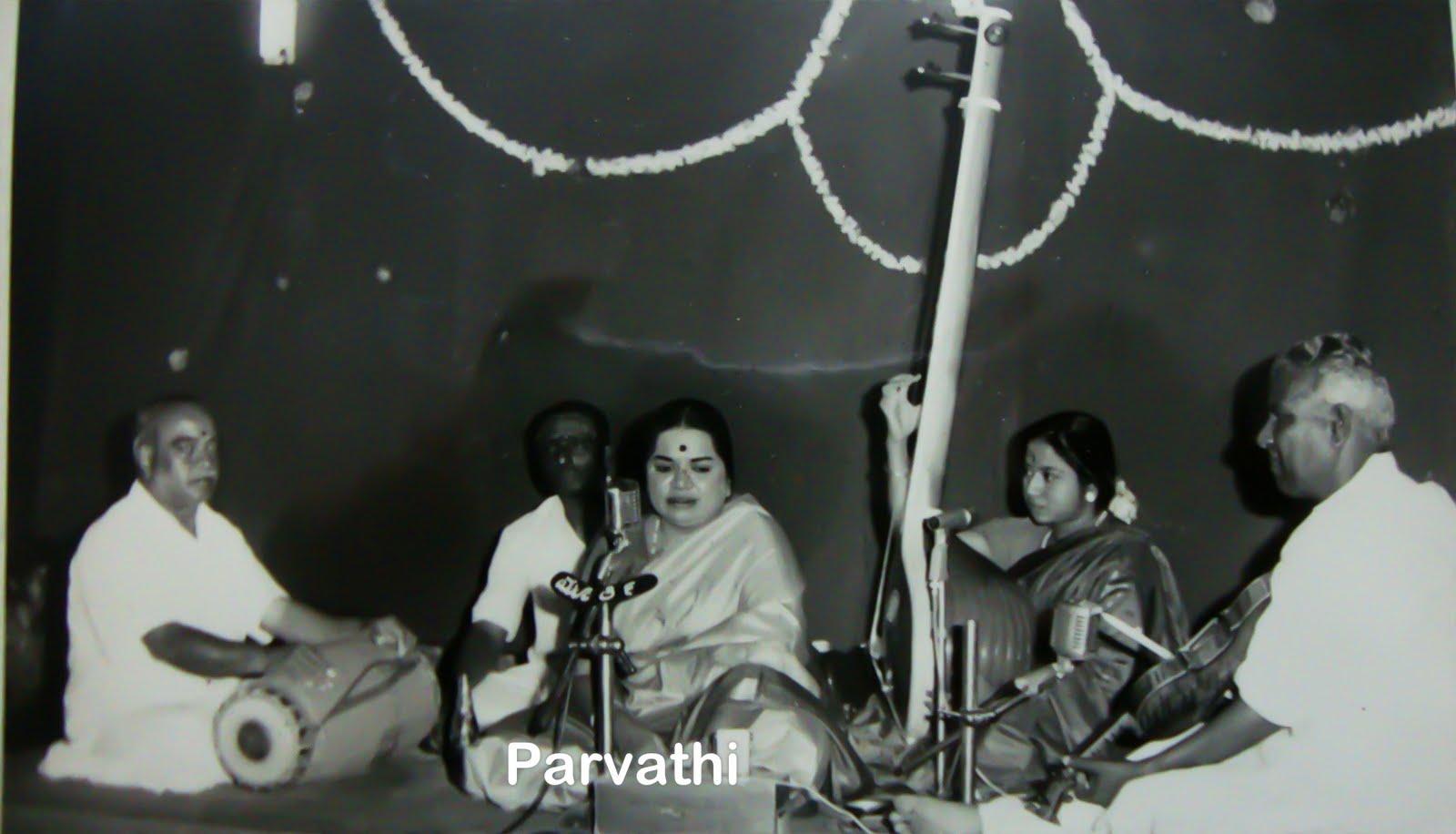
Reliving Beautiful Moments with Vidushis Radha Jayalakshmi, 1962


In an earlier posting we spoke of the visit of the Vidushis Radha & Jayalakshmi to "Parvathi" in 1962. But, we were not ready then with the concert from that performance ( you can guess why? ).

Instead, we posted another one of their performances from "Parvathi", the April 9, 1971 concert with Vidwans Kandadevi Alagirisamy (Violin) and Vidwan Mannargudi Easwaran (Mridangam). This was along with Sri. T. Chowdiah's 1962 speech, highlighting only a few of his words.

Smt. Radha and Smt. Jayalakshmi ( connected both by blood as cousins, and in music through their sheer artistry ) have left many a beautiful memory in "Parvathi".

If connoisseurs of wine are permitted a gush over the quality of a product depending on how old it is, then how much more meaningful would it be for us to be revering these great artists of the past, on music meant, only as 'ambrosia' for the Gods?


To retain the historical perspective to this blog, we are providing you with some sentimental echoes from Sri. K. Srikantiah:

"... Radha-Jayalakshmi have given about 10-12 concerts at Parvati during Ganesh festivals and Ramanavami Festivals.

They have had a close association with 'Parvati' for nearly 3 decades.

During 60s and 70s R-J were a much sought after performing duo. They were always crowd pullers, and invariably their concert used to be a grand success.

Their planning of a 3-hr concert was always excellent. R-J had created aunique niche for themselves in the Carnatic Music World with their inimitable, precise, clear rendition of kritis,comprehensive Raga presentation, creative Swaras, and Devotional Devaranamas with great mass appeal.

R-J were disciples of Sri Balu, who was a favourite disciple of G.N.Balasubrahmanyam. Sri Balu was himself gaining prominence which was unfortunately stopped by his untimely death.

One can discern the GNB baani in all concerts of R-J...."


As before, we also draw upon our own team member in music Sri. R.Sachi to write once again on this vintage 1962 Concert by the duo ( to see his own beautiful blog - please click here )

" We bring you this time excerpts from a Parvathi house concert held in 1962, on the occasion of Gouri Ganesha Festival.

Radha Jayalakshmi were a singing duo famous in the forties to the seventies. Jayalakshmi was a noted cine playback singer as well. They made a place for themselves at the top, alongside MSS, DKP and MLV. Inheriting a brisk and melodious singing style from their guru Sri GNB, they came several times to perform to full houses in Parvathi house concerts and later during Ramanavami festivals.


Held 50 years ago, the featured concert was organized by Mr. K. Srikantiah, then a young man, inheriting the mantle from his late father Sri. K. Puttu Rao (1894-1959). The audience consisted of many cognoscenti, all of whom had known Sri Puttu Rao closely.


An enthusiastic member was Sangeetha Ratna Sri T. Chowdiah. You can, as you listen to the excerpts, hear his ooh’s and aah’s. He was gracious enough to say a few words in the end, which we translate below: "


"So many distinguished people are gathered here, so who am I to speak?


If you want me to speak about today’s music, I request that someone else should cover the other aspects also.


Well, I will speak about two things today: about the great family legacy of Sri Puttu Rao and also about today’s concert.


In this age, it is very rare to find examples where the children preserve the family heritage, rare to see that the children follow in the great footsteps of their distinguished father. In this regard, Sri Puttu Rao should be considered indeed very fortunate.


Sri Puttu Rao was a noble soul and engaged in many activities. He did not simply confine himself to the goings-on of his legal profession and court proceedings. He was a very religious, culturally enlightened, and distinguished, pillar of society. He was himself a very learned man in matters of music and could sing well.


We see fortunately that his sons are fulfilling every dimension of his legacy: to follow the spiritual pursuits of Sri Puttu Rao, one son has taken the vows (in the Sringeri Sankara Math).


To continue further Sri Puttu Rao’s deep interest and patronage of classical music and fine arts, another son (K. Srikantiah) has taken up several activities. And finally, to further the family’s real-world interests and continue the ritualistic traditions, we have the first son joined by the remaining sons. What a rare and splendid example of children following in their venerable father’s footsteps indeed! It seems Sri Puttu Rao has made sure his sons will uphold the family tradition of excellence in each field. I pray to God Almighty to give them long life and success in their endeavours.


Coming to today’s concert, what can I say? I was totally carried away by the music and thoroughly enjoyed the wonderful fare. Each raga, every song, sruthi, laya -every aspect was excellent. Even the accompaniments were of a high order and very mature. We know how sometimes accompanists work at cross purposes- then the music suffers.


The whole experience was like enjoying a sweet delicacy cooked with splendid ingredients- all milk, sugar, kesari, badami, pacchakarpura…it was like that.


I am particularly fond of these youngsters Radha and Jayalakshmi. I have known them from the days of their tender youth. They are the shishyaas of my close friend Sri G.N. Balasubramaniam. I have said before… they are to me “GNB in sarees”. They truly embody the excellence of their master. Just as we extol a daughter for being as good as her mother, the disciple should emulate the guru sincerely and be a worthy successor.


Nada is paramount. One should dissolve oneself in the sruthi and live the music. This is after all a spiritual endeavour. The language and words are secondary. Today’s Shuddha Saveri was very good, high-class. Same with Thodi and Kalyani. With such music, the words seem less important.


I also earn my living as a mere musician, otherwise I would have done 'kanakabhisheka' to these artistes for any of those ragas.


The mridangam was resonant like a ghatam.. a well tuned ghatam-it merged with Panchama well.


I have known the family very well....Sri Puttu Rao was very religious and noble, a most generous man. His good deeds have borne fruit… therefore we are having excellent concerts like this one being held in his house. Mr. Srikantiah is a very worthy son of his father. I believe Sri Puttu Rao is feeling very happy today in heaven above.


Rarely are brothers this friendly and harmonious in nature. Not only those, their wives are also very affectionate towards one another. The strong root of this family is their worthy mother whom they all revere so much. The mother ( Smt. Parvathamma) was always engaged in prayer and worship.


To the family, the musicians and all the lucky ones gathered here…. May Lord Ganapathi bless all of you and shower prosperity."


Concert Details


Radha-Jayalakshmi ---- Vocal

R.S Gopalakrishnan ---- Violin

Krishnamani ----------- Mridangam

on Sept 4, 1962 at Parvathi during Gowri-Ganesh Festival.


Excerpts List

01.Pallavi “Sada Sriramam bhaja re Manasa” Kalyani, Bouli, Saraswati, Kuntalavarali*** 02. Tarakka Bindige – Tilang – Purandara Dasa *** 03. Agre Pashyami Narayaneeyam – Bilahari, Saveri, Natabhairavi, Madhyamavati*** 04. Smara Varam Varam – Sindhu Bhairavi -Sadashiva Brahmendra *** 05. Sri T. Chowdiah’s speech *** 06. Mangalam ***


Monday, March 19, 2012

Remembering God without a List of Demands confers True Joy – Dr. N. Ramani


We are privileged to feature another splendid flute recital from the Parvathi Ramanavami series, this time of Dr. N. Ramani from 1975. He is accompanied by stalwarts and the concert sparkles with great music.


After the preliminaries of Nata (Mahaganapathim) and Chakravaka (Neranammithi), Vidwan Ramani presents a delightful Bilahari.

In the ‘60s, Prof. P. Sambamurthy, the musicologist, visited Mysore and gave extremely interesting lectures about Carnatic music. He demonstrated how a flute could be constructed so it would be easier to play. Of course we are not suggesting that anyone can produce good Carnatic music by merely being able to blow into a flute! Prof. Sambamurthy then also spoke of the impact beyond cultural borders of melodies we develop via our ragas. He stated that the raga Bilahari instantly evokes joy wherever it is heard, even by someone totally new to Carnatic music. We remember his words as we listen to the Bilahari presented here. It is a timeless favourite at Parvathi.

The song that follows is a lovely composition of Maharaja Swathi Thirunal. He describes the charms and glories of Krishna, and the devotee is urged to remember God, not in the context of his own miseries, but for the devotee to delight in the glories of the Almighty: “Smara sadā mānasa bālagōpālam”. This chronicler once asked Vidwan KVN what he liked about Swathi compositions. The maestro stated that the Maharaja always spoke the language of the aesthete, a devotee who did not think of God from a perspective of misery. This song is a good illustration of that.

And that brings us to the violinist from Kerala, Vidwan Chalakudy N. S. Narayanaswamy (1925-2003). He has accompanied many stalwarts at Parvathi. A disciple of Semmangudi Srinivasa Iyer, Sri Narayanaswamy was a Professor of Music at Shri Swathi Thirunal College of Music , and Staff Artiste of the AIR at Tiruvanantapuram from 1946 to 1956. Later, he was the Principal of the Sri Swathi Thirunal College of Music at Tiruvanantapuram for a number of years.

After Bilahari, we are treated to a wonderful alapana of Amrithavarshini. Vidwan Ramani evokes a wide spectrum of moods with his manodharma and virtuosity on the flute. Later we have a grand Kambhoji prelude to ‘’O Rangashaayi.’’

Once again, the Parvathi favourite Vidwan Vellore Ramabhadran adorns this recital with his wonderful mridangam.

And there is a bonus: a scintillating Thani!


REMEMBRANCES OF VIDWAN H. P. RAMACHAR (KANJIRA)

The upa-pakkavadyam prominent in so many Parvathi concerts is the khanjira wielded by Vidwan H. P. Ramachar. Over many decades, he endeared himself to artistes and audiences with his enthusiastic presence. We quote below excerpts from the Kutcheribuzz obituary in 2006:

Having chosen music as life at the early age of seven, he had the fortune of accompanying the doyens of music as well as the young stars. He was a staff artiste of AIR, Bangalore. Performances in India and abroad brought him fame with his innovative approach, imagination and undying enthusiasm that remained unaffected by age. He had also participated in percussion ensembles alongside the likes of Zakir Hussain and Vellore Ramabhadran. Ramachar also directed a unique percussion ensemble of women percussionists called – ‘Mahila Laya Madhuri’.

He was a recipient of a number of awards and honours, some of which are: Rajyotsava award of Government of Karnataka, ‘Laya Kala Nipuna’ and ‘K Puttu Rao Memorial Palghat Mani Award’ of Percussive Arts Centre, ‘Sangeetha Kalaratna’ of Bangalore Gayana Samaja.


Homage by Prof. T. N. Krishnan:

" I am extremely sad to know about the sudden demise of my good friend and colleague H P Ramachar the well known, versatile Kanjeera Maestro. It is still fresh in my memory. the many concerts we had played together with the Stalwarts like Ariyakudi, Chembai, Maharajapuram, Semmangudi, GNB, Madurai Mani Iyer. Alathur Bros, Mali and others. Mr Ramachar was a very nice person and sincere friend. His contribution to the growth of music in general and percussive arts in particular is quite phenomenal.

My association with him on and off the concert platform dates back to more than six decades. His passing away is a great loss not only to the music world, but personally also. I am sure his tradition will be looked after and kept alive by his talented daughter Smt Latha. My sincere condolences to all the family members."


Concert details

Ramanavami concert held at Parvathi on 22 April 1975.
N. Ramani – Flute
Chalakudy Narayanaswamy – Violin
Vellore Ramabhadran – Mridangam
H. P. Ramachar – Khanjira

Song List
01. Mahaganapathim – Nata – Muthuswami Dikshithar*** 02. Neranammithi – Chakravaka- Mysore Vasudevachar*** 03. Smara Sada Manasa – Bilahari – Swathi Thirunal *** 04. Anandamrithakarshini – Amrithavarshini – Muthuswami Dikshithar *** 05. Nenarunchinanu – Malavi – Thyagaraja *** 06. O Rangashayi – Kambhoji – Thyagaraja *** Thani*** 07. TBA – Revathi – TBA*** 08. Sharavana bhava – Shanmukhapriya – Papanasam Sivan *** 09. Hey Govinda – Desh – Meera*** + Sadho - Ahir Bhairav - Surdas *** 10. Kavadi Chindu *** 11. Mangalam ***


Tuesday, March 6, 2012

In Memoriam – "A Simply Great Musician": Vidwan Vellore Ramabhadran


[ August 4, 1929 - Feb 27, 2012 ]

A Tribute by Sri K. Srikantiah ( as narrated to Sachi R )

“He came and performed in our house more than 100 times! For over sixty years, starting in early fifties when we were both around 24 years of age."

“He felt so much at home in Parvathi; he would come from Madras and call out for the help just as he alighted at the gate “Maadaa…” "

“He would say, “Vatsala amma, please,... I am so hungry, I will have your "thatte idli right away,"... " I will bathe later…”

“Ramabhadran started performing in Ganesha festival, and in house concerts, well before we started the Chowdiah Memorial Ramanavami concerts on a large scale in the outdoor pandal in 1970. Ramabhadran was not a reserved and reticent man like some other senior Mridanga Vidwans. He was a friendly and jovial conversationalist. He would add a quiet sparkle to the concert, and the musicians loved him as the concert would be smooth-sailing. He and Lalgudi Jayaraman were thick friends and used to perform a couple of concerts in every festival. We have several recordings of glorious concerts with Vellore Ramabhadran on the mridangam...”

Mr. Srikantiah is deeply saddened to hear of the passing away of this fine musician. He calls his style of playing “simply great”.


Sri Ramabhadran was present in Parvathi on two important occasions in 1986: at the function to release the 'Haridaasa Vaani' cassette of Mr. Srikantiah’s daughter Mysore Prabha by Vidwan Lalgudi Jayaraman. Soon afterwards, also at the wedding of Mysore Prabha, both these Vidwans graced the occasion. We feature two snapshots of Vidwan Ramabhadran from the video recordings of those occasions.

Soon afterwards, in 1986, there was a grand function (mentioned earlier in blog) to honour Vidwan Lalgudi Jayaraman at Krishna Gana Sabha, Madras, where Mr. Srikantiah was requested to felicitate Lalgudi. On that occasion, Sri Ramabhadran and family received, at their residence in Mylapore, Mr Srikantiah’s family including the newly wedded couple with 'aarathi' and their warm hospitality.

While paying our respects to this great vidwan and offering our prayers for the departed soul, we are happy we can share here excerpts from some great concerts featuring Vidwan Vellore Ramabhadran on the mridangam with leading musicians at Parvathi.

SELECT RENDERINGS

01. Pranamamyaham – Gowla – Mysore Vasudevachar
(V. Ramachandran-M. Chandrasekharan)***

02. Naa Jeevaadhaara – Bilahari – Thyagaraja
(Maharajapuram Santhanam- Lalgudi Jayaraman)***

03. Janani Ninnuvina- Reetigowla – Subbaraya Shastri
(M.D. Ramanathan, M. Chandrasekharan)***

04. Kamakshi Swarajathi – Bhairavi – Shyama Shastri
(Semmangudi Srinivasa Iyer, Lalgudi Jayaraman)***

05. Krishna Nee Begane – Yamuna Kalyani – Vysaraya
(N. Ramani, M. Chandrasekharan)***

06. Govindam iha – Bageshri – Narayana Tirtha
(Chittibabu)

[The full concerts and details thereof are accessible through the index in the blog.]


Thursday, January 26, 2012

The course of Kalyani, all beneficences of life - Madurai Somu waxing eloquent


In our humdrum lives, it is easy to pass by the true beneficences of life, busy as we are “getting and spending”, as Wordsworth said.

Therefore do we need to thank every moment our heritage, upbringing, and childhood experiences that foster a love for classical music. Our music combines so many life-affirmative resonances that nobody can ever feel totally down and out if he or she can even faintly recall the joy of music. Carnatic music insightfully combines all musical values - melody, rhythm and lyric - into a worship of life. And one of the high points of Carnatic music is Kalyani. Kalyani means not only the popular raga but also benediction, the Cosmic Mother, a cool pool of holy water we can immerse ourselves in… so many connotations. And the raga Kalyani celebrates life like none other. Hence every composition in Kalyani is such an enriching experience.

Madurai Somu, the eternal favourite of Parvathi rasikas, begins this concert with Kalyani. MSG follows his raga contours closely, and we have a solid foundation for the song that follows, śivē pāhi mām , of Thyagaraja. The saint refers to Kaveri, the nectarine river that courses through every Carnatic music lover’s veins...

Thyagaraja addresses the mother goddess as kAvErijOttara vAsini kAtyAyini dharma samvardhini , meaning, “ You are Katyayini, known as Dharma Samvardhani residing on the north side of Kaveri river”. This composition is one of his Thiruvaiyaru khestra compositions.

The neraval and swaras are executed very melodiously, with some great accompaniment by MSG and the redoubtable Raghu. Raghu intones the words so well on the mridangam, modulating each stroke to match the melody.

What strikes you is the fine fettle of Somu’s voice, matched by the sweetness of MSG’s violin, as well as Raghu’s measured percussion. An elaborate Bhairavi has a fullness to it. Somu lends a tangy flavour to the nishada, and MSG replicates it. Raghu takes off in the neraval and swara like only he can. The result is a virile treatment of Bhairavi lasting over 40 minutes. The audio quality of this home recording done 41 years ago is outstanding.


Madurai Somu is all praise for MSG as the honeyed flow of Abheri from his violin simply heightens the mood of this ever popular raga. We just got the happy news of MSG’s being honoured as Padma Bhushan in today’s Republic Day honours. A richly deserved recognition by a grateful nation of this outstanding violinist.

The Shanmukhapriya RTP is a feisty improvisation. Even here, Raghu revels in the rhythmical segments like a homing bird.

Among the following items, the impromptu shloka in Jijhooti and other ragas is highly memorable.


THE CONCERT
1971 Gowri-Ganesha Festival in "Parvathi"

Madurai Somasundaram – Vocal
Parur M.S. Gopalakrishnan ---- Violin
Palghat Raghu ------- Mridangam

01. Sive Pahimam – Kalyani –Thyagaraja *** 02. Manavi aalakincha- Nalinakanthi -Thygaraja *** 03. Shri Rajarajeshwari – Bhairavi –TBA*** 04. Shankaraparane – ragamalika –TBA *** 05. Nagumomu – Abheri – Thyagaraja *** 06. Shanmukhapriya RTP *** 07. Unnai Bharata – Hindolam – TBA *** 08. Azhagiya mayil – Basant Bahar – TBA *** 09. Bhaja mana bhajare – Bhimplas – TBA *** 10. Swarna Gowri Srimahaganapathe – Shloka – Jinjhooti, Punnagavarali, Sindhubhairavi, Natakurinji, Kambhoji, Saveri Kalyani Bhairavi Kamach Kanada Kedaragowla *** 11. Nadabindukala – Jinjhooti – Arunagirinathar *** 12. Bhajore Bhayya – Desh, Mand – Kabir *** 13. Mangalam ***


Thursday, January 5, 2012

Welcoming the Year with the “Madhura” Vani of Mani Iyer School

We are happy to bring you a recording of the concert by Vidwan T.V. Sankaranarayanan held in the Puttu Rao Memorial series in the Jagan Mohan Palace, Mysore recently. The vidwan is a great favourite of Parvathi rasikas, with his effervescent style and the bani of the great Madurai Mani Iyer. The world celebrates Madurai Mani Iyer’s centenary throughout 2012. As this blog is also a tribute to the great rasika Sri Puttu Rao and his legacy at Parvathi, we think it is fitting that we begin the new year by giving a great concert fare from Vidwan TVS just on the eve of Sankranthi. We would like to quote some fine words about Vidwan Mani Iyer from the Hindu:
2002 Birth Anniversary (http://www.hindu.com/thehindu/fr/2002/10/25/stories/2002102501340900.htm)
" A vidwan with a unique style, Madurai Mani had indeed cast a spell on the listeners of Carnatic music, young and old, connoisseurs and even the rickshawallahs of those times. People came in hordes to listen to his singing. They sat on the walls, on the floors and wherever they could find a place to sit or stand. They did not mind the inconvenience. They only wanted to listen to Madura Mani as he was fondly called. Madurai Mani was certainly Madura (sweet) Mani. His music was melodious. More than anything else, he enjoyed singing and that reflected in his personality both on and off stage. In fact he often eschewed lyrics that smacked of disillusionment with the world and other worldly matters. He firmly believed that music should enliven the listener. That was his conviction right from the start of his professional career as a musician, a joyous journey that began in 1924 at a temple Kumbhabishekam in the district of Ramanathapuram. He was 12 years old then. "
2011 Margazhi Season (http://www.thehindu.com/todays-paper/tp-national/tp-tamilnadu/article2754050.ece)
From the pen of Vidwan Ravikiran:
" The torch-bearer of the Madurai Mani Iyer bani, T.V. Sankaranarayanan reminisces about his uncle's incredible repertoire, memory and musicianship. “Mama taught me numerous songs that one would have rarely heard him sing at concerts — Idisamayamura (Chayanata), Sanatana (Phalamanjari), Evarunnaru (Malavashri), Paramatmudu (Vagadheeshwari), Samukhana nilva (Kokilavarali), Namoralagimpa (Devagandhari), Etavuna nerchitivo (Yadukulakambhodhi), Nadachi nadachi (Kharaharapriya), Ninnuvinaga (Poorvikalyani), Durusuga (Saveri)... I can go on and on,” he says. “What is incredible is that he would not have revised these songs in 20 years but would access them from memory at will.” This was augmented by the celebrated mridangam vidwan T.K. Murthy. “At a concert in Delhi, Mani Iyer sang outstandingly but a critic, known for his inconsistent and perverse reporting, had a dig at him the following day for singing his usual fare. Mani Iyer just smiled but in another concert the same day, his list consisted of pieces that even I — who had accompanied him for several years — had never heard him sing. The critic, who also made it to the concert, apologized profusely!” TVS adds: “His voice had just the right balance between delicateness and weight and his sense of gamakas was impeccable. And the way he could hold any note almost endlessly was mesmeric! It would create an all-permeating tranquility that had to be experienced to be believed.” Anyone who has spoken to me about this distinguished musician has been unanimous in accrediting him as a human being of impeccable qualities. He was gentle, courteous, well-meaning, helpful to younger artistes, loving towards his disciples, committed to the art, and devoid of negativism even in jest. In short, as pitch-perfect in life as in music... "
THE CONCERT Performed on Sept 4, 2011 T.V Shankaranarayanan ----- Vocal Mahadevan (son of TVS) ---- Vocal support M.S. Govindaswamy -------- Violin C.Cheluvaraju --------------- Mridangam M.A.Krishnamurthy ------- Ghatam 01 Maha Ganapate Namo- Hamsadwani- Indira Natesan*** 02 Orajupuju- Kannada Gaula – Thyagaraja *** 03 Appa Rama Bhakti- Pantuvarali- Thyagaraja *** 04 Ee Pariya Sobagava- Ragamalike – Purandaradasa *** 05 ManasuNilpaShakti- Abhogi – Thyagaraja *** 06 Smara Janaka Shubha Charita – Behag – Swathi Thirunal *** 07 Marakathavallim – Kambhoji – Muthuswami Dikshitar *** 08 Virtuttam – Bageshree, Tilang *** Rama Rama Rama Enniro-Tilang *** 09 EnglishNote- Shankaraabharana – Muthiah Bhagavathar *** 10 EppoVaruvaro- Jonpuri – Gopalakrishna Bharathi*** 11. Mangalam ***

Friday, November 18, 2011

Gamanashrama sung by Ganavisharade Dr. M. L. Vasanthakumari


To our community of listeners, we bring again another stellar concert from the redoubtable Dr. MLV. A musician hailing from the classical mould, she combined outstanding creativity with excellent voice control. The result was quite often deeply memorable raga elaborations, rare krithis mined from the repository of compositions going beyond the trinity, and a brisk technique of delivery that gripped the audience from the word go. It is no exaggeration that today, as we listen to fast paced "modernist" Carnatic music, we often recall the GNB bani and the unique place held in our hearts by Dr. MLV.

In this concert, we are treated to elaborate renderings of Madhyamavati and Kharaharapriya. The recording quality is not good in quite a few places. But there is a persuasive argument why we share this concert - there is a brilliant, yes brilliant, rendering of Gamanashrama in the Ragam, Tanam and Pallavi. Dr. MLV is quite at home giving us the rich fare of a rare raga more remembered as the 53rd Melakarta whose Janyas are Purvi Kalyani and Hamsanandi. There are very few compositions in this raga which was called Gamakakriya by the Dikshitar school. There are also only a handful of recordings of RTP in this raga in Carnatic music archives. We could translate literally Gamanashrama to 'tough going'!

The concert has many fine Bhajans, Dasa compositions and ragamalikas. Overall a rich experience that one associated with Dr. MLV in Parvathi concerts.


PARVATHI CONCERT
April 1, 1972

Dr. M.L. Vasanthakumari --- Vocal
Smt T.M. Prabhavathi --- Pinpattu
Sri Tiruvallur Subrahmanyam --- Violin
Sri Tanjavur Krishnamurthy Rao --- Mridangam
Sri H.P.Ramachar --- Khanjira.

01_Varnam- Shuddha Todi- Kothavasal Venkatarama Iyer 4:37
02_Srimahaganapathe_Abhogi - N.S. Ramachandran 4:22
03_Swaminatha_Natai_ Muthuswami Dikshitar 7:44
04_Nadupai_Madhyamavathi_ Thyagaraja 19:12
05_Kalayami Raghuramam_Begada_Swathi Thirunal 20:03
06_Mariyadagadayya_Bhairavam_Thyagaraja 5:55
07_Ramaneesamana_Kharaharapriya_Thyagaraja 29:25
10 Gamanashrama RTP ( Kanada Hindola) 43:08
11_Yadavaraya_Ragamalika_Kanakadasa 5:31
12_Yakenirdaya_Ragamalika-Purandaradasa 5:47
13_Abhang_Devaranama 8:11
14_Payoji Maine Ramratan_Mishra Pahadi_Meera Bai 4:35
15_Ragamalika Shloka Mamava Pattabhirama_Manirangu_Dikshitar9:33
16_Barokrishnayya_Ragamalika_Kanakadasa 4:55
17_Mangalam 0:39


IF AUDIO DOESN'T PLAY CLICK HERE.


Monday, November 14, 2011

The Lord Sri Raama as Kubera


As we waited on our very learned friend in music R.Sachi to extol the virtues of the next concert from "Parvathi", we found ourselves engrossed in a few serious issues concerning our own would be 'Identities'; and they came simultaneously from three very different sources.

The first, on the seriousness of 'Identity' was brought home by a very powerful representative of the Hindu community here in the USA, who has made this his home over several decades. He is a man who has been given to some tremendous world wide charities, who is a very distinguished scholar in his own right, and who takes away ones breath in a most dynamic manner when he is on the podium relating to this very intriguing subject. In two very rapid successions this year, he has penned two extraordinary books "BREAKING INDIA" and "BEING DIFFERENT" and is currently riding on the crest of some very thought provoking meets both in India and in the USA.

He is also currently involved in some very serious discussions with the senior members of India's government, bringing home issues facing India's integrity, its security and above all a 'lost' IDENTITY, far from the pale of issues that India's media can either comprehend or discuss with their public, other than the feeding of salacious material for some immediate end.

With just this introduction we leave you to your own devices to discover him for yourself, either through Google/Bing, through YouTube, Facebook or through a publishing entity such as the Huffington Post.

For those in India, who wish for a face to face meeting, here is your opportunity! (Click)

"Life in the 70s!"
Cherished patron and very popular Karnataka Chief Minister
Devaraja Urs, and F. K. Irani builder of Ideal Jawa
preside at an event in "Parvathi".
Seen also is Gowri Kuppuswamy rendering the invocation.

Our other absorption, came from some of those innocuous but precious moments relating to a life, spent with the very respected octogenarian Sri. K. Srikantiah.

Of particular note and leading inevitably towards contemplation, were those words wherein he spoke of 'mystical forces at work' in his life

"... you know, all these years, any time I became involved in this 'Karya', I would be besieged with hundreds of responsibilities and problems... sometimes these problems would become huge obstacles, all created by all sorts of people and their agencies. It seemed so petty and incomprehensible and here I was providing the Lord's music free to all of them!... I felt, many a time, of giving all this up,...but there was always that one thought with Lord Raama! that held it all together... some inexplicable force would always make all these problems go away...the solutions were all beyond me...and in the end, each occasion would be a success leaving everyone feeling happy ..."

The ever smiling legend of Bollywood - Dilip Kumar- during a visit
in the early 70s!


A final urge to examining our own identity came in the light of reading the Ramayana, in its very first section where Valmiki asks the sage Narada:

"Who can possibly be full of virtues in this present world?"

Narada thrusts upon him the description of a Sri Raama.

One of the descriptions he provides is in comparing Raama with Kubera.

While reading this, we were made conscious of the very ignoble way in which we ourselves think of the word Kubera. When we have occasion to use the name, we often use it as a term, in comparing someone as 'Avan Kuberan' or 'Avanu Kubera', and we allude to it singularly as someone who is possessed of wealth.

So, where is the virtue in this?

Narada, however, in emphasizing Raama with Kubera, has a message for all us. Raama the Prince is a 'prince of the heart', to be emulated by us as a model of bountiful-ness; a 'Kubera' in the distribution of his own wealth towards the welfare of people around him.

In a very refined way (and these books of human heritage are indeed so beautiful) we are pointed to the very gross ways in which we color our very own minds!

It all comes from the theater that we subscribe to!