/* START Google Analytics Code*/ /* END of Google Analytics Code */ A home called "Parvathi"

Monday, March 29, 2010

"Ingeetham should come before Sangeetham” : Vidwan Palghat K.V. Narayanaswamy


Those who have been following the annals of Parvathi would have asked in their minds, “What about KVN ? Did he not perform at Parvathi ?”

Well, as we delight our listeners with more and more fascinating concerts, we now come to KVN, as Palghat K.V. Narayanaswamy is universally known.
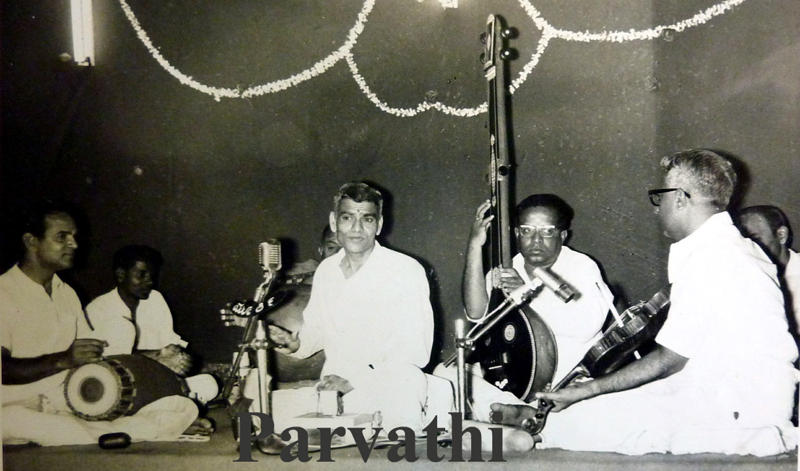
April 23, 1970, "Parvathi", Mysore
Vidwans: KV Narayanaswamy (Vocal)- T.N. Krishnan (Violin)- Umayalpuram Sivaraman(Mridangam)- K.S. Manjunath (Ghatam)- H.P.Ramachar (Kanjira)
CHRONICLE OF TEAM MEMBER R.SACHI

Who doesn't know KVN among the Carnatic music aficionados? Just three coordinates will do.

1. KVN is universally acclaimed to be the inheritor of the Ariyakudi legacy. Ariyakudi Ramanuja Iyengar was hailed as the crest jewel in Carnatic music (Sangeetha Shikhamani).

2. KVN enjoyed the admiration of many musical greats – let us just mention Pandit Ravi Shankar, Yehudi Menuhin and of course KVN's own guru Palghat Mani Iyer.

3. Rasikas who have a penchant for specific composers all claim that KVN's renditions are truest to their tradition... and most notable for this are the Travancore royal family and KVN's mastery over the compositions of Swati Tirunal.

KVN was born in 1923 into a musical family in Palghat. This chronicler knew him closely in the '80s. He heard directly from the master how he would be bribed with four annas just to practise music as a young boy. The same boy later would have great teachers: C. S. Krishna Iyer, Palghat Mani Iyer, Papa Venkataramiah, and Ariyakudi Ramanuja Iyengar. It was Palghat Mani Iyer who taught KVN how to actually “sing”- be it alapana, compositions, and swaras – the actual intonations, and the embellishments, without the rough edges and idiosyncrasies one normally finds in any busy performer. That is why you will find in KVN a perfect balance of everything, and no quirks like nasal twangs or too much gimmickry. He always remembered the words of Ariyakudi, that one should have immense understanding and common sense before musical sense. He would quote Thyagaraja, “Ingitham should come before Sangitham”. That is why all rasikas found in KVN the true expression of “mot juste”.

KVN was reverence personified when speaking of Ariyakudi, whom he called “Gurnathar”. In many interviews, he has spoken in a hushed awe about his Guru. It is a bit like Swami Vivekananda's relationship with Sri Ramakrishna. Once, when Swamiji was asked to speak about his master in America, with tears in his eyes he said that he could not do justice to the topic at all.

KVN used to sing a song in memory of his Guru, composed by T.S. Balakrishna Shastrigal. On the suggestion of the famous critic Subbudu, KVN had set it to a languid tala scale and a lovely ragamalika. He would pause with awe when he came to the words, “Nija-guru-pada-sevitha- shishya-vrindam”.

KVN spent time in Mysore with Ariyakudi, who was the guest of the Mysore Palace. This chronicler believes that was the time when Ariyakudi would sit on a swing in a veranda and enjoy the salubrious hospitality of the princely city. He would begin to compose the music for one of the songs in Andal Thiruppavai. KVN the scribe would write it down. And it would be finally polished into shape. Everyone follows the Ariyakudi tradition for singing Thiruppavai and you hear these lovely songs not only in concerts but also during the Margazhi season on AIR.

Once KVN sang a delightful composition in raga Ranjani. This chronicler asked him later whose composition it was. He said it was that of Mysore Ganapathi Sacchidananda Swamiji and KVN himself had set it to music.

KVN taught many university students in India and USA. He was for many years a professor at the Music Teacher's Training College in Madras. He also had many stints at the Wesleyan University in California.

Someone once mused, “what if KVN had a powerful resonant voice?” This chronicler replied that KVN's musical armamentarium is like a BMW or Mercedes engine. So much power would not suit a ceremonial golden chariot, known more for its glitter than as a conveyance. The chariot would hardly cope with performance of a BMW or Mercedes engine. That somewhat explains how KVN had honed his vocal equipment to produce perfect Carnatic music aligned to the resonance of a tambura. And consequently was the supreme vocalist in Carnatic music for many generations of rasikas. And both God and the gifted composers of Carnatic music listened to KVN in thrall.

Sri K. SRIKANTIAH RECOLLECTS
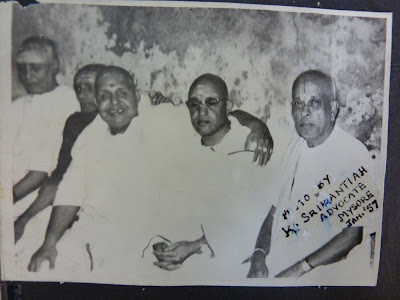


An Assembly of the Giants in Tiruvayyaru![ Annaswamy Bhagavatar- Kumbhakonam Rajamanickam Pillai - Chembai Vaidyanatha Bhagavatar - Semmangudi Srinivasa Iyer - Ariyakudi Ramanuja Iyengar ]

“… you know I had such a lot of respect for KVN …. he performed so many times in our house “Parvathi”…sometimes with Lalgudi, sometimes with Parur (Gopalakrishnan) … sometimes with T.N.Krishnan … with Shivaraman … Ramabhadran …with Raghu … very, very chaste concerts … always a crowd favorite…”
“… but whenever his name comes up …somehow, immediately, Sri Ariyakudi’s (Ramanuja Iyengar ) name also crops up in me …you know when my father Shri K.Puttu Rao died in 1959, Shri Ramanuja Iyengar came all the way to “Parvathi” to extend his personal condolences … during one of my visits to Tiruvayyaru for the Thyagaraja Utsavam, I attended a concert of Dhanammal sitting next to Ariyakudi, and Ariyakudi was so very happy about it”
“... you know there is also that time in 1963 …when a public function was arranged in Rajaji Hall in Madras to honor Sri Ariyakudi as architect of our modern Carnatic music … now in this connection, one fine morning, KV Narayanaswamy shows up in “Parvathi”… and guess who he has brought along with him? Sriyuts Madurai Krishnan and Rajam Iyer … now they all want His Highness Jayachamarajendra Wodeyar to preside … so they wanted my help … how could I say “No” ?... I arranged for an interview through the Durbar Bakshi of the Palace … and they were all very happy when the Maharajah gladly agreed … I remember the commemoration committee was chaired by Justice P.V. Rajamannar ... they also included my name in their committee … overall it was a very grand function… the Maharaja had earlier conferred the honorific 'Gayaka Shikhamani' on Shri Ariyakudi ..."
'PARVATHI' CONCERT
K. V. Narayanaswamy -----Vocal
T.N Krishnan ------- Violin
Umayalpuram Sivaraman ------Mridangam
K.S.Manjunath -----Ghatam
Performed on 26-3-1972


[ 1. Era napai–Todi varnam–Patnam Subrahmanya Iyer 2.Evarani–Devamrutavarshini-Thyagaraja 3.Ninne nera nammi naanu raa-Pantuvarali–Thyagaraja 4.Enta rani–Hari kambhoji–Thyagaraja 5.Ora jupu–Kannada Gowla–Thyagaraja 6. Manasu Swadhina–Shankarabharana–Thyagaraja 7. Brochevarevarura–Khamach–Mysore Vasudevachar 8. Janaati Rama–Shloka Ragamalika–Traditional 9. Thiruppavai–Sindhu Bhairavi–Andal 10. Tillana–Paras–Ramnad Srinivasa Iyengar 11. Mangalam ]

If you have difficulty in accessing the audio, please click here.


Thursday, March 18, 2010

The Master Flautist: Vidwan Dr. N. Ramani


"Parvathi", the hallowed musical conclave in Mysore that hosted many a maestro year after year, was a wellspring of inspiration for the artistes as much as it was a haven for the rasikas. The famed flautist Dr. N. Ramani ( b. 1934) was one of those who came and performed many times in Mysore.

The mantle of the leading flautist in Carnatic music fell on his shoulders quickly after his own guru 'Mali' (T.R. Mahalingam) reduced his concert appearances. Ramani not only stepped into the role readily, he also gave a wholesome dimension to the flute concert, enriched with a great vocal technique of his own and a fine repertoire. His mastery over the instrument as well as his gayaki manodharma ooze out from the word go in every concert. He exults in collaborating with top-notch accompanists and his concerts always leave the listener satiated.


RECOLLECTIONS BY VETERAN MR. SRIKANTIAH

" ... you know how I've spoken to you many times about our traditions in Parvathi ... it was the same way when Ramani performed (so many times) ... after the concert, the performing artistes, we, the inmates of Parvathi and a few close friends would all have a leisurely 'Kannada Oota (meals)' together .... this would go on till about midnight, what with the anecdotes, jokes, mimicry, discussions and recollections on music and other musicians ...

... after this particular concert of N. Ramani (re-played below) ... dinner was ready and everyone was waiting for Ramani to join us ... but he didn't show up? ... I went in search of him ... and guess where I found him?... you know that stone bench in the front garden of Parvathi... next to that 'champaka' tree... I found him in the subdued garden light there, all by himself, lost in his own contemplation. The superb music of the evening ... his own rendering had so mesmerised him ... he was rewinding it in his own mind and enjoying the ethereal waves that had come out of his own flute in the past few hours.... I tell you, such is the power of his music! ... and what a noble personality too ... perfect gentleman ...very few words ... "


Ramani was born the city of Tiruvarur, Tamil Nadu (the birthplace of the Carnatic trinity). In a city blessed with rich musical traditions, the young Ramani was exposed to almost every corner of Carnatic music. Ramani's grandfather, Sri Aazhiyur Narayanaswami Iyer, was his first guru and was a well known flute artiste and singer himself. Well aware of young Ramani's keen interest in the Carnatic flute, Ramani's initiation to Carnatic music began at the age of five.


[The following excerpts are from the Hindu -Friday Review, Hyderabad Jun. 23, 2006]

As on his flute, he is soft, restrained and gentle. We caught up with N. Ramani, renowned flautist and disciple of the legendary T.R. Mahalingam, who spoke about what makes for great music. Ramani began learning from his grandfather, more as an informal routine than a strict regimen. And it was all vocal lessons than on the flute — but this helped familiarise Ramani with sahitya. "The vocal exercise is an important facet that strengthens the foundation for any musician," says Ramani. "Today, unfortunately, several instrumentalists don't concentrate on lyrics. They focus only on swaras, which is bereft of sahitya bhava."

"A good teacher should be open to learning from his students too," avers Ramani. "Mali learnt Aahiri raga from me, which I had learnt from T. Vishwanathan, Balasaraswathi's brother," recollects the artiste.

Actually, Ramani was amongst the earliest Carnatic artistes to attempt jugalbandis. He also took South Indian classical music to the West. This not only fetched recognition for his own self, but also to the art. "Jugalbandis with Hariprasad Chaurasia gave me valuable insights into the Hindustani style, with Lalgudi Jayaraman, it was music education."

Mali would constantly throw challenges at his students says the flautist which would help uncover a student's potential. "Mali would demand an extempore pallavi. Or ask me to play Bhairavi varnam in thrishra nadai. Tough, but I would manage!"

Ramani also learnt from Mali his famed techniques of cross-fingering. He himself is renowned for producing fast gamakas on the flute. "The Indian bamboo flute can produce superior gamakas compared to the western or metallic flutes," he says. He strongly commends yoga for playing the flute, which packs power over one's breath — a vital requirement for flautists.

He stresses that technique is undoubtedly important but equally vital is the sangeeta gyaana or scholarship which distinguishes the outstanding musician from the average one. "Technique is something the teacher gives you." After that, it is up to the student to gather gyaana (developing the discipline of listening to more number of artistes more and more) and benefit from the experience and wisdom of vidwans by asking them for their insights/advice. Studying music-theory and constantly welcoming a feedback are but the last features of a good classroom revision," opines Ramani.

Many recall with delight the Venu-Vina-Violin trio of Ramani and Venkataraman with Lalgudi.

LISTENER'S PLEASURE

We reproduce the April 17, 1973 "Parvathi" Concert of Dr. N. Ramani (Flute) with Vidwan M. Chandrasekharan (Violin); Vidwan Vellore Ramabhadran (Mridangam); Vidwan K.S Manjunath (Ghatam)

[ 1. Viriboni-Bhairavi Varnam-Pacchimiriyam Adiyappayya 2. Vallabha Nayakasya-Bebade-Muthuswami Dikshitar 3. Saamaja Varagamana-Hindola-Thyagaraja 4. Paridaana Micchite-Bilahari-Patnam Subrahmanya Iyer 5. Gaanamoorte-Ganamoorti-Thyagaraja 6. Vaasudevayani-Kalyani-Thyagaraja 7. Sarasa Saama Daana- Kaapi Narayani-Thyagaraja 8. Mokshamu Galada-Saaramati-Thyagaraja 9. Ragam Tanam Pallavi-Keeravani-Ragamalika Swaras 10.Krishna Nee Begane-Yaman Kalyani-Vyasaraya 11.Magudi ***12. Tillana-Sindhu Bhairavi-Lalgudi Jayaraman 13. Mangalam. ]


[Post Script: In the context of our Flute music, we would also encourage listeners after they listen to the genius of Ramani to go to our 'Mali' posting of January 20, 2010 and listen to the Abheri piece towards the end, which, too, would afford a simultaneous testimony to the brilliance of the Guru ]

Wednesday, March 3, 2010

The Jewel in the Mysore Crown - Ashthana Vidwan before 16 ? - Mysuru’s legendary Veena Maestro : V. Doreswamy Iyengar


Galaxy of artists honor the memory of T. Chowdiah on his birth Centenary in 'Parvathi' 1994

[ L to R: Vidwan S.Mahadevappa (Violinist, and father of Mysore Nagaraj and Mysore Manjunath); Vidwan U.Srinivas (Mandolin); Vidwan V. Deshikachar (Flutist, and younger brother of V. Doreswamy Iyengar); Vidwan Titte Krishna Iyengar (Vocalist); Host K. Srikantiah; Ambarish (Actor and grandson of T.Chowdiah); Vishnuvardhan (Actor); Vidwan V. Doreswamy Iyengar (Veena artiste); Vidwan T.K. Murthy (Mridangam); Vidwan R. Chandrasekhariah (Vocalist ---of Mysore Brothers); Prof. R. N. Doreswamy (Veena artiste); Vidwan M. A. Narasimhachar (Vocalist); Vidwan Prof V. Ramaratnam (Vocalist, Senior disciple of T.Chowdiah)]

OUR CHRONICLE

Those fortunate to be called Mysoreans hear all their life, wherever they live, about the lovely associations that the word “Mysore” resonates with among the cognoscenti. Things that can be readily listed are the flavoursome Mysore rasam, the fragrance of Mysore jasmine flowers, the refinement of Mysore silk, and the sweetness of the Mysore Veena.


More than anyone else in the 20th century, it was Mysore V. Doreswamy Iyengar who symbolised the sweetness of Mysore Veena. He was also a dear and admired friend of the leading Carnatic and Hindustani musicians of that era.

When Doreswamy Iyengar performed at the Madras Music Academy after receiving the Sangeetha Kalanidhi in 1984, a proud Mysorean eye-witness (this chronicler) recalls how the hall was filled with music’s Who’s Who with the legendary MSS and Semmangudi sitting in the first row. He also recalls the brilliant Begada and Behag that he played that day.


Foregoing one's veena for the mike?
V. Doreswamy Iyengar speaks of Chowdiah
Flanked by Vidushi M.L. Vasanthakumari and K. Srikantiah


RECOLLECTIONS OF Shri R.K. NARAYAN
[ courtesy: http://www.hinduonnet.com/fline/fl1423/14231000.htm ]


“… Some time after this, a music festival was conducted in Mysore at the Bidaram Krishnappa Hall. The concerts were by senior musicians like Ariyakudi (Ramanuja Iyengar), Chembai (Vaidyanatha Bhagavatar) and Semmangudi (Srinivasa Iyer). I was surprised to see a 14-year-old featured among these giants. Somewhat irked by this choice, I decided to leave the hall when it was his turn. Anyway it was close to eight and dinner time. But the boy began to play with such confidence that I was taken aback. He did so well that I sat through the performance, convinced of his genuine talent. "

“Do you know that the Maharaja made him the youngest asthana vidwan in Mysore state?”

“No ego, no self-importance. He wore them lightly, and remained simple, sweet-natured and uncomplicated all his life. He had no bad habits.”

“…He could give up food, but not music...”

“…Doreswamy had sweetness and melodiousness. Many people don't know how to play the veena. They bang on it as if it were a harmonium and end up producing noise. Venkatagiriappa was a good man. He allowed his disciple to develop in his own way, doing what came naturally to him…”

“…Doreswamy belonged to a family that had an essential nobility and humility in temperament….’


RECOLLECTIONS OF Shri K. SRIKANTIAH

"...now if you ever find yourself in Doreswamy Iyengar's house you will see an old photograph...it is that of my father (K. Puttu Rao) honoring Doreswamy's Guru, Veena Vidwan Venkatagiriyappa in our home "Parvathi"... both Doreswamy and I were so young...like with Lalgudi our friendship started as teenagers...you see us seated on the 'jhamkhana'(floor spread) there..."

"... ours was all brotherhood ... friendship ... whatever you may want to call it ... during the early '50s and '60s we all used to meet together... myself, V.Doreswamy Iyengar, M.Cheluvarayaswamy...we used to go to this 'Galli (by-lane) Hotel' in K.R.Mohalla... we all loved this 'set' dosa' [ note: a specialised Mysore delicacy of the popular Dosa, stacked up like pancakes, served with mouthfuls of distinct soft white buttermilk butter called 'benne' with a bowl of 'sambar' to dip into ] ... after this meal we would proceed to R.K. Narayan's house in Lakshmipuram for a long chat about music and musicians... sometimes Thitte Krishna Iyengar and M. A. Narasimhachar would join us. R.K. Narayan would play his spool tape recordings of Karaikudi brothers' veena recital and other such recordings of the old veterans...these meetings would go on till about 2 pm"

"... the same friendship continued even in the recent years (the '90s) when I took up partial residence in Bangalore...V. Doreswamy Iyengar would regularly take walks from his Malleswaram residence to the Indian Institute Of Science. On his way back, he would sometimes drop in at our house in Sadashivanagar. After breakfast and a long hearty chat, I would drop him back to Malleshwaram....sometimes I myself would drop in at his 18th cross residence. During these meetings we would have long, relaxed chats about Music, Musicians, T. Chowdiah, his dynamism and would recollect many anecdotes..."


OTHER REMINISCENCES
[ Courtesy: Gowri Ramnarayan with Ravi Sharma in http://www.hinduonnet.com/fline/fl1423/14230990.htm ]

“Doreswamy Iyengar revered his forebears in the tradition so much that he painstakingly gathered the compositions of Veena Seshanna and popularised them. He attributed his good fortune to his guru's blessings and, as his guru lay bedridden before death, he played Bhairavi day after day at Venkatagiriappa's command."


“He was uncompromising in his principles. He refused to play at weddings because they were venues of noise and distraction inimical to music. He was even against amplification because it robbed music of its nuances and often distorted the tone. He eschewed an aggressive style and strident fingering techniques, which made for easy popularity. And though connoisseurs found that with its preponderance of meettus (plucking), the Mysore style lacked fine-shaded gamakas and contouring anuswaras, they accepted Doreswamy Iyengar's music as smooth, sweet and satisfactory. He had the gentle touch of a cultured mind. His modesty and charm won friends for him everywhere. "


As we hinted in some of our earlier postings, we have come to love vintage things for now. So, we leave you once again with a very vintage concert from April 17, 1978 in "Parvathi" by the great maestro; sweet sounds, no contact mike as the Vidwan refused to wear one, Philip spool clarity as it was then ! Also performing, are Vidwan M. Chandrasekharan on Violin; Vidwan Erode Gururajan on Mridangam and Vidwan Manjunath on Ghatam.

[01-Shivashiva-Pantuvarali-Thyagaraja 02-Marivere-Ananda Bhairavi - Shyama Shastry 03-Inta Kannanandamemi-Bilahari- Thyagaraja 04-Brochevarevarura-Khamach-Vasudevachar 05-RTP-Kambhoji & Ragamalika 06-Vishweshwara-Sindhu bhairavi Bhajan- Swati Tirunal ]


A TANGENTIAL STORY ON A MYSORE VEENA

As we poured through “Parvati” photographs looking for things connected with Vidwan Shri. Doreswamy Iyengar, we espied a photograph of K. Puttu Rao’s only daughter, Smt. Lakshmi Murthy ( nee Subbulakshmi ), playing a Veena in the center of an orchestra. The photograph (reproduced below) was supposed to be that from many decades ago, shot in a river valley project in Bihar, a place signified as a source of pride for Nehru as he strove to usher India into a modern era with the help of American engineers from the Tennessee Valley Authority.


While she did not make it into any professional rank, K. Puttu Rao's daughter chose to remember her Guru (Doreswamy Iyengar) in the only way she could, through self practice of the things he had taught her. As time tends to hang heavily in such lonely river valley projects, Smt. Subbalakshmi strove to fill in her time by collecting any lady with any fragmentary knowledge of music to weave musical patterns together from a Thyagaraja or Dikshitar composition, not withstanding the hybrid nature of such a process. There was supposedly an American player too in their group, a Ms. Mary Lou Williams, who would bring in her accordian for occasional lessons in Carnatic notes ( we couldn't find a picture for Ms. Mary Lou, so we are just sending a shout out to her in any corner of the world by mentioning her name )

We soon arrived at an interesting sequel connected to Puttu Rao's daughter and a Veena ( somewhat sad in the end ) . When a newly arrived engineer called Chidambaram moved into the river valley project from Madras, he came with a passionate weakness in wanting to one day see his young daughter shine as brilliantly as a Saraswati through the Veena. Coming to realize that there was a local person with somewhat of a connection to the great Vidwan Doreswamy Iyengar, he approached the lady in question and expressed his intense yearning for owning a Mysore Veena for his daughter. The lady, not sure what made her accede, did however consent and found herself executing the job very personally, hand carrying the best Veena she could buy in Mysore and protecting it like a baby all the way from Mysore to Bihar, all through the tedium of a long train journey through a scorching Indian summer and presenting it as a free gift to the man, accepting nothing in return. Needless to say, she made a certain father delirious in his joy.

Time, however, moved on; the happy man called Mr. Chidambaram found himself soon transferred to Calcutta. It was then that Smt. Subbalakshmi’s only daughter, still a child of seven, was diagnosed with a brain tumor. The local doctors made a definite pronouncement. The child under any circumstances, had to be removed to Vellore hospital immediately, to be operated by none other than the brain specialist of the day, Dr. Chandy. This caused the young parents to panic. It was one thing to have so sick a child on your hands. It was another to procure reservations so suddenly on such a long journey? You had to first change trains in Calcutta which might include ( when you are in a hurry ), waiting out entire days for a reservation in the busiest train station in the world. Where would they stay in Calcutta? With nothing to hope for but to just chance it out at the railway station, waiting out time within a waiting room or maybe even spreading it out on the floor of a filthy platform , they left for Calcutta pinning their hopes on the one above to show them the way.

It was when they arrived at Howrah, that a very eventful situation transpired. As their train pulled into the city, a man had simultaneously arrived to confirm train reservations for his family’s return from Chennai. As the lady Subbalakshmi,a sick child and her husband wended their way, not sure where and what they would be doing, they happened to bump into the person who had just come in. As each lifted their face to apologize, there was a brief pause and then a mutual gasp of recognition. The man proved to be none other than the Mr. Chidambaram of earlier times. Pleasantries aside, each came to recognize the reason for the other being there. Mr. Chidambaram acknowledged mentally the presence of a sick child and the predicament of a family uncertain of where they would spend their night. Hadn’t Saraswati once sent this same lady as a succor when he needed a Veena? That was sufficient reason for him to hear no more. They were going to honor him by staying in his house and he was going to make sure that their onward journey would be a very safe one!

A few months later found the erstwhile Mrs. Subbalakshmi and her husband back in the same place on their return leg, but this time without the child who had succumbed to the hands of fate.


Wednesday, February 24, 2010

Harikathe by Shri Arunkumar (''Gururajulu Naidu'')


Another famous exponent of Harikathe was Shri Arunkumar. Trained by his father, this versatile and dynamic artiste made a mark for himself all over South India as a Harikatha exponent. Interestingly, he was equally at home in the cinema world and he acted in many Kannada movies.

As he mentions in this Harikathe, he also had served in Hindustan Aeronautics Ltd.

Shri Arunkumar came and performed in Parvathi when he was much sought after all over Karnataka. His reputation was for his fast-paced, interesting and humorous style which was quite different from that of the other more traditional exponents. He had a prolific repertoire and recorded many Harikathes on cassettes. He knew several languages other than Kannada, viz. Telugu, Tamil, Malayalam, Marathi, Hindi, English and so on. He performed Harikathes through the length and breadth of Karnataka and also in the neighbouring states.

Mr, Srikantiah recalls that this artiste had a busy schedule and travelled extensively. Many times, he had multiple Harikathe assignments in a single day. He would not disappoint his fans.

Shri Arunkumar was at the peak of his popularity when he passed away .We learn that his daughters and students have carried forward his legacy.

Mr. Srikantiah recalls that this artiste had a lot of affection and respect for him and Mr. K. K. Murthy. When Arunkumar fell ill, it seems he had expressed to Mr Srikantiah's assistant a desire to meet Mr. Srikantiah and his brother Mr. K.K. Murthy. But before either of them could do so, Shri Arunkumar had left for his heavenly abode.

In this Harikathe, at many points, Shri Arunkumar expounds the philosophy of Vairagya, and the theme of reaching life's true goal before being felled by the stroke of death. He quotes the metaphor of a mouse riding a cat... the mouse symbolizing our momentary life and the cat signifying Death.

We pay tribute to this great artiste by featuring his wonderful Harikathe, Seethaparithyaga (Kusha Lava Charitre).


Thursday, February 18, 2010

A friendship strong as diamond


January 22nd, 2010
Two veterans, Sri Lalgudi Jayaraman and Sri K. Srikantiah
greet each other in the Maestro's house in Chennai!

It was circa 1948.

The Bidaram Krishnappa Prasanna Seetharama Mandiram of Mysore was featuring the redoubtable GNB in the annual Ramanavami festival. The organizers had also invited a young violinist from Madras to accompany the star. This youngster, sporting the traditional tuft (kudumi), was still in his teens, and yet was already making waves with his prowess on the violin. But that day, he wasn’t destined to go on stage in the GNB concert. The reason? GNB had brought along his own set of accompanists from Madras, including another violinist. It was indeed a disappointment for the young lad named Jayaraman.

But Jayaraman surprised everyone with his decision to stay back, and he sat through the concert as a member of the audience. He happened to sit next to another teenager, the son of Mr. K. Puttu Rao who was then the President of the Rama Mandiram. The youngsters broke the ice and exchanged notes, and soon were friends. Thus was born a friendship between Advocate K. Srikantiah and Vidwan Lalgudi G. Jayaraman. It grew decade after decade like a huge Parijatha tree, being a friendship built on mutual affection and respect for each other’s qualities of excellence. This bond of friendship between an epochal musical genius and a musical connoisseur and patron is now past its diamond jubilee, i.e. more than 60 years.

One can paraphrase Shakespeare while describing this association between K. Srikantiah and Vidwan Lalgudi G. Jayaraman; “age cannot wither nor custom stale its infinite variety”. And after that initial occasion when Jayaraman was sitting in the audience, there would be countless occasions when GNB would ask for the violin accompaniment of Lalgudi Jayaraman and the rasikas would be treated to a double delight.
January 22nd, 2010
Another picture of the Srikantiahs together with the Jayaramans!

During the marriage ceremony of Mr. Srikantiah, Vidwan Lalgudi G. Jayaraman accompanied Vidwan T.K. Rangachari in the concert featured at Parvathi. A photograph taken in this concert has been included in the documentary film on Vidwan Lalgudi G. Jayaraman. Recently, a commemorative volume has been brought out titled “Lalgudi 80”. That book also features this photograph.

Mr. Srikantiah recalls that Vidwan Jayaraman’s wedding was held in Salem in the same period and he would have loved to attend the function, but could not do so on account of some family preoccupations. Mr Srikantiah recalls that a veena concert of Vidwan S. Balachander had been arranged during Lalgudi’s marriage ceremony.

Lalgudi has come and played in Parvathi year after year as a soloist as well as accompanist. He has given solo violin concerts and also violin duet with his son G.J.R. Krishnan and later with his daughter Vijayalakshmi. He has also accompanied stalwarts like GNB, Semmangudi Srinivasa Iyer, Madurai Mani Iyer, T.K.Rangachari, K.V. Narayanaswamy, Madurai Somasundaram, Balamuralikrishna, Maharajapuram Santhanam, and others.

In 1986, a grand function was organized in Krishna Gana Sabha to celebrate the 50th solo concert appearance of Vidwan Lalgudi G. Jayaraman at that Sabha. The function was attended by the glitterati of the musical world and fine arts. Lata Mangeshkar, a close friend of the violin maestro, represented Bombay. The doyens Semmangudi Srinivasa Iyer and M. S. Subbulakshmi represented Tamil Nadu. The Travancore Ilayaraja represented Kerala. Dr. K. Pinakapani represented Andhra. Mr. Srikantiah, whose family were invited and hosted graciously by the organizers, represented Karnataka.

In later years, a musical archive project was undertaken by the Indian Foundation for Performing Arts to commemorate Lalgudi Jayaraman’s achievement. Mr. Jayaraman himself suggested to the Managing Director of the project, Ms. Padmasani, that Mr.Srikantiah be interviewed in that regard. We share below a letter from Ms. Padmasani to Mr. Srikantiah thanking him for the contribution to this project through his sharing the memories of his association with the violin maestro.


Mr. Srikantiah recalls he has been in frequent touch over all these years with the maestro and they have always had something to share with each other. Once he heard over the radio how Vidwan Lalgudi Jayaraman had won the Best Violinist award in some European City music festival and immediately phoned the maestro. The maestro himself had not received the news yet and was delighted to get the good news from such a close friend.

We also add some more spontaneous comments from Mr. Srikantiah on Padma Vibushan Lalgudi Jayaraman


"...I tell you Lalgudi’s violin is really something else…the melody that he produces is simply out of this world…he will take that raaga’s Jiva and squeeze it completely of it’s rasa…I will really play some concerts for you to hear what I am saying …"

"... a truly great man…no bad habits…I used to see him when he used to live in Saidapet having moved from Lalgudi…his father Shri Gopala Iyer used to be in that house before they moved to T’Nagar and I used to go there to pay my respects …. "


We are also delighted to share with listeners some excerpts from a solo concert in Parvathi (distinct solo pieces from the concert on April 13, 1984 with Vellore Ramabhadran and H.P. Ramachar (kanjira) )


[ 1-Enduku Peddala-Shankarabharanam -Thyagaraja; 2-Ragamalika Pallavi; 3-Bageshri Bhajan and Misra Shivaranjani Tilllana ]


and a full-fledged scintillating 1975 “Parvathi”concert with the “Pithamaha” Semmangudi Srinivasa Iyer

[ 01-Devadeva-Mayamalavagowla-Swati Tirunal; 02-Dwaithamu-Reetigowla-Thyagaraja; 03-Pahimam-Janaranjani-Mahavaidyanatha Sivan; 04-Kamakshi-Bhairavi swarajati-Shyama Shastri; 05-Biranabrova-Kalyani-Tarangampadi Panchanada Iyer; 06-Teliyaleru-Dhenuka-Thyagaraja; 07-Kshinamai-Mukhari-Thyagaraja; 08-Srimathrubhotham-Raga Kannada-Muthuswami Dikshitar; 09-Ramaneesamana-Kharaharapriya-Thyagaraja; 10-RTP-Todi; 11-Ramajogi-Kamas- Bhadrachala Ramdas; 12-Mangalam ]


Semmangudi Srinivasa Iyer-Lalgudi Jayaraman-Vellore Ramabhadran-V.R.Krishnan

SMALL ADDENDUM TO THIS CONCERT:

“… you know for years whenever Semmangudi came … he would usually stay in our house when he would come for AIR auditions and he would come with the office bearer of the Music Academy Subbarao … I would drive him all around Mysore … This started when I was hardly eighteen with no driver’s license also. We would sleep in the corner room … and then every time at 5 o’clock in the morning he would wake me up …’ Srikantiah get up … get up ... I am going to sing now … and I want you to listen’ … this was the atmosphere … how could I escape this personality and his music? ... ”


[All text in this posting is excerpted from R.Sachi’s "Recorded Conversations with Kunigal Srikantiah" (a private collection) ]


Thursday, February 11, 2010

The Nectar of Musical Discourse


"….you see our house "Parvathi" was not just about Music and Sangeethakaraas only…for example my father would call me to tell me that his wish was that every Ekadasi day all the famous Karnataka Harikatha artists must be assembled in our house….Gamaki Ramakrishna Shastriar, Venugopal Das, Lakshmipati Sahodar…then that famous person in Chamundi extension whose name I forget. Ours was a huge 40x35 hall…then we had another hall in front of it…and we used to have 3 hours of non-stop Harikathas... I was young, then, and everywhere I would jump on my bike and go up and down Mysuru’s extensions to assemble everyone. Then we used to have those huge Chandi Homas,too...imagine Parayana for 45 days! Mother was highly religious...she would do dhyana to the Audumbra (fig) tree in our orchard for hours…she believed Lord Dattatreya lived in that tree…so we performed even 'Upanayana' to that tree in 1954/55….with full Nadaswaram to it ...hundreds of people showed up even for this event..."

K. Srikantiah

[ From R. Sachidananda's "Recorded Conversations with Advocate Kunigal Srikantiah" (a private collection) ] /font>

Brahmashri T.S. Balakrishna Shastrigal in 'Parvathi'
KUjantam rAma-rAmeti madhuram madhurAkSaram
Aruhya kavitA-SAkhAm vande vAlmIki-kOkilam

The story of Rama has always been sung. Its honeyed narrative was first and foremost sung by Valmiki himself. Valmiki was a sage blessed by none other than Narada and entrusted with the task of singing the story of Rama. Valmiki has been compared in this shloka to a cuckoo singing from the branches of the tree of poesy, in a nectarine voice filled with the chant of Rama's charming name. Valmiki delighted in the highest musical values, and taught Lava and Kusha the story of Ramayana to be sung in the most classical way, and Rama was totally captivated by that recitation when they sang in his durbar. There is much proof of that in the original Ramayana itself. Saint Thyagaraja, the Valmiki of our times, is the composer non-pareil in Carnatic music. Therefore imagine a musical discourse from a learned scholar, filled with gems from Thyagaraja's life and times, and music culled from the saint's glorious compositions. Can there be a more fitting finale in a Ramanavami festival?

Thus it came to pass that on the evening of 12 April 1982, the rasikas who filled the pandal were fortunate to immerse themselves in a musical discourse by Brahmashri T.S. Balakrishna Shastrigal. Shastrigal was famed far and wide for his Harikathas filled with sweet Carnatic music, learned discourse on Vedantic ideas, scholarly story-interpretation, couched in a captivating narrative, and punctuated by humorous digs at our so-called modern life style. Shastrigal had retired from the position of a senior official in State Bank of India, Madras. Born in 1919, he had been giving musical discourses for over 40 years, and had even undertaken foreign tours. His style was such that the music, the narrative, the language easy to understand for anyone who knew any South Indian language, were sure audience-pullers. Senior musicians like Ariyakudi were all admiration for his learning and musical interpretation. It is interesting how Mr. Srikantiah arranged this Harikatha discourse. He (Srikantiah) was a regular during the Thiruvayyaru festival year after year. One year, he had heard the legendary Annaswami Bhagavatar's Harikatha there, and recalls that Palghat Mani Iyer himself played the mridangam in that discourse. Similarly, as Shastrigal narrates in his own discourse, once, during the Purandara centenary festival at Thiruvaiyyaru, he had occasion to give his discourse in front of several famous musicians. Captivated by his exposition of the raga Saranga, with support from his gifted brother (who provided the musical vocal accompaniment during the narrative), the maestro T. Chowdiah had remarked to the doyens of Carnatic musicians that day that he had felt compelled to take up the violin and accompany Shastrigal himself but could not do so. Mr. Srikantiah repeatedly stresses that 'Parvathi' saw and heard not only great musicians, but also played host to famed stage and cinema artistes, writers of international repute, scriptural experts and Sanskrit scholars from all over. It is therefore no wonder that he was keen on arranging good Harikathas during the Ramanavami festival. The devotional musical narrative has been a key feature of all Indian fine arts, and Kathak, Kathakali, Baul music, Harikathas from Maharashtra to the end of South India, have all been a rich cultural heritage for us. Carnatic music and the concert format in fact is said to have evolved from Harikathas. A Harikatha exponent was expected to be trained in singing, scriptures, languages, the art of story-telling, acting, mimicry, humour, and even dancing. Only performers of great intelligence and skills in fine arts succeeded in this genre. And Brahmashri Balakrishna Shastrigal was a shining star in this difficult art-form. Having heard about Shastrigal, Mr. Srikantiah took the trouble in one of his Madras trips to find out where Shastrigal was discoursing that day. So it happened that he went to a Harikatha in Mylapore area and had a chance to see and hear Shastrigal. His mind was made up on the spot and soon the occasion arose for the Harikatha in Parvathi in 1982. Mr. Srikantiah recalls that the audience that day had many scholars and eminent men from all walks of life. One of them, Mr. A. Ramaswamy, was the Principal of the Administrative Training College in Mysore, where budding IAS officers would undergo training before their posting. Mr. Ramaswamy was so taken with Shastrigal's Harikatha that he requested him to come and perform the next day in front of his officer-trainees at the college! Mr. Srikantiah says appreciatively that the Principal did a world of good to the future IAS community by giving them a chance to listen to a learned, musical discourse from a doyen like Brahmashri Balakrishna Shastrigal, who represented all that is precious and sacred in Indian culture. WE BRING YOU THE MUSICAL DISCOURSE IN FULL, as we are lucky to have a good quality recording done by Mr. Srikantiah himself nearly 28 years ago.  
The words of appreciation spoken towards the end of the Harikatha are by the senior musician and musicologist from Mysore, Sri M. Cheluvarayaswamy. PS: Look out for another delectable Harikatha treat soon, this time by the famed Arun Kumar, who was a rage with his wonderful Harikathas all over Karnataka even at a young age.


Tuesday, February 2, 2010

" The Genius at Nine"


April 10, 1984 in "Parvathi": The fifteen year old maestro U. Srinivas enthralls audiences
with M.S.Govindaswamy (Violin) – Tanjavur Upendran (Mridangam) – Bangalore Venkatram (Ghatam)


It was the year 2005.

"Parvathi" Ramanavami concerts honoring the memory of Sangeetha Kalanidhi T. Chowdiah were in their 35th year. Advocate Sri K. Srikantiah wanted to feature the world famous Mandolin U. Shrinivas once again, after a gap of two years. The date set was the 18th of April.


But when contacted, the maestro confessed that there was great logistical difficulty. He would be performing April 17th, just the previous day at Kolkata. And he was bound for the US concert tour just the day after on the 19th. How could he fit in the long trip to Mysuru by road within the constraints of this extremely tight schedule and come to perform at "Parvathi" ? Nevertheless, the humble genius gave his word to the elder statesman, and this is what followed.

The maestro finished the concert in Kolkata and immediately departed by a 'red-eye' flight to Chennai. As soon as he landed, he transferred at the airport terminal to the Bengaluru flight. The ever meticulous Mr. Srikantiah had arranged for a car to ferry the artistes straight from the Bengaluru airport to Mysuru while comandeering the driver that he could not stop anywhere for any reason. They barely made it in time but the concert went off as scheduled. The mammoth crowds were satiated with the heavenly music, ever the hallmark of a Mandolin Shrinivas performance. Later, as was the delightful custom at "Parvathi", dinner and post-dinner sessions of singing, chatting and Bon'homie' followed. It was 3 AM before the maestro and his entourage could leave back for Bengaluru in the same car as they had come. They reached the airport in time and bleary-eyed took the early morning flight to Chennai , just in time to board the flight to US directly. The baggage for the long trip had been packed and brought by the family to the airport.

What an astounding commitment to his music, his listeners and keenness to honour the wishes of a venerable person like Mr.Srikantiah ! This episode shows how a real prodigy-turned maestro was still connected to his music and his early beginnings, unswayed by the global adulation and the never-ending craze of his fans for his music, be it Carnatic, fusion, Jazz or the world music genres.

1994 : U.Srinivas – Mysore Nagaraj (Violin) – T.K. Murthy (Mridangam) – M.A.K. Murthy (Ghatam). Keeping an eye on his brilliant son with the 'Thalam' is father Sri. U. Satyanarayana


Born in 1969, this child star came on the scene before he was 12. He learnt under Mr. Subba Raju, a vocalist who had studied under Chembai. His musical sensibilities were honed in classicism by his teacher, but Shrinivas showed prodigious talent in playing the western instrument mandolin, and in the way he tamed it to the rigorous demands of 'gamaka-laden' Carnatic music. These are verily his own breakthroughs. Mandolin U Shrinivas blazed a brilliant trail across the Carnatic world from late '70's. So much so that even great musicians like Semmangudi Srinivasa Iyer were ready to acknowledge this new phenomenon.


The elderly Mr. Srikantiah felicitates the young Prodigy (also seen approving is Sangeetha Vidyanidhi , Violinist S. Mahadevappa)

Mr. Srikantiah remembers the first time Shrinivas came to Mysuru. Hardly 12 years old, he was a timid boy, clinging to his mandolin, and sitting quietly on the red carpet in a corner next to his father. Every now and then, he would touch the instrument with a prayerful gesture. He was all humility and respect to elders, a quality he has retained in spite of his phenomenal worldwide success as the 2005 episode bears testimony. Mr. Srikantiah also recalls the 1988 concert, when Shrinivas's father Sri U.Satyanarayana came over to him, asking him to make a recording as the boy was going to play 'Saramathi' that day. And what a 'piece de magnifique' !


[Excerpted from
R. Sachidananda's "Recorded Conversations with Advocate Kunigal Srikantiah" (a private collection) ]

We proudly feature that 1988 U.Shrinivas concert for your listening pleasure with Mysore Nagaraj(Violin)-Vellore Ramabhadran (Mridangam)-Bangalore Venkataram (Ghatam) .