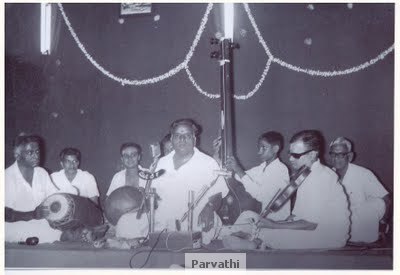
/* START Google Analytics Code*/ /* END of Google Analytics Code */ A home called "Parvathi"

Wednesday, December 30, 2009

How 'eerie' can a phone call get?


Remembering VishnuVardhan


He indeed spread joy everywhere!
Vishnuvardhan and Bharathi in "Parvathi" with the Srikantiahs and Mysore Prabha


How much more 'eerie' does a phone call have to get?

Its 10 a.m. Wednesday Dec 30 in the USA (around 8:30pm in India same day).

A member of the blog is on the phone with Advocate K. Srikantiah wanting to check on some facts related to the old photographs of Karnataka Screen thespians Ananth Nag, Vishnuvardhan and the musical genius Yesudas. In fact, the desire to post the photographs of those names was an inspiration of a couple of days back, as the same member, in accidentally tracking Mr. Srikantiah's whereabouts to Mysore, had finally connected with him but only for a few moments as the latter was about to retire to bed.

Due to the inconvenience of the hour, the blog member was barely able to get past the initial courtesies of a conversation. The only noteworthy sentence that he was able to remember from those few minutes was that the elder had had "...a good time in Mysore connecting with my dear friend Vishnuvardhan for some laughs!..." In someways, this also reminded the member that maybe the next posting on "Parvathi" might as well be on the famed name of Vishnuvardhan and that of the other famous ones that periodically collected in "Parvathi". If so, he needed to speed up the collection and verification of some photographs for the weekend deadline!

The next phone call, made in innocence, today, at the time noted earlier, may perhaps be the eeriest thing that this member would remember for a long time to come in his life "... and I am calling you about putting some Vishnuvardhan's
photographs and thinking of calling it 'Happy times at "Parvathi" '...does the title sound OK to you? "

...and as he waited for the moments silence for the other's elderly voice to synchronize with him in a response, it came in a very sad and feeble but devastating way "... Just want to let you know Vishnuvardhan is no more!...the airways have all been carrying the news....I just came away to Bangalore...left him behind in Mysore... and now he is no more!...how can one forget thirty years and more of this great friendship!...."

This Karnataka screen legend departed his mortal frame of fame around 3am Wednesday Dec 30 in Mysore, on cardiac arrest.

From our side, we can but only honor him in sharing whatever he leaves behind with us!


Vishnuvardhan being honored 1994 along with Mysore's other famous sons! Silver Jubilee Commemeration of Chowdiah in "Parvathi"


Honoring friend Yesudas for his music in "Parvathi"


Friends all - Vishnuvardhan, Bharathi, Yesudas, Srikantiahs and Mysore Prabha


Friday, December 25, 2009

Chowdiah: "I call them but GNB in sarees! "


Whenever the name Radha & Jayalakshmi pops up these days a simultaneous void is cast in many a heart, as is echoed in these sentiments from many members of a well known forum:

“I have an impression that the music world has totally forgotten this duo”
or
“I agree. I was floored by an astounding amruthavarshini and have been searching for more from this duo” or

“Their music is a beautiful breeze” In 50s, they were most sought musicians by almost all the Sabhas.
etc. "

There are any number of reasons (all but only known to the one above) why anyone’s life takes a particular pattern. Ours can only be one of speculation, till the sources themselves decide to reveal the real reasons. Till then, we can only draw upon their beautiful memories and recall them as fresh as they were during the days when theirs was but to command.

We offer the following (close to our hearts) picture of the duo performing in “Parvathi”, Mysore in 1962.

[Courtesy: Book "Sangeetharatna Mysore T. Chowdaiah" by K. Srikantiah; Prasaranga, University of Mysore 2007]

During their performance, a very distinguished guest, a great admirer of theirs and a well known colleague and a friend of their Guru, GNB, happened to drop in to offer them his encouragement; it was none other than Sriman T. Chowdiah , himself! (please look for picture displayed elsewhere). What greater tribute can one obtain than the one that Chowdiah bestowed on them by calling them “GNB in Sarees!” and by adding “Listening to their heavenly performance I have lost my mind!”

We offer you Chowdiah’s living voice from that day:


And, finally, a concert

[01-Paripalayamam-Reetigowla; 02-Rararajeeva-Mohanam; 03-Evarimata-Kambodi; 04-Emani-VeeraVasantham; 05-RTP-Shanmukhapriya; 06-Sharavana-Shanmukhapriya; 07-Tharakka- Tilang ; 08-SHLOKA-Kedaragowla, Saveri;]


Sunday, December 20, 2009

Why their music can only be Divine?


They say that the most miniscule drop of ambrosia is sufficient for immortality.


It is only with such thoughts that we console ourselves and bring you the remnants of an almost destroyed tape, on what might have been an extraordinary concert of the early 60’s by the Alathur Brothers and who else? but T.Chowdiah and Palghat Mani in “Parvathi”, Mysore. While the snatches of a brilliant ‘Tani’ between Mani-Chowdiah in a barely preserved 3 minute ‘Chakanniraja’ reveals their virtuosity, the Alathur Brothers rendering of ‘Epapamu’ (the only fully retrieved piece) reveals an extraordinary devotion. As everyone knows by now, the Brothers were known to be adepts in ‘laya’.

Bhakti’ is the one singular aspect that the great artists from the past brought from their own lives into their performances. Their voices, back then, revealed that aspect of the theatre of their lives. The compositions that they sang all came from Saints who had revelations (Purandara Dasa, Thyagaraja, Muthuswamy Dikshitar et.al.) and who expressed themselves only poetically of their divine experiences ( ‘Kavim Kavinaam Upa mashra vastamam’ ). The ‘Vidwans’ and the ‘Vidushis’ who carried their expressions to us masses were basically ‘Upasakaras’ and fixed in the ‘Niyamas’ of the faith and tradition of their times.

This is brought to us in many ways and in many aspects of all the artists of old; we learn how Chowdiah was devoted to his Guru Bidaram Krishnappa and was a great Anjaneya devotee. We learn of another example, from that of GNB and we let the following words ( written by a person who could not be any closer to him ) amongst other things speak for itself

“... Pooja. He had a mantap built specially for his puja and it had a Mahameru, Srichakram, and also a 8inch panchaloha idol of His ishtadevatha Nadaroopa sundari, made at home on his instructions.”


Of “Parvathi” itself, we have shown of how the place was a transported mini-durbar from the Wodeyar’s durbar, sans the royal regalia. The same leading citizens of art and culture would move from there to here. Through our posting “Homams”, and through participating pictures of Vasudevachar, M.S. Subbalakshmi, Lalgudi Jayaraman, Umayalpuram Sivaraman et.al. we have shown how the ‘yagnas’ of prayer and music would take place. We have Chowdiah himself expressing through an audio of how the matriarch of the family would be found “twenty-four hours” in supplication. On K. Puttu Rao and Chowdiah we found the following interesting link

“... after visiting Kanyakumari we (Chowdiah, K.Puttu Rao and K.Srikantiah) were on our way to Madurai. On the way we halted at a wayside village temple to enable my father (K.Puttu Rao) to perform the evening ‘sandhyavandanam’…..the local onlookers (then) recognized Chowdiah and gasped “Soundayya!” ….the priest (at that point) entered the scene and pleaded Chowdiah to give a ‘sevartha’ concert there…”

To sum up all this ‘devotional’ aspect of the past and difference in generations today we leave you best with the words of the great mridangist Dr. T.K. Murthy ’s take on this:


“Tyagaraja sang and Lord Rama came. Muthuswami Diskhitar sang and Lord Murugan came.

Shyama Sastri sang and Goddess Kamakshi came.

Purandaradasa sang and Lord Narayana came.

Who comes when we sing?

They forgot themselves when they sang. That is bhakti. They were totally devoted to their God.

It is not like the way we sing today.

These days we pray that we will go to the temple and break 2 coconuts if we get 1 lakh rupees or if a marriage gets fixed.

We must totally surrender to God! "


Now, onto whatever music we could save.


Tuesday, December 15, 2009

1970 - A Watershed Year

[Photo Courtesy: Academy of Music, Bangalore]
President of India A.P.J.Abdul Kalam at the Chowdiah Memorial 25th year Jubilee
honoring eminent musician Pandit Shivkumar Sharma
[Left to right: President of India A.P.J. Abdul Kalam, Chief Minister Karnataka N. Dharam Singh, Pandit Shivkumar Sharma, Music Academy President K.K. Murthy (who invited the President), Karnataka Governor T. N. Chaturvedi and Transport Minister M. Mallikarjun Kharge.]


We have hinted, in many of our earlier postings of how 1970 was the ‘watershed’ year in the Chowdiah Memorials coming up.

The popular newspaper The Hindu, in attempting to capture the same sentiment on the 25th anniversary celebration of the Memorial in 2005, wrote inline “As he walked one morning in a park, K.K. Murthy, former chairman of the BDA ruminated over M.L. Vasanthakumari's concert he had heard the previous evening at the Ramanavami music festival. "I remember the concert went on till midnight and it was heaven," recalls this working president of the Academy of Music, an independent registered body that administers the Memorial Hall.”
K. K. Murthy’s words "the previous evening" related to April 15, 1970, the evening in “Parvathi”, Mysore, honoring the memory of T. Chowdiah.

The Mysore event had been inaugurated by Karnataka Governor Dharmavira (a very popular Governor in India) along with Karnataka Industries Minister Rajasekhar Murthy, who by then had both become close friends to the house of “Parvathi”. T. Chowdiah’s violin was on display to the thronging crowds of his native town and the joyousness of the occasion coupled with ML Vasanthakumari’s music, her eulogizing Chowdiah and the aftermath of dinner with those that mattered culminated in the ‘Sankalpa’ that there must be a fitting memorial to the memory of such a great stalwart of Carnatic Music.

But, as the earlier Hindu article also pointed out, this was an act easier said than done! As the son of the man who spearheaded the project K.K. Murthy recalls in a posted video on the blog , the bank balance was but an astronomical figure of only Rs. 500! ($10 in today’s conversion).

What followed, is something for the history pages to decide, as we leave you here with some connecting pictures, a full concert by Vidushi MLV and her speech, all for your enjoyment.


Minister Rajasekhar Murthy addresses, while an attentive Governor Dharma Vira listens


An evening of 'trupthi' with Vidushi ML Vasanthakumari and party

[ 01_Jagadanandakaraka_Nattai;02_Manasu Nilpa_Abhogi;03_Saketanagaranatha_Hari Kambhoji; 04_Bhagayanayya_Chandrajyothi;05_Eduta nilachite_Sankarabharanam; 06_Mariyadagadayya_Bhairavam; 07_RTP_Shanmukhapriya;08_Yake Nirdaya_Ragamalika; 09-Shloka, Amrutahuni goad, Baliyamanege,Baro Krishnayya_Ragamalika; 10_Pavamana Mangalam_Saurashtra; ]


AUDIO PROBLEMS? CLICK HERE


Leading by example? Academy of Music President K.K. Murthy occupies a front row listening to MLV.
That 'rapt attention' would pay dividends later!


Some others too with a rapt attention on MLV!
Prof. H.S.K. Iyengar, India's great novelist R.K. Narayan and Agaram Rangaiah, Editor "Sadhvi".


Ah, even a Governor eats with his hands when the dinner is in "Parvathi"!
Minister Rajasekhar Murthy, K. Srikantiah, Governor Dharma Vira, K.K. Murthy

Finally, remembering the man who came to the support of a Memorial !


Advocate Srikantiah's family at home to Chief Minister Gundu Rao and Mrs. Varalakshmi Rao


Academy President Murthy ,too, remembers in gratitude!
Felicitating Mrs. Varalakshmi Rao with Karnataka Chief Minister Dharam Singh


Wednesday, December 9, 2009

The first woman to perform the RTP : Sangeetha Kalanidhi Vidushi D.K. Pattamal


With this posting, we bring you that ‘grand old lady’ of our Carnatic musical heritage and Padma Bhushan, Smt. D.K. Pattamal, about whom we find ourselves unable to add any more to the extraordinary amount of material that is already out there. As the year winds down, however, we remember with certain sadness, that it was only this July that she passed away from our midst. In her wake, however, she has left behind such a rich and lasting legacy that we feel that our own lifetimes may be insufficient to absorb even a sufficient amount of her.

In paying homage to her, we would like to just remind ourselves of the core things that made up her personality,the formative years of her life and just how rare were her gifts and accomplishments.


“…She received no formal Gurukula training. As a child, (she) would sit through the concerts, and on returning home, would notate the kritis she heard, and key phrases of ragas…She would also sing simple devotional hymns and songs that her father had taught her…Later, she received tuition from an unnamed Telegu-speaking musician, whom she would call "Telugu vadyar" or "Telegu teacher"…. At age 8, she won first prize for singing Thyagaraja’s "Raksha Bettare" in Bhairavi, at a competition…”


“(In later life) her knowledge was encyclopedic and she was considered as an authority on Muthuswami Dikshitar’s compositions.…(She) was also the first woman to have performed the Ragam Thanam Pallavi (RTP) in concerts…She was not just a musician, but a patriot and freedom fighter who used her art to propagate the struggle for Indian independence...."


[courtesy of words borrowed from
Wikepedia
and 'Rasikas']

We leave you with a snapshot of Vidushi D.K.Pattamal performing in "Parvathi" in 1976 with Vidwan D.K. Jayaraman, Vidwan Seshagiri Rao (violin) and Vidwan Kuniseri Krishna Mani Iyer (Mridangam, and teacher of Vidwan Mannargudi Easwaran) along with the audio from the concert


If the audio doesn't play, please click here

[01-Varnam-Pantuvarali; 02-Evarani-Devamruthavarshini; 03-Sujanajeevana-Kamas; 04-Nadachi Nadachi-Kharaharapriya; 05-Sandehamu-Kalyani; 06-Elavatarame-Mukhari; 07-He Kamakshi Ekambreshwari-Yadukula Kambhoji (composer 'Andavan Pichai') ; 08-Mohanarama-Mohanam; 09-Bhajare-Abheri; 10-Mamava PattabhiRama-Manirangu; 11-Neenaayako-Ragamalika; 12-Nan Oru Vilayattu Bommeyya-Khamach; 13-Shloka & Theeradavilyattu-Ragamalika; 14-Kavadi Chindu-Bhairavi; 15-Rama Enniro-Vasantha; 16-Thillana-Bilahari; 17-Bhavayami Raghuramam-Ragamalika ]


Thursday, November 19, 2009

Brahmachari and a person called UG Krishnamurti


"U.G. is not a teacher."
"He is a friend to you when your own teacher has become your enemy"
- (late) Vijay Anand, film director

If words like 'anti-Christ', 'anti-Guru' etc. have managed to create philosophical speculations for a good number of years in our world, then the good citizens of Sankar Mutt in Bangalore, members of a Bollywood industry ( Mahesh Bhatt , late Vijay (Goldie) Anand, late Parveen Babi ), and parts of the California and European worlds would not be found lacking for similar thoughts following astounding experience(s) with the personality of the late "UG" ( U.G. Krishnamurti ) .


Some have attempted to compare UG to a modern day Rasputin in struggling to come up with an image for him. Others have been simply caught numb, mesmerized by the provocative thoughts and pronouncements of an extraordinarily mysterious man. Some have thought of him as a thinker's thinker as he continued to pulverize all notions of a religious world; indeed of any world that chose to think in terms of the structure of a God or Divinity .

Growing up in a milieu of prayers, chanting, sacred music and amidst Shankaracharyas , it was indeed a fascinating walk that Brahmachari Shivaram Sharma ( Kunigal Shivaramiah, fourth son of K.Puttu Rao ) took from growing up in the shelter of "Parvathi" to finding himself besides UG and to decades of an association with the latter.

If there are any gleanings to be drawn from a reading of lives in the links provided, it is only to remind ourselves that this process that we call life is indeed but an extaordinary journey.

We present to you a UG, in the most expressive of terms by the late Brahmachari Shivaram Sharma (borrowed from the link on UG), and leave you to further fascinating readings within the same:


U.G. -- AN ENIGMA
--Brahmachari Sivarama Sarma


[Brahmachari Sivarama Sarma was once professor of Chemical Engineering at the Indian Institute of Science, Bangalore, India. He joined the Indian Administrative Service in the Nehru administration as Chief Engineer in the Sindhri Fertilizer Factory and resigned the job when Nehru pressured him to go to Russia. He then dedicated himself to spiritual pursuits under the guidance of the Sankaracharya of Kudli Math in the Karrnataka State, who subsequently chose him as his successor. But factional intrigue prevented him from accession to the seat (pitha= "seat" of religious authority). --Editor]

" The Naiyayikas (followers of one of the six orthodox systems of Indian Philosophy which specializes in logic and theory of knowledge) have declared that knowledge of the sixteen fundamental categories propounded by them would lead one to moksha (liberation). The scientists have vouchsafed that the knowledge of nature and the discovery of its mysteries will lead one to final and total happiness.


Both the claims have been negated by an `experience' which is intellectual and conceptual and is pushing mankind toward total annihilation. Here comes a man called U.G. who knows something of our Shastras (scriptures) but condemns them outright.


Who is this U.G.? What does he stand for? What are the principles of his teaching? What are his ideas? What is the meaning of his roaming around the world twice a year spending thousands of dollars on air travels and moving from continent to continent like a migratory bird?


In spite of my contact with U.G. for two decades I am unable to make out exactly what he stands for. I am unable to place him either as a `sage' or as a `saint', much less a social reformer.


U.G. doesn't give public lectures, nor does he belong to any institution. But people go to see him wherever he is and flock around him discussing all sorts of things `from disease to divinity' (as he himself would put it), including sex, morality, politics, and corruption.

He shuns religious persons, ridicules social reformers, condemns saints, speaks with disgust about sadhakas (spiritual aspirants), detests the chanting of the Vedas or the recitation of the Upanishads, and is full of rage when one speaks of Shankara or Buddha. He becomes furious of the very mention of Sai Baba or Rajneesh. The height of his rage could only be seen when `J.Krishnamurti freaks' approach him.


He doesn't give any solution to any of the problems raised and avoids questions on `enlightenment'. Whenever he gets entangled in a controversy he says, "It is so. Take it or leave it." Whenever he is confronted with arguments he becomes violent and says, "Who asked you to come here? You may get up and go. That's fine with me."


U.G. is a good conversationalist. He can speak confidently on any topic, be it economics, politics, history, or geography. He gives the impression of being a jack of all trades. He has studied a bit of Vedanta and is quite an expert in misquoting the passages from the Upanishads to suit his argument. When he is questioned about the authenticity of his statements he lashes out saying, "What I say has an authority of its own." Isn't it an egotistic attitude to make such claims, as if he is a `sage' or God?...


He is against morality, but refrains from preaching immorality. He gets wild when somebody speaks of honesty, though he is not dishonest himself. He is a bundle of contradictions. He statements are devastating. His ideas are shocking. His expressions are bewildering. His utterances are irritating.


Yet, I am pulled toward such a person! Is it my weakness? No. Or is it because of my passivity or cowardice, or incapacity to stand on my own? No. Not at all. Then what? I don't know! I don't give a tuppence for what he says on matters religious, much less his teaching. Yet, there is something in him that drags me to him.


He is like a machine gun shooting anything that moves in its vicinity. We only seem to be supplying the bullets.


What a tragic situation! Is this `hero worship' on my part? Am I idolizing? No. Certainly not. Am I then foolish or stupid? Am I such a gullible fellow; a fainthearted chicken? Is it the pusillanimity in me? Oh, man! Answer your conscience, if you have any left of your own. What avail is all your holy associations, your Japa (worship and meditation) and the like, if you still hang around him in spite of your distaste toward his way of life and teaching?


Yes. These are the questions I often posed to myself. I found no answers. I made up my mind not to think about him any more; nor bother to visit him. And yet, the moment he is anywhere near Bangalore my nerves reverberate! I become restless and find no peace till I run to him. Why? Why? Why? ...


There is yet another aspect of U.G.'s life, a totally different side of this man. He is very simple and behaves like a child. He acts meticulously and doesn't make a mess of things. Whenever a new visitor comes he receives him with all kindness and courtesies. When people are in difficulties, he helps them to come out of their troubles. Yet he says he has no `bleeding heart'.

He is at his best when he explains the chemical changes that have taken place in his body.


What have I gained in my twenty years of association with him? As a result of my contact with him my attachment to Gurus and sannyasins (holy men) has faded away. I have lost all my interest in visiting temples and sannyasins. Havanas and homas (oblations) which I was regularly performing have dropped away. I felt and still feel that dropping them, however, is not the be-all and end-all of existence.

Is it possible to reject totally whatever he is saying and go your own way? Impossible. At the same time, is it possible to swallow all that gibberish that he throws at you? That is out of the question. That is my predicament!


But then when someone asks, "Who is this U.G. whom you are talking about?" what answer can I give? Is he an enigma? Yes. It is impossible to gauge him. The Gurus and God-men we have in our midst to-day are no match to him. He is unique in every way. He is an undaunted spirit. He is a daring and fearless person.

Hearing him is one thing and being with him is altogether different. Meet him. Listen to him and you will yourself know what I am talking about. Don't bother about what he says. Don't try to know "THAT which is beyond words." If you attempt to do so, you may "land up in the loony bin singing loony tunes and merry melodies," to use his own expression. Or, to put it also in his own words: "You may have to go and hang yourself on the tallest tree with the longest rope."


This much is certain. You will not be the same after meeting him. You will start questioning your own actions--their validity and their usefulness. This is the help that he renders. He puts you on your path in a subliminal way and removes the cloak which you put on, trying to be what you are not. That's the sort of help you get from him. "


[Thought provoking times with UG in Bangalore, in the 1970s]
[Courtesy: ‘Stopped in our Tracks’ Second Series part 2 by K.Chandrasekhar; Editor J.S.R.L. Narayan Moorty]


Mahesh Bhatt talks on UG and Brahmachari Shivaram
[ Excerpted from the book U.G. Krishnamurti: A Life by Mahesh Bhatt ]
" U.G. and Brahmachari have for more than twenty years shared a volatile relationship. Brahmachari apparently had the world at his feet when U.G. stepped in and prevented him from getting it. The story goes that before dying the pontiff of the Kudli Math nominated Brahmachari as his successor. This meant being an heir to a property worth hundreds of millions of rupees, a fleet of cars and a residential palace in the heart of the city of Bangalore. A contest for the throne began when a rival stepped in, challenging Brahmachari's succession. This was the beginning of a long-drawn legal battle for the throne. Obviously both sides had much to gain. Little did Brahmachari know that even his life was in danger. Had it not been for U.G., who for three months, till the appointed day of coronation, sheltered him, Brahmachari's life would have ended in a tragedy. Every day, from dawn to late night, U.G. kept him under his guard, preventing him from venturing out, dissuading him from entertaining the idea of becoming a pontiff of the math. Brahmachari was permitted to go back home every night only when it seemed safe. On the day of the coronation, when his dream of scepter, throne and crown came tumbling down and his rival ascended the throne, Brahmachari was with U.G. The next day Brahmachari took him to visit a piece of land granted to him by the Karnataka Government. That same evening U.G. dropped him off at his residence, which happened to be a garage, and handing him two rupees, the remainder of the cab fare, said, 'With this, start your own ashram...' Months later, with the assistance of the Karnataka Government, Brahmachari set up a huge ashram on the outskirts of Bangalore, in which he also built a school, a temple, a guest house and cottages for the elderly. "


"Brahmachariji brings the Brahmajnani "

[ Title and text below excerpted from the book Stopped in Our Tracks : Stories of U.G. in India By K. Chandrasekhar, J. S. R. L. Narayana Moorty ]


" After Barry left, all the friends in the hostel talked for a long time about the things they had heard from him about U.G.
That same night, about 9 p.m., suddenly Mr. Brahmachari, a spiritual teacher who later became a friend of U.G., appeared outside the hostel. "I don't have much time. I am just arriving from Mysore to tell you of an important event. Tomorrow morning a Brahmajnani is coming to our 'cave'. Take a leave of absence in your offices, come to the Cave and meet him," he summoned. Who is this Brahmajnani that was going to sanctify Mr. Brahmachari's Cave? Normally Brahmachariji did not invite anyone to the Cave.
"He is U.G.Krishnamurti. Everyone calls him U.G." These words of Mr. Brahmachari resounded in my ears. I couldn't believe myself hearing them.
"Who? U.G.? The man who recently arrived from Switzerland?" I asked, containing my amazement and excitement with great difficulty. Mr. Brahmachari turned pale: "How do you know him? When did you meet him?" "I have heard about him. But I haven't met him yet. I am going to see him tomorrow morning," I briefly reported to him what had happened earlier with Barry."
"So, the publicity has started even before he has arrived in Bangalore. I met him in Mysore. When he told me he was coming to Bangalore, I invited him to the Cave."
"What sort of a man did he appear to be when you saw him?" I asked Mr. Brahmachari.
"I have no doubt that he is a true Brahmajnani. Wisdom dawned on him in a peculiar way. If you look at his eyes, it is absolutely certain that he is a jivanmukta. No matter how long I observed him, I could not find him blinking. His skin is soft and smooth like silk. Why try to know the taste of the curry when you are going to eat it? You will see him tomorrow." So saying, he left hurriedly.
That night I marveled: "What is this? Is this a dream or is it true? Or is this an illusion of Vishnu?" Such was the state of my mind. "I heard about him this morning. And tonight I have this news. Are these events coincidental? Or is this a grace from a mysterious force? Or is this merely my good fortune?" I pondered for a long time. "Tonight is a long night. When will it be dawn?" I laughed at my own craziness and dropped off into sleep.. "

Below, is the life of UG life as foretold by a Nadi Reader.......

"...So, the nadi reading resumed. 'This man will rise to prominence in his ravidasa (the phase of the Sun) like the rising Sun. Having been displaced from his native place, he never stays in any one place long. He does not go through initiation of any kind, he is born with it. His teaching is not like the teachings of hermits and jungle-dwellers. The light of his teaching keeps spreading everywhere. But he thoroughly disappoints those who come to him hoping to get somewhere. This person should be addressed as "atma" and not as "man" (implying that individuality is absent in him)...."


Brahmachari Shivaram seen with the Nadi reader who read UG's life


2012 Update: Associates of the late Brahmachari Shivaram Sharma and UG discuss the androgynous form of UG found in a painting.

L to R: K. Ravishankar, R. Sachi , 'Sripada' ( as named by Brahmachari ), K. Babu Chandrasekhar ( Author, Biographer of UG ), Shashidhar Arkalgud ( back to camera )


Sunday, November 8, 2009

Remembering Dec 3 as Vidwan Maharajapuram Santhanam Day, Each Year

In remembering Maharajapuram Santhanam's great compositions and the great 'bhakti' in his singing, we are reminded simultaneously in thinking of the Lord Murugan (who was the 'self' in several of his compositions) and of the great Seer of Kanchi, Chandrasekhar Saraswati Swamigal for whom he had a very great devotion. Maharajapuram Santhanam was a very honored guest in "Parvathi" and was accompanied in his concerts by the greatest Vidwans of his times. In 1972 he was joined by M.Chandrasekharan (violin) and Palghat Raghu (mridangam). 1977 saw him featured with Chandrasekharan (again) along with Guruvayur Dorai (Mridangam) and Ramachar (Kanjira). The next year 1978 saw him with Lalgudi (Violin), Vellore Ramabhadran (Mridangam) and M.A.Krishnamurthy (Ghatam). He completed the hat trick in 1979 again with Lalgudi, Ramabhadran and MAK and such was his draw that he went on to perform at the same venue for the next four years; 1980 (MC-VR-Ramachar), 1981 (Lalgudi, VR, MAK), 1982 (Lalgudi, VR) and 1983 ( V. Thyagarajan, Tanjore Upendran) .

[Palghat Raghu - Maharajapuram Santhanam - M. Chandrasekharan - Vikku Vinayakaram at "Parvathi", Mysore, March 28, 1972 ]
The Concert April 18, 1978 at "Parvathi" Maharajapuram Santhanam ---Vocal Lalgudi Jayaraman --- Violin Vellore Ramabhadran --- Mridangam M.A.K Murthy --- Ghatam 

Song List

 01. Brochevarevare - Sriranjani; 02. Rararaghuveera - Atana; 03. Saramegaani - Pantvarali; 04_Enthanerchina - Shuddadhanyasi; 05. Theliyaleru - Dhenuka; 06. Najeevadhara - Bilahari; 07. UrakeGalguna - Sahana; 08. Thungatheeravirajam - Ragamalika; 9.  Bansiwale - Mohanakalayani;10. Sreechakraraja - Ragamalika; 11. Tathwameruga - Garudadhawani; 12. Thillana; 13. Mangalam.