/* START Google Analytics Code*/ /* END of Google Analytics Code */ A home called "Parvathi"

Saturday, July 14, 2012

Rama’s story was always meant to be sung - Malladi Brothers’ Duet- 2006


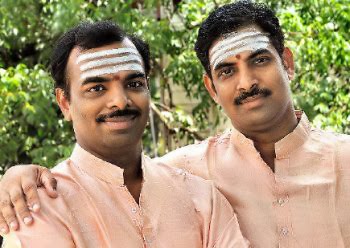
We are happy to feature a duet by the popular Malladi Brothers this time.


Malladi Brothers (Vid. Sreeramprasad and Vid. Ravikumar) have a musical lineage that includes their father and grandfather as well as three outstanding gurus: the highly respected scholar Sangeetha Kalanidhi Dr. Sripada Pinakapani, the long-famous Sangeetha Kalanidhi Sri Nedunuri Krishnamurthy, and the creative genius Vid. Voleti Venkateshwarulu.

Malladi Brothers have rich and facile voices that combine well and make an impact from the word go. Carnatic music shines when presented in rich resonant male voices that euphoniously harness violin and mridangam accompaniments. This is on full display in the concert we feature here. Malladi Brothers are currently very active performers all over the globe. They have come and sung in Parvathi festivals a few times.


( Courtesy: The Hindu )


In Carnatic music, there are many famous duos past and present: brothers and sisters who have made a lasting impact, like Alathur Brothers and Radha Jayalakshmi. What is the instant appeal of duos? It is interesting to know that in a way the very first documented musical concert was that of twins, Kusha and Lava. They sang for no less an audience than great sages and in Lord Rama’s court. They had been trained by Valmiki himself! What a glorious concert tradition! We reproduce the relevant verses from the opening pages of Valmiki Ramayana:


Translation: That sage Valmiki after observing sacred vows has rendered the entire epic in the name of 'Ramayana', 'Sublime Legend of Seetha' and 'elimination of Ravana'. To read or to sing it is melodious, adaptable to music with three scales and sevenfold tune, and orchestral to the tunes of string-instrument and rhythm included. Aesthetics like romance, pathos, comic, fury, fright, valour etc., embodying the epic. This is sung by Kusha, Lava. They are conversant with the art of music and proficient with the pitch and pausing their voices, and those two brothers have not only a wealthy voice, but they also look like celestial singers. They have charm in their appearance and melodiousness in their voice, they are like the two reflections of one original object, and thus they came out from the body of Rama, separately.


So Malladi Brothers are in a long and illustrious line of duos who have captured our hearts through the ages with their music!

The Paramaguru of Malladi Brothers, Dr. Sripada Pinakapani, holds a high place among the scholarly musicians of our country. In his childhood, no one would have predicted a musical career for this would-be physician, as he was averse to delve into the “girlish pursuit”. But his musical vistas opened when at the age of 11 he began lessons with his sister’s music teacher Mysore Lakshmana Rao, who taught him first a krithi in Todi (The Hindu). As they say, the rest is history. The Todi song referred in The Hindu interview is the second piece in the concert we feature here.

The brothers go on to give us a concert of rich repertoire, including two major raga essays-Pantuvarali and Kharaharapriya. Kharaharapriya is the centerpiece, with elaborate raga alapana, a vibrant krithi “Pakkala Nilabadi” embellished with with neraval and swaras, followed by an energetic thani avarthanam.

In Pantuvarali, a melodious vocal essay is presented with many meditative moments, well complemented by the violinist. Pantuvarali ( The correct technical name is Kamavardhini) comes out as a raga of great power from Thyagaraja. We feel this raga’s timeless appeal stems perhaps from its nodal alignments to Kundalini chakras! This is probably an area for deep research, an idea supported by two recent articles on this raga: A Raga’s Journey: Poignant Pantuvarali and Mystical Flights of Ragas. We can gauge Thyagaraja’s assessment of this raga’s musical and devotional impact by listing just the famous compositions (there are many others too):

1.Vadera daivamu manasa
2.Siva Siva Siva yana rada
3.Raghuvara nannu
4.Sambho Mahadeva
5.Saramegani
6.Naradamuni vedalina
7.Ninne neranamminanura
8.Appa Rama bhakti

So all in all, in this concert, we dwell in the realm of a classical art form that traces its beginnings to Valmiki and Kusha-Lava duo. We are treated to some absorbing concert fare by Malladi Brothers representing a great guru parampara. We have some wonderful delineations of Patuvarali and Kharaharapriya (the eternal Parvathi favourite). So let us sit back and enjoy the concert!


CONCERT DETAILS
(Ramanavami Music Festival, held on 8 April 2006)

Malladi Sreeramprasad and Malladi Ravikumar – Vocal Duet
Mysore V. Srikanth – Violin
Tumkur Ravishankar – Mridangam
M.A. Krishnamurthy - Ghatam

Song List:

01. Evari Bodhana – Abhogi Varnam – Patnam Subrahmanya Iyer *** 02. Gajanana Yanuchu – Todi - ? *** 03. Sita Lakshmana Sahitam – Athana – Thyagaraja *** 04. Vadera Daivamu – Pantuvarali – Thyagaraja *** 05. Sringara Lahari – Neelambari – Mysore Lingaraje Urs *** 06.Ninu Vina – Balahamsa – Mysore Sadashiva Rao *** 07. Kharaharapriya Alapana *** 08. Pakkala Nilabadi – Kharaharapriya – Thyagaraja *** 09. Tani *** 10. Kande Na Govindana – Mand – Purandara Dasa *** 11. Akati Velala – Revati – Annamacharya *** 12. Ramachandru Ditadu – Dwijavanti – Annamacharya *** 13. Anta Ramamayam – Varali – Bhadrachala Ramadasu *** 14. Bayarani Baliche – Kapi Javali – Tirupathi Narayanaswami *** 15. Patiki Harati re Sita– Surutti – Thyagaraja *** 16. Mangalam *** (Please note this recording was not made from a line-in audio).


Friday, June 15, 2012

The Glory of Serving the Lord is also through His Grace: Prof. T. R. Subramanyam at "Parvathi" 1973


We bring to you a splendid concert by Prof. T. R. Subramanyam this time. A recognized scholar, teacher and gifted musician, he has shone in Carnatic music for many decades now. We had earlier posted a concert of his to much appreciation. This time too, his concert has all the ingredients of a memorable performance, with wonderful accompaniment by Sri M. Chandrasekharan, Sri Vellore Ramabhadran and Sri K.S. Manjunath.


(2009 photo, Courtesy: The Hindu)


A noteworthy inclusion in this concert is a rendering in Khamach of a rare composition of Mysore Sadashiva Rao (ca. 1790-1880). Being a disciple of Walajapet Venkataramana Bhagavatar (a disciple of Saint Thyagaraja), Rao is said to have met and served the saint in Walajapet. He moved later to Mysore and became the royal musician in the court of Krishnaraja Wodeyar III. His famous disciples included Veene Sheshanna and Veene Subbanna. Mysore Vasudevacharya is said to have compiled his compositions. Vidwan Sadashiva Rao is hailed as the harbinger of the Mysore Bani.

In his brilliant book, “Splendours of Royal Mysore”, Vikram Sampath narrates an interesting episode. Sadashiva Rao’s definitive night-long exposition of Todi brought a misguided musician to his senses. The musician had before arrogated to himself mastery over Todi and had even mortgaged the Raga for a financial consideration to a zamindar in his native land. After listening to Rao’s Todi, he surrendered his ego and confessed that he had not known the heights of Todi before. Wodeyar himself came in disguise to witness the master class, and later revealed himself to honour the great vidwan. Vikram Sampath also narrates that a young Sadashiva Rao had at a young age composed and presented extempore “Thyagaraja Swamy Vedalina” in Todi to Saint Thyagaraja himself and won his appreciation and blessings. Many interesting episodes from Mysore Sadashiva Rao’s life are listed also in karnatik.com. His famous compositions are Saketa Nagaranatha (Harikambhoji) made famous by GNB, Ee Maguva (Dhanyasi), and Sri Kamakotipeethasthite (Saveri).

In the Khamach composition, “Sadashiva Kavi” sings of the lord of Srirangam, describing in detail His grandeur as the deity goes in a procession, and how devas, rishis, and Vaishnavas are performing devotional services. The composer says he is blessed to attend the grand event in Srirangam, and be able to serve the lord, and says that it is all His grace. This sentiment is highly evocative for all of us, as we consider how the Sri Rama Navami festivals initiated in Mysore by Vid. Sadashiva Rao afterwards inspired generations of musicians and rasikas like Bidaram Krishnappa, Sri Puttu Rao, Mysore T. Chowdiah and our own Mr K. Srikantiah, to continue the glorious tradition. This has been a continual act of worship joined by a galaxy of great musicians, some of whom we feature here.

The enthusiastic accompaniment of Vid. M. Chandrasekharan and Vid. Vellore Ramabhadran often draws out appreciation from the Prof., with words “Appadi!”, “Appadi!” The rich atmosphere of inspired manodharma sangeetha by the ensemble abounds in creativity and even a touch of flamboyance, and all rasas are served in full measure to the lucky set of rasikas. In reflection, all the bells and whistles added by TV Mahotsavams today seem peripheral to the fundamental, rich mood of Carnatic music. Nothing indeed seems lacking in this presentation 39 years ago by Prof. T. R. Subramanyam.

There is more. The musician has chosen a Kannada poem to present like a viruttam. It is composed by Betageri Krishna Sharma (1900-1982)-his pen name was Anandakanda- who was a school teacher, poet and journalist. He composed the following poem in Belgaum in mid-1930’s. We reproduce below an extract from Sahitya Akademi’s History of Indian Literature: .1911-1956, struggle for freedom : triumph and tragedy by Sisir Kumar Das:


We are sufficiently inspired by Prof. T. R. Subramanyam’s brilliant rendition (in ragas Mohana, Kannada, Bageshri and Abheri) to give you the full text of the poem:


A rough translation:

How wonderful is this Kannada language, an enchanting nectarine flow! It’s akin to the high-pitched songs of parrots, the joyous songs of cuckoos, the tête-à-tête of squirrels in early morn.

Its melody flows from the lips of Goddess Sarasvati, singing to her vina’s accompaniment in unceasing splendour.

The cascade from Krishna’s flute has inspired gopis to dance in moonlight, and that joy has filled Kannada.

Well, we reluctantly come down to earth from that mood, and give you the list of songs. Mr. Srikantiah points out that in this concert also, Prof. T. R. Subramanyam has shown noteworthy prowess in kalpanaswaras, especially daatu movements and swaraksharas, that will have an amazing appeal to rasikas.


Ramanavami Concert, Parvathi, Mysore
Date: 18th April 1973

Vidwan T. R. Subramanyam – Vocal
Vidwan M. Chandrasekharan – Violin
Vidwan Vellore Ramabhadran – Mridangam
Vidwan K. S. Manjunath – Ghatam

Song List (Please note the mridangam sounds prominent in this 39 year-old mono recording)

01. Kanada Varnam Nera Nammithi – Ramnad Srinivasa Iyengar *** 02. Gajavadana – Hamsadhwani- Purandara Dasa *** 03. Neebhakti bhagyasudha- Jayamanohari – Thyagaraja*** 04. Paramadbhuta Maina – Khamach – Mysore Sadashiva Rao *** 05. Mama hrudaye – Reetigowla – Mysore Vasudevachar*** 06. Varanarada – Vijayasri – Thyagaraja*** 07. Meevalla –Kapi-Thyagaraja *** 08. Vaddane Varu- Shanmukhapriya – Thyagaraja *** 09. Tani (partial)*** 10. Etu nammina – Saveri – Patnam Subrahmanya Iyer *** 11. Ragam Tanam Pallavi – Sriranjani+Kanada *** 12. Enitu Inidu (Kavite) – Mohana, Kannada, Bageshri, Abheri – Anandakanda*** + Bhajare Manasa – Mysore Vasudevachar *** 13.Ma Ramachandruniki shubhamangalam- Kedaragowla- Thyagaraja ***


Thursday, May 10, 2012

Mandolin U. Shrinivas – Puttu Rao Memorial Concert 2011


A VIBRANT MILEU OF CREATIVITY CALLED CARNATIC MUSIC

by

R. SACHI


We feature this time a brilliant concert held last year at the opening of the Puttu Rao Memorial Concert series on 31 August 2011.

Held in the Jaganmohan Palace, Mysore, the concert marked an auspicious beginning for the new festival, and also brought a heavy downpour in the city. Braving the weather, a few hundred rasikas came to attend a memorable concert.

The story behind the scenes was no less dramatic. Vidwan Shrinivas had come straight from his US tour, and his baggage was wrongly directed by the airline to Mumbai. There were only a couple of hours before the concert after the KFA flight landed in Mysore. What was needed was an assortment of electronic amplification attachments for the mandolin as well as the artiste’s concert attire. The elderly host Sri.K. Srikantiah and his assistants managed to put everything together in a short time. A much relieved Vidwan Shrinivas came up with a highly cherishable recital.

The concert is recorded in good quality audio. Vidwan K.V. Prasad has provided sonorous and highly responsive mridangam accompaniment.


We bring you the whole concert on audio as well as a You Tube clip of the opening moments.


It is befitting to ruminate on how Carnatic music has embraced the phenomenon called Mandolin Shrinivas before we give you the full audio stream.

A few years ago, I was asked to recommend some music to be played at a family function attended by music lovers. The music had to be classical, yet contemporary and beyond banis and genres. I readily suggested Mandolin Shrinivas’s CDs. Which one? Anyone would do, I said. After all, his music sets an Olympian benchmark in creativity, melody, classical interpretations, lyrical depth, rhythmic dynamics and variety. There is NO other musician like this genius.

How come we have such a phenomenon called Mandolin Shrinivas in a highly tradition-bound mileu called Carnatic music?

In afterthought, the answer is not difficult to understand. Carnatic music traces its beginnings to Saint Purandara Dasa some five centuries ago. At the same time, Carnatic music has shown a great capacity for creative evolution and sometimes even revolution so much so that it is garnering new audiences worldwide even today. This dynamic mileu is unparalleled in its many dimensions:

1. The range of ragas, a few hundred of them, all organized in a beautiful structure, codified and exemplified by the stalwarts’ renditions. Some innovations are seen in this area even today.

2. The range and complexity of talas, or rhythmic cycles, with complex, dynamic, slow/fast structures with a beauty unique to Carnatic music. The tala dimensions are constantly innovated and unravelled by great exponents even today.

3. A whole world of compositions, all dedicated to our deities, and telling a wonderful story full of rasa. This lyrical dimension is best described as an ocean, with unfathomed depths and countless treasures.

4. Incorporation of western instruments like violin, guitar, piano, and mandolin into mainstream music. A whole new variety of wind and percussion instruments have also ascended the concert stage.

5. Enthusiastic adoption of electronic amplification for the concert stage.

Not all these innovations meet with universal approval. But even then, critics do not protest with any belligerence. It seems almost that “we are willing to try anything once”.


We need to remember these aspects in order to understand the phenomenon called Mandolin Shrinivas. Not only has this genius wowed the biggest exponents of Carnatic music, he has also experimented and extended his presence on the world music stage in an emphatic way. Mr. Srikantiah told me how Vidwan Shrinivas was invited to perform at the Barcelona Olympics. A fitting honour for a creative genius who is one of the finest examples of the youth of shining India.

We don’t need to dilate on this subject. We merely refer the rasikas to Mandolin Shrinivas’s website.


Concert Details ( held on 31.8.2011)

U. Shrinivas (Mandolin)

V.V. Srinivasa Rao ( Violin )

K.V. Prasad ( Mridangam )

G.S.Ramanujam ( Ghatam )


Song List

01. Viriboni – Varnam, Bhairavi – Pachimiriyam Adiappayya***

02. Sharanu Siddhivinayaka – Saurashtram- Purandara Dasa ***

03. Raghunayaka – Hamsadhwani – Thyagaraja ***

04. Annapoorne – Sama – Muthuswami Dikshitar ***

05. Mokshamu Galada – Saramathi – Thyagaraja ***

06. Varanarada – Vijayashree – Thyagaraja ***

07. Rama Nee Samanamevaru – Kharaharapriya – Thyagaraja *** Thani Avarathanam ***

08. Krishna Nee Begane – Yamuna Kalyani – Vyasaraya ***

09. Chinnanchiru Kiliye – Ragamalika – Subrahmanya Bharathi ***

10. Bhajan – Ahir Bhairav ***

11. Thiruppugazh – Desh ***

12. Chandrashekhara – Sindhu Bhairavi – Aanai Vaidyanatha Iyer ***

13. Dhanashree Tillana – Swathi Thirunal ***

14. Mangalam ***


Friday, April 27, 2012

Reliving Beautiful Moments with Vidushis Radha Jayalakshmi, 1962


In an earlier posting we spoke of the visit of the Vidushis Radha & Jayalakshmi to "Parvathi" in 1962. But, we were not ready then with the concert from that performance ( you can guess why? ).

Instead, we posted another one of their performances from "Parvathi", the April 9, 1971 concert with Vidwans Kandadevi Alagirisamy (Violin) and Vidwan Mannargudi Easwaran (Mridangam). This was along with Sri. T. Chowdiah's 1962 speech, highlighting only a few of his words.

Smt. Radha and Smt. Jayalakshmi ( connected both by blood as cousins, and in music through their sheer artistry ) have left many a beautiful memory in "Parvathi".

If connoisseurs of wine are permitted a gush over the quality of a product depending on how old it is, then how much more meaningful would it be for us to be revering these great artists of the past, on music meant, only as 'ambrosia' for the Gods?


To retain the historical perspective to this blog, we are providing you with some sentimental echoes from Sri. K. Srikantiah:

"... Radha-Jayalakshmi have given about 10-12 concerts at Parvati during Ganesh festivals and Ramanavami Festivals.

They have had a close association with 'Parvati' for nearly 3 decades.

During 60s and 70s R-J were a much sought after performing duo. They were always crowd pullers, and invariably their concert used to be a grand success.

Their planning of a 3-hr concert was always excellent. R-J had created aunique niche for themselves in the Carnatic Music World with their inimitable, precise, clear rendition of kritis,comprehensive Raga presentation, creative Swaras, and Devotional Devaranamas with great mass appeal.

R-J were disciples of Sri Balu, who was a favourite disciple of G.N.Balasubrahmanyam. Sri Balu was himself gaining prominence which was unfortunately stopped by his untimely death.

One can discern the GNB baani in all concerts of R-J...."


As before, we also draw upon our own team member in music Sri. R.Sachi to write once again on this vintage 1962 Concert by the duo ( to see his own beautiful blog - please click here )

" We bring you this time excerpts from a Parvathi house concert held in 1962, on the occasion of Gouri Ganesha Festival.

Radha Jayalakshmi were a singing duo famous in the forties to the seventies. Jayalakshmi was a noted cine playback singer as well. They made a place for themselves at the top, alongside MSS, DKP and MLV. Inheriting a brisk and melodious singing style from their guru Sri GNB, they came several times to perform to full houses in Parvathi house concerts and later during Ramanavami festivals.


Held 50 years ago, the featured concert was organized by Mr. K. Srikantiah, then a young man, inheriting the mantle from his late father Sri. K. Puttu Rao (1894-1959). The audience consisted of many cognoscenti, all of whom had known Sri Puttu Rao closely.


An enthusiastic member was Sangeetha Ratna Sri T. Chowdiah. You can, as you listen to the excerpts, hear his ooh’s and aah’s. He was gracious enough to say a few words in the end, which we translate below: "


"So many distinguished people are gathered here, so who am I to speak?


If you want me to speak about today’s music, I request that someone else should cover the other aspects also.


Well, I will speak about two things today: about the great family legacy of Sri Puttu Rao and also about today’s concert.


In this age, it is very rare to find examples where the children preserve the family heritage, rare to see that the children follow in the great footsteps of their distinguished father. In this regard, Sri Puttu Rao should be considered indeed very fortunate.


Sri Puttu Rao was a noble soul and engaged in many activities. He did not simply confine himself to the goings-on of his legal profession and court proceedings. He was a very religious, culturally enlightened, and distinguished, pillar of society. He was himself a very learned man in matters of music and could sing well.


We see fortunately that his sons are fulfilling every dimension of his legacy: to follow the spiritual pursuits of Sri Puttu Rao, one son has taken the vows (in the Sringeri Sankara Math).


To continue further Sri Puttu Rao’s deep interest and patronage of classical music and fine arts, another son (K. Srikantiah) has taken up several activities. And finally, to further the family’s real-world interests and continue the ritualistic traditions, we have the first son joined by the remaining sons. What a rare and splendid example of children following in their venerable father’s footsteps indeed! It seems Sri Puttu Rao has made sure his sons will uphold the family tradition of excellence in each field. I pray to God Almighty to give them long life and success in their endeavours.


Coming to today’s concert, what can I say? I was totally carried away by the music and thoroughly enjoyed the wonderful fare. Each raga, every song, sruthi, laya -every aspect was excellent. Even the accompaniments were of a high order and very mature. We know how sometimes accompanists work at cross purposes- then the music suffers.


The whole experience was like enjoying a sweet delicacy cooked with splendid ingredients- all milk, sugar, kesari, badami, pacchakarpura…it was like that.


I am particularly fond of these youngsters Radha and Jayalakshmi. I have known them from the days of their tender youth. They are the shishyaas of my close friend Sri G.N. Balasubramaniam. I have said before… they are to me “GNB in sarees”. They truly embody the excellence of their master. Just as we extol a daughter for being as good as her mother, the disciple should emulate the guru sincerely and be a worthy successor.


Nada is paramount. One should dissolve oneself in the sruthi and live the music. This is after all a spiritual endeavour. The language and words are secondary. Today’s Shuddha Saveri was very good, high-class. Same with Thodi and Kalyani. With such music, the words seem less important.


I also earn my living as a mere musician, otherwise I would have done 'kanakabhisheka' to these artistes for any of those ragas.


The mridangam was resonant like a ghatam.. a well tuned ghatam-it merged with Panchama well.


I have known the family very well....Sri Puttu Rao was very religious and noble, a most generous man. His good deeds have borne fruit… therefore we are having excellent concerts like this one being held in his house. Mr. Srikantiah is a very worthy son of his father. I believe Sri Puttu Rao is feeling very happy today in heaven above.


Rarely are brothers this friendly and harmonious in nature. Not only those, their wives are also very affectionate towards one another. The strong root of this family is their worthy mother whom they all revere so much. The mother ( Smt. Parvathamma) was always engaged in prayer and worship.


To the family, the musicians and all the lucky ones gathered here…. May Lord Ganapathi bless all of you and shower prosperity."


Concert Details


Radha-Jayalakshmi ---- Vocal

R.S Gopalakrishnan ---- Violin

Krishnamani ----------- Mridangam

on Sept 4, 1962 at Parvathi during Gowri-Ganesh Festival.


Excerpts List

01.Pallavi “Sada Sriramam bhaja re Manasa” Kalyani, Bouli, Saraswati, Kuntalavarali*** 02. Tarakka Bindige – Tilang – Purandara Dasa *** 03. Agre Pashyami Narayaneeyam – Bilahari, Saveri, Natabhairavi, Madhyamavati*** 04. Smara Varam Varam – Sindhu Bhairavi -Sadashiva Brahmendra *** 05. Sri T. Chowdiah’s speech *** 06. Mangalam ***


Monday, March 19, 2012

Remembering God without a List of Demands confers True Joy – Dr. N. Ramani


We are privileged to feature another splendid flute recital from the Parvathi Ramanavami series, this time of Dr. N. Ramani from 1975. He is accompanied by stalwarts and the concert sparkles with great music.


After the preliminaries of Nata (Mahaganapathim) and Chakravaka (Neranammithi), Vidwan Ramani presents a delightful Bilahari.

In the ‘60s, Prof. P. Sambamurthy, the musicologist, visited Mysore and gave extremely interesting lectures about Carnatic music. He demonstrated how a flute could be constructed so it would be easier to play. Of course we are not suggesting that anyone can produce good Carnatic music by merely being able to blow into a flute! Prof. Sambamurthy then also spoke of the impact beyond cultural borders of melodies we develop via our ragas. He stated that the raga Bilahari instantly evokes joy wherever it is heard, even by someone totally new to Carnatic music. We remember his words as we listen to the Bilahari presented here. It is a timeless favourite at Parvathi.

The song that follows is a lovely composition of Maharaja Swathi Thirunal. He describes the charms and glories of Krishna, and the devotee is urged to remember God, not in the context of his own miseries, but for the devotee to delight in the glories of the Almighty: “Smara sadā mānasa bālagōpālam”. This chronicler once asked Vidwan KVN what he liked about Swathi compositions. The maestro stated that the Maharaja always spoke the language of the aesthete, a devotee who did not think of God from a perspective of misery. This song is a good illustration of that.

And that brings us to the violinist from Kerala, Vidwan Chalakudy N. S. Narayanaswamy (1925-2003). He has accompanied many stalwarts at Parvathi. A disciple of Semmangudi Srinivasa Iyer, Sri Narayanaswamy was a Professor of Music at Shri Swathi Thirunal College of Music , and Staff Artiste of the AIR at Tiruvanantapuram from 1946 to 1956. Later, he was the Principal of the Sri Swathi Thirunal College of Music at Tiruvanantapuram for a number of years.

After Bilahari, we are treated to a wonderful alapana of Amrithavarshini. Vidwan Ramani evokes a wide spectrum of moods with his manodharma and virtuosity on the flute. Later we have a grand Kambhoji prelude to ‘’O Rangashaayi.’’

Once again, the Parvathi favourite Vidwan Vellore Ramabhadran adorns this recital with his wonderful mridangam.

And there is a bonus: a scintillating Thani!


REMEMBRANCES OF VIDWAN H. P. RAMACHAR (KANJIRA)

The upa-pakkavadyam prominent in so many Parvathi concerts is the khanjira wielded by Vidwan H. P. Ramachar. Over many decades, he endeared himself to artistes and audiences with his enthusiastic presence. We quote below excerpts from the Kutcheribuzz obituary in 2006:

Having chosen music as life at the early age of seven, he had the fortune of accompanying the doyens of music as well as the young stars. He was a staff artiste of AIR, Bangalore. Performances in India and abroad brought him fame with his innovative approach, imagination and undying enthusiasm that remained unaffected by age. He had also participated in percussion ensembles alongside the likes of Zakir Hussain and Vellore Ramabhadran. Ramachar also directed a unique percussion ensemble of women percussionists called – ‘Mahila Laya Madhuri’.

He was a recipient of a number of awards and honours, some of which are: Rajyotsava award of Government of Karnataka, ‘Laya Kala Nipuna’ and ‘K Puttu Rao Memorial Palghat Mani Award’ of Percussive Arts Centre, ‘Sangeetha Kalaratna’ of Bangalore Gayana Samaja.


Homage by Prof. T. N. Krishnan:

" I am extremely sad to know about the sudden demise of my good friend and colleague H P Ramachar the well known, versatile Kanjeera Maestro. It is still fresh in my memory. the many concerts we had played together with the Stalwarts like Ariyakudi, Chembai, Maharajapuram, Semmangudi, GNB, Madurai Mani Iyer. Alathur Bros, Mali and others. Mr Ramachar was a very nice person and sincere friend. His contribution to the growth of music in general and percussive arts in particular is quite phenomenal.

My association with him on and off the concert platform dates back to more than six decades. His passing away is a great loss not only to the music world, but personally also. I am sure his tradition will be looked after and kept alive by his talented daughter Smt Latha. My sincere condolences to all the family members."


Concert details

Ramanavami concert held at Parvathi on 22 April 1975.
N. Ramani – Flute
Chalakudy Narayanaswamy – Violin
Vellore Ramabhadran – Mridangam
H. P. Ramachar – Khanjira

Song List
01. Mahaganapathim – Nata – Muthuswami Dikshithar*** 02. Neranammithi – Chakravaka- Mysore Vasudevachar*** 03. Smara Sada Manasa – Bilahari – Swathi Thirunal *** 04. Anandamrithakarshini – Amrithavarshini – Muthuswami Dikshithar *** 05. Nenarunchinanu – Malavi – Thyagaraja *** 06. O Rangashayi – Kambhoji – Thyagaraja *** Thani*** 07. TBA – Revathi – TBA*** 08. Sharavana bhava – Shanmukhapriya – Papanasam Sivan *** 09. Hey Govinda – Desh – Meera*** + Sadho - Ahir Bhairav - Surdas *** 10. Kavadi Chindu *** 11. Mangalam ***


Tuesday, March 6, 2012

In Memoriam – "A Simply Great Musician": Vidwan Vellore Ramabhadran


[ August 4, 1929 - Feb 27, 2012 ]

A Tribute by Sri K. Srikantiah ( as narrated to Sachi R )

“He came and performed in our house more than 100 times! For over sixty years, starting in early fifties when we were both around 24 years of age."

“He felt so much at home in Parvathi; he would come from Madras and call out for the help just as he alighted at the gate “Maadaa…” "

“He would say, “Vatsala amma, please,... I am so hungry, I will have your "thatte idli right away,"... " I will bathe later…”

“Ramabhadran started performing in Ganesha festival, and in house concerts, well before we started the Chowdiah Memorial Ramanavami concerts on a large scale in the outdoor pandal in 1970. Ramabhadran was not a reserved and reticent man like some other senior Mridanga Vidwans. He was a friendly and jovial conversationalist. He would add a quiet sparkle to the concert, and the musicians loved him as the concert would be smooth-sailing. He and Lalgudi Jayaraman were thick friends and used to perform a couple of concerts in every festival. We have several recordings of glorious concerts with Vellore Ramabhadran on the mridangam...”

Mr. Srikantiah is deeply saddened to hear of the passing away of this fine musician. He calls his style of playing “simply great”.


Sri Ramabhadran was present in Parvathi on two important occasions in 1986: at the function to release the 'Haridaasa Vaani' cassette of Mr. Srikantiah’s daughter Mysore Prabha by Vidwan Lalgudi Jayaraman. Soon afterwards, also at the wedding of Mysore Prabha, both these Vidwans graced the occasion. We feature two snapshots of Vidwan Ramabhadran from the video recordings of those occasions.

Soon afterwards, in 1986, there was a grand function (mentioned earlier in blog) to honour Vidwan Lalgudi Jayaraman at Krishna Gana Sabha, Madras, where Mr. Srikantiah was requested to felicitate Lalgudi. On that occasion, Sri Ramabhadran and family received, at their residence in Mylapore, Mr Srikantiah’s family including the newly wedded couple with 'aarathi' and their warm hospitality.

While paying our respects to this great vidwan and offering our prayers for the departed soul, we are happy we can share here excerpts from some great concerts featuring Vidwan Vellore Ramabhadran on the mridangam with leading musicians at Parvathi.

SELECT RENDERINGS

01. Pranamamyaham – Gowla – Mysore Vasudevachar
(V. Ramachandran-M. Chandrasekharan)***

02. Naa Jeevaadhaara – Bilahari – Thyagaraja
(Maharajapuram Santhanam- Lalgudi Jayaraman)***

03. Janani Ninnuvina- Reetigowla – Subbaraya Shastri
(M.D. Ramanathan, M. Chandrasekharan)***

04. Kamakshi Swarajathi – Bhairavi – Shyama Shastri
(Semmangudi Srinivasa Iyer, Lalgudi Jayaraman)***

05. Krishna Nee Begane – Yamuna Kalyani – Vysaraya
(N. Ramani, M. Chandrasekharan)***

06. Govindam iha – Bageshri – Narayana Tirtha
(Chittibabu)

[The full concerts and details thereof are accessible through the index in the blog.]


Thursday, January 26, 2012

The course of Kalyani, all beneficences of life - Madurai Somu waxing eloquent


In our humdrum lives, it is easy to pass by the true beneficences of life, busy as we are “getting and spending”, as Wordsworth said.

Therefore do we need to thank every moment our heritage, upbringing, and childhood experiences that foster a love for classical music. Our music combines so many life-affirmative resonances that nobody can ever feel totally down and out if he or she can even faintly recall the joy of music. Carnatic music insightfully combines all musical values - melody, rhythm and lyric - into a worship of life. And one of the high points of Carnatic music is Kalyani. Kalyani means not only the popular raga but also benediction, the Cosmic Mother, a cool pool of holy water we can immerse ourselves in… so many connotations. And the raga Kalyani celebrates life like none other. Hence every composition in Kalyani is such an enriching experience.

Madurai Somu, the eternal favourite of Parvathi rasikas, begins this concert with Kalyani. MSG follows his raga contours closely, and we have a solid foundation for the song that follows, śivē pāhi mām , of Thyagaraja. The saint refers to Kaveri, the nectarine river that courses through every Carnatic music lover’s veins...

Thyagaraja addresses the mother goddess as kAvErijOttara vAsini kAtyAyini dharma samvardhini , meaning, “ You are Katyayini, known as Dharma Samvardhani residing on the north side of Kaveri river”. This composition is one of his Thiruvaiyaru khestra compositions.

The neraval and swaras are executed very melodiously, with some great accompaniment by MSG and the redoubtable Raghu. Raghu intones the words so well on the mridangam, modulating each stroke to match the melody.

What strikes you is the fine fettle of Somu’s voice, matched by the sweetness of MSG’s violin, as well as Raghu’s measured percussion. An elaborate Bhairavi has a fullness to it. Somu lends a tangy flavour to the nishada, and MSG replicates it. Raghu takes off in the neraval and swara like only he can. The result is a virile treatment of Bhairavi lasting over 40 minutes. The audio quality of this home recording done 41 years ago is outstanding.


Madurai Somu is all praise for MSG as the honeyed flow of Abheri from his violin simply heightens the mood of this ever popular raga. We just got the happy news of MSG’s being honoured as Padma Bhushan in today’s Republic Day honours. A richly deserved recognition by a grateful nation of this outstanding violinist.

The Shanmukhapriya RTP is a feisty improvisation. Even here, Raghu revels in the rhythmical segments like a homing bird.

Among the following items, the impromptu shloka in Jijhooti and other ragas is highly memorable.


THE CONCERT
1971 Gowri-Ganesha Festival in "Parvathi"

Madurai Somasundaram – Vocal
Parur M.S. Gopalakrishnan ---- Violin
Palghat Raghu ------- Mridangam

01. Sive Pahimam – Kalyani –Thyagaraja *** 02. Manavi aalakincha- Nalinakanthi -Thygaraja *** 03. Shri Rajarajeshwari – Bhairavi –TBA*** 04. Shankaraparane – ragamalika –TBA *** 05. Nagumomu – Abheri – Thyagaraja *** 06. Shanmukhapriya RTP *** 07. Unnai Bharata – Hindolam – TBA *** 08. Azhagiya mayil – Basant Bahar – TBA *** 09. Bhaja mana bhajare – Bhimplas – TBA *** 10. Swarna Gowri Srimahaganapathe – Shloka – Jinjhooti, Punnagavarali, Sindhubhairavi, Natakurinji, Kambhoji, Saveri Kalyani Bhairavi Kamach Kanada Kedaragowla *** 11. Nadabindukala – Jinjhooti – Arunagirinathar *** 12. Bhajore Bhayya – Desh, Mand – Kabir *** 13. Mangalam ***